Survival cell saves driver buried by cargo in Porto Alegre Por Bruna
3 min de leitura
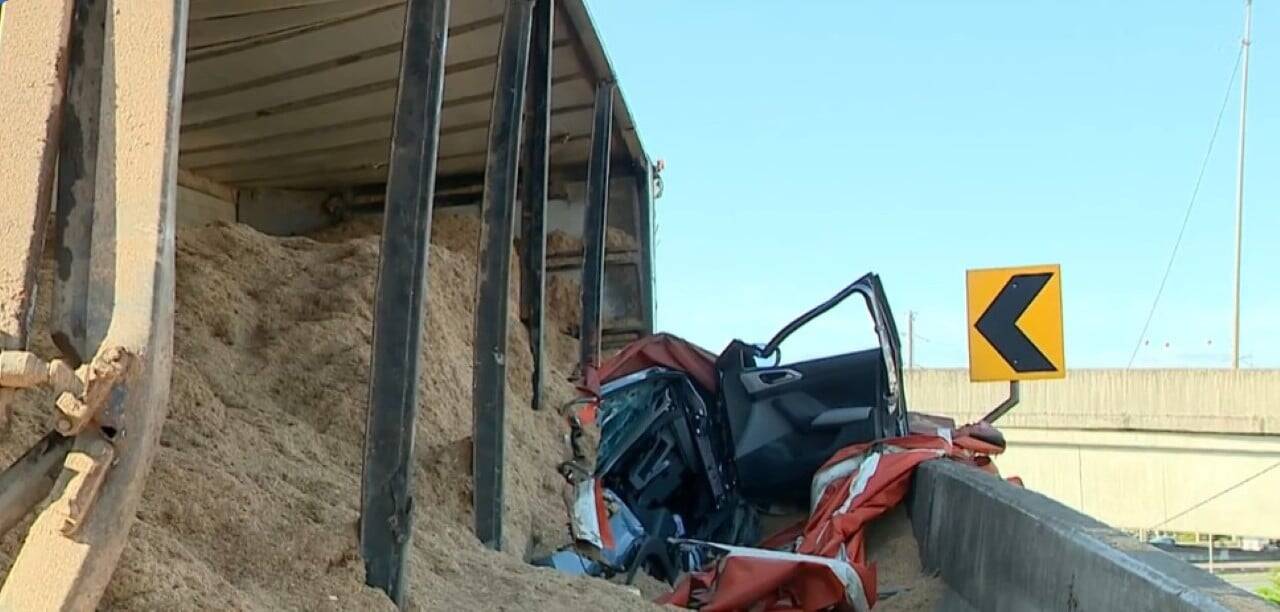 |
A 23-year-old driver survived after being buried for two hours under a load of sawdust in an accident on the access ramp to BR-448 in Porto Alegre on the morning of October 9, 2025. Eduarda Corrêa, driving a passenger car, was hit by an overturning truck, but the vehicle’s reinforced structure and seatbelt use were crucial for her survival. She remains hospitalized in stable condition, with no discharge date set. The rescue involved teams from Samu, Military Brigade, and Fire Department.
The young woman contacted family during the incident, speeding up the arrival of rescuers. The sawdust, a less dense material, helped form an air pocket, essential for keeping her alive.
- Survival factors: Reinforced car structure and seatbelt use.
- Rescue time: Approximately two hours, with coordinated emergency team efforts.
- Victim’s condition: Stable, under medical care at Cristo Redentor Hospital.
The truck driver sustained minor injuries and was treated in Canoas.
Survival cell was key
The structure known as a survival cell, found in modern cars, prevented the total collapse of Eduarda’s vehicle. Made of reinforced columns and doors, it absorbed the impact of the overturn.
According to experts, the car’s position and closed windows created an air pocket, allowing the driver to keep breathing during the burial.
Role of sawdust in the accident
The sawdust load, being light and porous, did not fully invade the car’s interior. This reduced pressure on the vehicle and helped preserve the internal space.
Mechanical engineer Anderson de Paulo explains that in collisions, the engine is designed to detach, preventing damage to the passenger compartment.
The combination of the light cargo and the car’s sturdiness was essential for the positive outcome.

Vehicle safety in focus
Modern cars feature active safety systems, such as automatic seatbelt and door locking during sudden decelerations. Seatbelts and airbags help control body movement in violent impacts.
The presence of these devices in Eduarda’s car was critical in minimizing injuries. Experts emphasize that details, like the exact point of collision, influence survival in severe accidents.
Joint rescue effort
Eduarda’s rescue mobilized specialized teams, who worked for two hours to free her from the vehicle. She remained conscious and communicated with her parents and fiancé, Gabriel Zanettin dos Santos, who arrived at the scene before professionals.
Gabriel reported attempting to remove sawdust until firefighters arrived. Samu and the Military Brigade also participated in the operation. The efficiency of the teams was vital for the rescue’s success without worsening the victim’s condition.
Health status and next steps
Eduarda was admitted to Cristo Redentor Hospital, where she underwent tests. Despite the ordeal, she has no fractures or perforations but remains under observation due to elevated CK levels, indicating muscle stress.
Medical care includes hydration and pain management, with a stable condition.
Importance of safety equipment
Ricardo Hegele, president of Abramet-RS, highlights that the survival cell is designed to protect occupants in rollovers or severe collisions. In Eduarda’s case, the car’s structure and proper seatbelt use prevented more serious consequences.