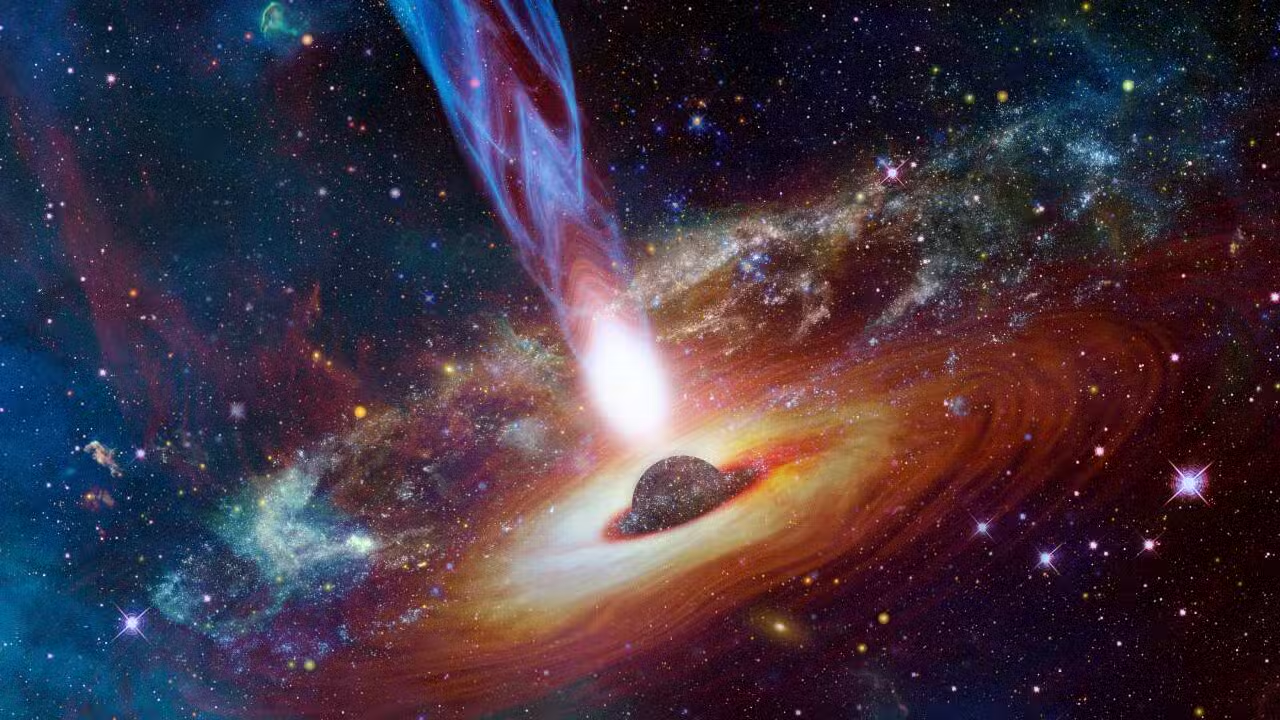
Astronomers have detected the largest and most distant explosion ever recorded from an active supermassive black hole, an event that challenges current theories about galactic dynamics. The phenomenon, nicknamed “Superman”, originated an impressive 10 billion light years from Earth. At its peak intensity, the light emitted reached the brightness equivalent to 10 trillion suns, setting a new record.
The source of this powerful emission is classified as an active galactic nucleus (AGN), a compact and extremely luminous region at the heart of a galaxy. This activity is fueled by the central black hole, which is in a voracious feeding process. By consuming gas and dust, which rotate in a disk around it, the material is superheated, releasing intense radiation.
- The light from the event took 10 billion years to reach our planet.
- The glow of “Superman” was 30 times more intense than the previous record.
- The black hole is estimated to have a mass 500 million times greater than that of the Sun.
Researchers suggest that the energy released indicates that the black hole consumed amassive star that would otherwise have exploded in a supernova. The study’s lead author, Matthew Graham of the California Institute of Technology, called the event “so extreme” that it falls into a category of its own, being roughly a “one-in-a-million event” among AGNs.
The stellar banquet: star 30 times bigger than the sun is torn apart in eventcosmic
The initial detection of “Superman” occurred in November 2018, using the Catalina Real-Time Transient Survey and Zwicky Transient Facility, located at the Palomar Observatory, in California. At first, the object was classified as a blazar, a type of supermassive black hole that projects energetic jets of material into the cosmos.
The object didn’t look unusual initially, just shiny. It was only after five years that the team reviewed the data and noticed that the signal had consistently changed brightness over time. Follow-up observations, carried out with more powerful telescopes such as the W. M. Keck Observatory in Hawaii, confirmed that the light source was significantly more luminous and energetic than previously assumed.
The light, according to the researchers, emanated from an active galactic nucleus with a mass of about 500 million times that of the Sun. This confirmation led to a complete reassessment of the nature of the observed phenomenon. The data pointed to the most likely cause: a tidal disruption event, where a star comes too close to the black hole and is torn apart by its immense gravity.
New class of extreme events challenges cosmological and physical models
“Superman” reached a brightness 30 times greater than any other black hole phenomenon known in scientific literature. The star consumed in this process has an estimated mass of at least 30 times that of the Sun. The previous record for rupture by tidal forces was the event called “Scary Barbie”, which resulted from the ingestion of a star three to 10 times the size of the Sun.
Study co-author K.E. Saavik Ford of the Borough of Manhattan Community College emphasized the importance of the discovery, saying this is possibly the most massive star ever seen being destroyed by a supermassive black hole. This observation indicates the existence of hitherto unknown populations of massive stars orbiting in the midst of gas disks around supermassive black holes.
Giant stellar populations at the centers of galaxies
The massive explosion suggests the presence of unknown populations of giant stars near the centers of large galaxies, which also harbor supermassive black holes. Such discoveries bring to light the complex and violent interactions between these cosmic giants. The luminous phenomenon is still active, which indicates that the black hole continues to consume material from the star.
Continuous monitoring of the event revealed the influence of cosmological time dilation, an effect of the stretching of space-time. As the light from the explosion travels through the vastness of expanding space, time lengthens. In practice, the event is being observed at a quarter of normal speed; seven years on Earth correspond to two years where the phenomenon is occurring.
Research opportunities on galaxy formation
Events like “Superman” demonstrate that supermassive black holes have dynamic environments, being much more than just gigantic sinkholes surrounded by spiraling material. Identifying more rare occurrences like this will be facilitated by new telescopes, such as the Vera C. Rubin Observatory in Chile. Such explosions reveal the presence of incredibly large stars near the centers of galaxies and help elucidate the structure of galaxies.
Understanding the stellar composition at galactic centers in such remote periods of the universe offers a new tool to investigate the formation and evolution of galaxies over cosmic time. The event, which releases an amount of energy comparable to the total conversion of the entire Sun into radiation, is being classified as an Extreme Nuclear Transient (ENT), a category that challenges current models of the interaction between black holes and stars.
Window into the extreme physics of the universe
The discovery is considered a surprising advance in understanding the most powerful events in the universe. The record intensity glow captured by astronomers opened a new window for the study of extreme physics in galactic centers.
In these cosmic laboratories, the colossal gravity of black holes, stars and gas collide, generating the most violent interactions known. Such sudden eruptions provide unique insight into the growth of black holes, the way they destroy nearby stars, and how their immense energy can shape the galaxiesaround you.