The Virtual Telescope Project captured an image of the interstellar comet 3I/ATLAS in the early hours of November 11, 2025, revealing an elongated ion tail that extends visibly into space. The observation took place in Manciano, Italy, using an ARTEC-250 robotic telescope. This structure arises due to the ionization of gases by the solar wind, a common phenomenon in active comets. The capture aims to monitor the object’s evolution after its perihelion on October 30.
Astronomers highlight that the ionic tail measures about 0.7 degrees in angular length, with an anti-tail pointing to the southeast. The image resulted from 18 exposures of 120 seconds each, processed by sigma-clipping to reduce noise. Despite lunar interference of 61% illumination, the comet appears at magnitude 9.8, accessible to amateur telescopes. The focus lies on analyzing gaseous composition to understand interstellar origins.
Comet 3I/ATLAS, the third interstellar object confirmed in the Solar System, follows a hyperbolic trajectory.
Discovery and initial trajectory
The object was detected on July 1, 2025 by the ATLAS system, funded by NASA, during routine searches for asteroids. Preliminary observations indicated doubt as to whether an asteroid or comet, but confirmations on July 2 revealed a marginal coma and elongation of 3 arc seconds.
Initial forecasts point to an entry speed of 32 km/s, aligned with the ecliptic plane. Perihelion occurred 1.4 astronomical units from the Sun, within the orbit of Mars.
- Hyperbolic trajectory confirms external origin too Sistema Solar.
- Aceleração não gravitacional observada em 1,66 × 10⁻⁶ UA/dia² radial.
- Massa estimada em 33 bilhões de toneladas, com perda de pelo menos 13% no periélio.
3I/ATLAS Unleashes a Massive Ion Tail
— Space and Technology (@spaceandtech_) November 11, 2025
New image of 3I/ATLAS captured by the Virtual Telescope Project on November 11, 2025, shows a stunning massive ion tail extending into space. pic.twitter.com/5AHUsRiRj2
Características da cauda iônica
A cauda iônica forma-se pela interação de íons com o campo magnético solar.
No caso de 3I/ATLAS, ela alonga-se devido à geometria pós-periélio, melhorando a visibilidade matinal.
Imagens de 10 de novembro já mostravam complexidade, com jatos assimétricos.
- Ionização de CO⁺ e N₂⁺ domina a composição.
- Comprimento atual: 0,7 graus, projetado para crescer até 1 grau.
- Anti-cauda visível aponta para direção solar oposta.
Essa estrutura difere de caudas de poeira, focando em gases leves.
Interactions with space missions
The Europa Clipper probe potentially crossed the tail between October 30 and November 6, 2025. Instruments detected variations in the solar wind and magnetic draping.
Esa’s Hera mission recorded similar immersion from October 25th to November 1st.
Preliminary data indicates unique chemical signatures, such as excess hydroxyl.
In situ observation offers rare chance to study interstellar ion tails.
Monitoring continues with telescopes on the ground and in orbit.
Observed chemical composition
Hubble spectra reveal core rich in carbon dioxide and water vapor.
The coma displays a subtle greenish tone, attributed to CO emissions.
It differs from solar comets by low dust and high volatility.
On November 9, stacked images showed multiple jets at angles from 0° to 316°.
- OH detection via Swift observatory confirms water.
- Transverse acceleration of 7.09 × 10⁻⁷ AU/day² suggests directed ejection.
- Nuclear diameter estimated at 5 to 10 km.
Recent Earth Observations
Telescopes like Lowell in Arizona captured post-perihelion images on November 5.
Initially without a clear tail, they evolved into complex structures on November 8.
Amateurs report visibility in the constellation Virgo, before dawn.
- 35 second exposures in green filter highlight 5 arc minute coma.
- Reduced lunar interference after November 10.
- Stable magnitude allows tracking until December.
Approach to Earth and future visibility
The comet reaches its closest point to Earth on December 19, 2025, at 1.8 AU.
No threat is predicted, maintaining a distance of 270 million km.
Visibility declines after mid-November, but reappears in December.
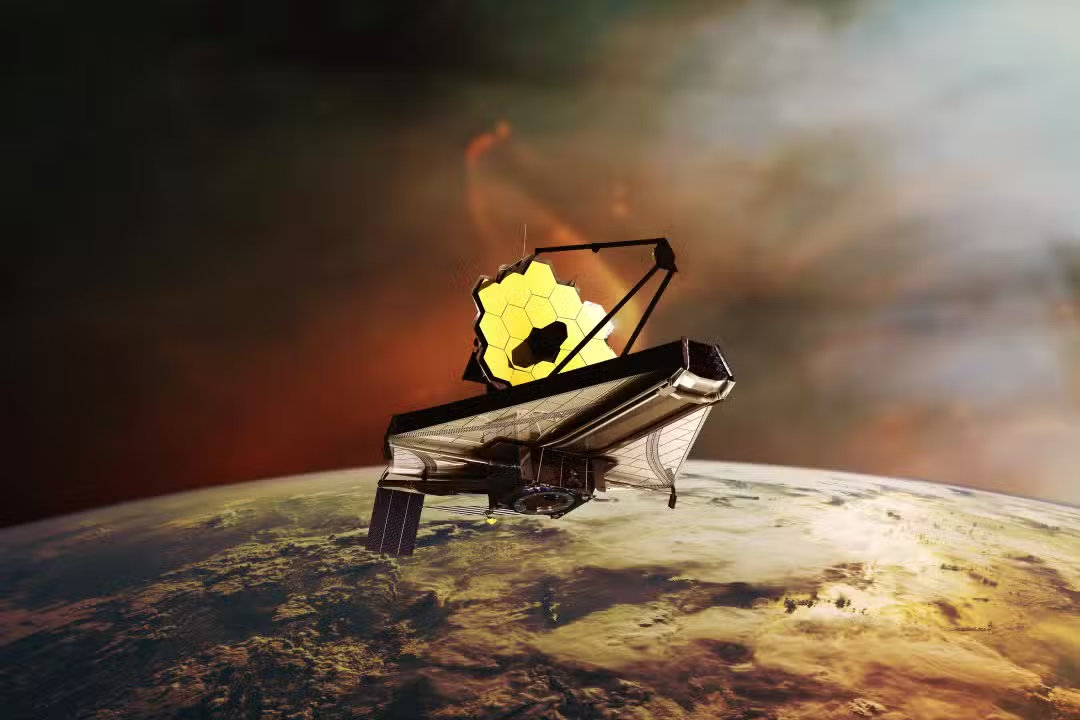
The James Webb Space Telescope plans UV spectroscopy for exotic gases.
Spectroscopy and anomalies
Initial analyzes note planar acceleration, unusual for natural comets.
Absence of debris plume suggests efficient mass ejection.
Radio data confirms OH signal on November 10.
The object remains under global monitoring to reveal its composition.