
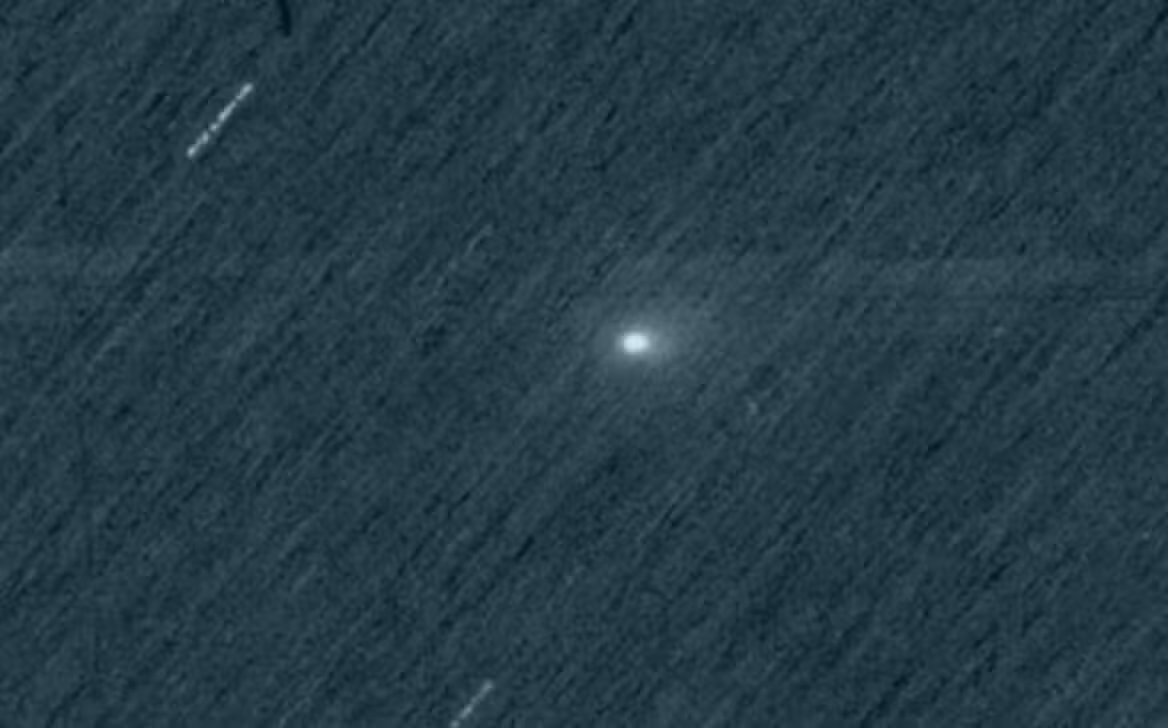
The interstellar comet 3I/Atlas, detected by NASA equipment, surprised scientists by stopping its movement for days in the orbit of Mars, about 27 million kilometers from the planet, in October 2025. The event, which defies the known laws of physics, occurred on a hyperbolic trajectory, in which objects should not stop. The scientific community is looking for explanations for the phenomenon, which may indicate the action of unknown forces. Telescopes and Martian probes recorded detailed images, transforming the comet into a natural laboratory.
- Unique composition: high concentration of carbon dioxide in the coma.
- Ancient origin: estimates point to 10 billion years old.
- No risk to Earth: it will pass by Venus and Jupiter before leaving the Solar System.
Unprecedented phenomenon
3I/Atlas, the third interstellar object identified in the Solar System, remained almost motionless in relation to the background stars, something unusual for its trajectory. NASA ruled out instrumental failures, confirming the veracity of the records.
The event, observed in October 2025, challenges orbital theories, as the comet’s kinetic energy should prevent any pause.
Possible scientific explanations
Spectroscopic data revealed subtle vibrations in the comet’s nucleus during its immobility. One hypothesis suggests interaction with magnetic fields or interstellar plasma, which could have caused theeffect.
The presence of metallic grains on the surface of 3I/Atlas reinforces the theory of a temporary electromagnetic anchor.
Another possibility involves symmetrically emitted microplumes of gas, a rare behavior in comets.
These factors indicate an internal structure more complex than that of known comets.
Chemical composition and origins
Analysis of the 3I/Atlas coma revealed a predominance of carbon dioxide and low water content. This suggests formation in cold regions of a distant star system.
The core, with an estimated diameter of between 320 meters and 5.6 kilometers, is surrounded by a thick layer of gas and dust.
Data indicate that the object is around 10 billion years old, older than the Sun.
Chemical composition offers clues about the formation of stellar systems in ancient times.
Celestial Models Review
The 3I/Atlas stop requires adjustments to orbital simulation software used to predict trajectories.
Including non-gravitational interactions will be crucial for future calculations.
The phenomenon highlights the need for studies on unknown forces in space.
Comet’s next steps
After resuming movement, the3I/Atlas heads towards its perihelion, scheduled for October 29, 2025.
The comet will pass Venus in November 2025 and Jupiter in March 2026, before leaving the Solar System.
Detailed notes
The proximity to Mars allowed detailed records, with data on brightness and gas emissions still being analyzed.
The event transformed the 3I/Atlas into a unique object of study to understand rare cosmic phenomena.
