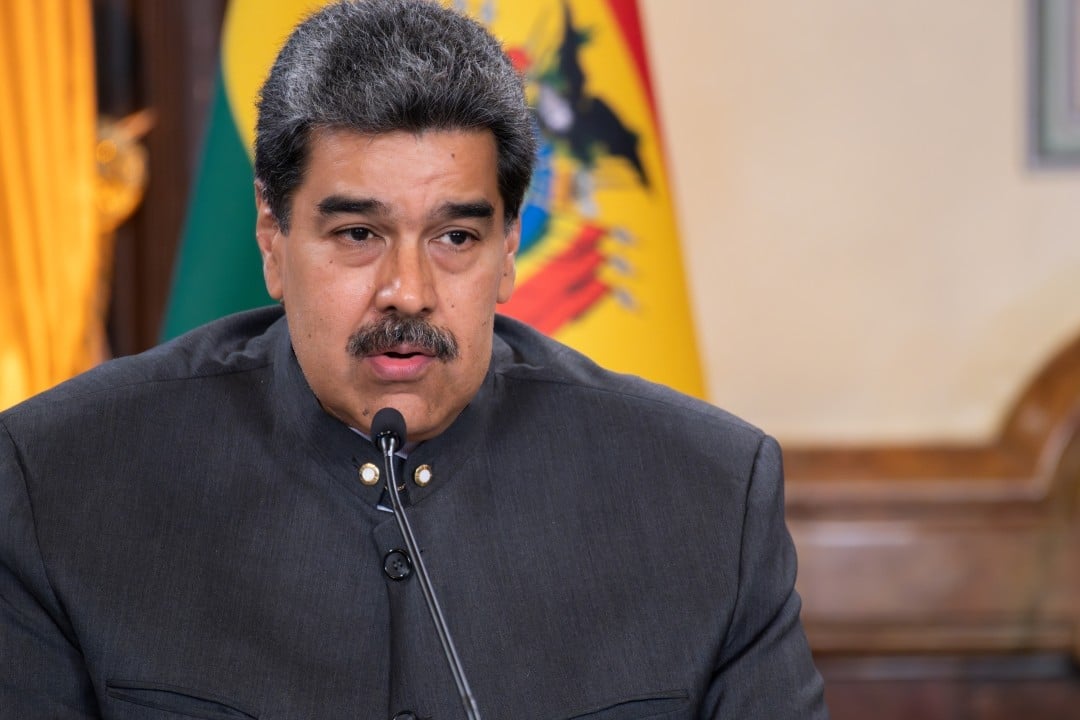
On Saturday, January 4, 2025, Nicolás Maduro, the former president of Venezuela, was brought to the United States aboard an American aircraft, following a dramatic overnight operation by U.S. forces in Caracas. The high-profile arrival at Stewart National Guard Base in New York marks a pivotal moment, signaling a significant escalation in U.S. efforts to address accusations of drug trafficking and arms dealing against the Venezuelan leader. This unprecedented move underscores a bold shift in international relations and justice enforcement by the United States.
Maduro, accompanied by his wife Cilia Flores, was forcibly removed from their residence during the pre-dawn raid. This swift military action aimed at securing their custody highlights the long-standing tensions and accusations leveled against his administration.
He is slated to appear in a Manhattan federal court next week to face multiple charges, including drug trafficking and weapons possession. The U.S. government has been building a case against Maduro for years, culminating in this direct intervention.
Details of the Caracas operation
The meticulously planned U.S. military operation unfolded in the early hours of Saturday in Caracas. Elite American forces executed the raid with precision, targeting Maduro’s known location and overcoming any immediate resistance to secure his apprehension. The mission concluded successfully before dawn.
Reports indicate that Maduro and his wife were apprehended directly from their private quarters, highlighting the tactical depth and intelligence gathering involved in the cross-border operation. This direct action bypassed traditional diplomatic channels, emphasizing the U.S. commitment to bringing those accused of severe crimes to justice.
Following their capture, the couple was swiftly transported to an undisclosed location within Caracas before being transferred to the waiting aircraft for the journey to the United States. This rapid exfiltration ensured the safety of the operation and prevented potential counter-measures.
U.S. policy statement on Venezuela
President Donald Trump commented on the situation following Maduro’s arrival, affirming the United States’ intention to oversee Venezuela. He stated that the U.S. would govern the South American nation until a “safe, proper, and sensible transition” could be implemented.
This declaration outlines a highly assertive posture regarding Venezuela’s future political landscape. The statement underscores a direct challenge to the nation’s sovereignty, indicating a prolonged period of U.S. influence.
Legal proceedings and accusations
Maduro’s indictment includes serious federal charges in New York, primarily revolving around allegations of narco-terrorism, drug trafficking, and illegal weapons possession. These accusations stem from extensive investigations conducted by U.S. authorities over several years, implicating him and other high-ranking Venezuelan officials in a conspiracy to flood the U.S. with cocaine.
His appearance in federal court in Manhattan next week will mark the official commencement of these judicial proceedings. The trial is anticipated to draw significant international attention, setting a precedent for international law enforcement against sitting or former heads of state implicated in such crimes.
The U.S. Justice Department has previously unsealed indictments against Maduro and more than a dozen other current and former Venezuelan officials, offering rewards for information leading to their arrest. This systematic pursuit highlights the gravity with which the U.S. views these alleged illicit activities and their impact on regional stability.
The charges specifically outline a long-running scheme where FARC rebels in Colombia allegedly partnered with Venezuelan officials to use the country as a transit zone for cocaine, with Maduro at the center of the conspiracy. Prosecutors allege that these operations were conducted to destabilize the region and enrich cartel leaders, ultimately fueling violence and corruption.
Regional and international reactions
The dramatic capture of a former head of state has triggered varied reactions across Latin America and the broader international community. Some nations cautiously welcomed the move, while others condemned it as a breach of sovereignty and international law.
Diplomatic bodies and human rights organizations are closely monitoring developments. Scrutiny on the operation’s legitimacy and the legal process will impact future international cooperation.
Venezuelan domestic challenges
Venezuela has been grappling with severe economic and social crises for years, marked by hyperinflation, widespread food and medicine shortages, and a mass exodus of its population. The political instability has exacerbated these conditions, leading to widespread calls for change from within the country and from the international community.
The U.S. intervention and Maduro’s capture could significantly alter the internal power dynamics within Venezuela, potentially paving the way for new political leadership. However, the exact trajectory remains uncertain, with a fragile opposition landscape and ongoing internal military loyalties contributing to the complex environment. The transition process, as outlined by President Trump, is expected to be protracted.
Maduro’s past and rise to power
Nicolás Maduro rose to prominence as a close confidant of the late Hugo Chávez, eventually succeeding him as president in 2013. His tenure has been marked by escalating authoritarianism, suppression of dissent, and economic mismanagement, leading to a humanitarian crisis. His government consistently denied accusations of drug trafficking and human rights abuses, branding them as attempts by the U.S. to orchestrate a coup.
Future outlook for Venezuela
The immediate future of Venezuela hangs in the balance as legal proceedings against Maduro commence. The international community, especially neighboring countries, awaits clear indications of a stable path forward, hoping for a resolution to the prolonged crisis and a return to democratic governance.