

A new scientific investigation published on March 3, 2026 has brought to light revealing data about the dynamics of cosmic visitors crossing our solar system. Pesquisadores identified that the celestial body called 3I/ATLAS presents a much more complex non-gravitational acceleration behavior than initially estimated by space agencies. Contrary to predictions that indicated a movement driven mainly away from Sol, the new analyzes demonstrate the existence of a significant lateral force, with an intensity comparable to its radial movement.
The discovery profoundly changes the current understanding of the trajectory of this object. Anteriormente, reports from NASA’s Laboratório from Propulsão to Jato (JPL) suggested that the radial acceleration would be five times greater than the tangential. However, the refinement of the data points to an equivalence between these forces, suggesting that the object is not only being pushed out, but also “sliding” laterally through space due to internal and external physical processes still being detailed by the astronomical community.
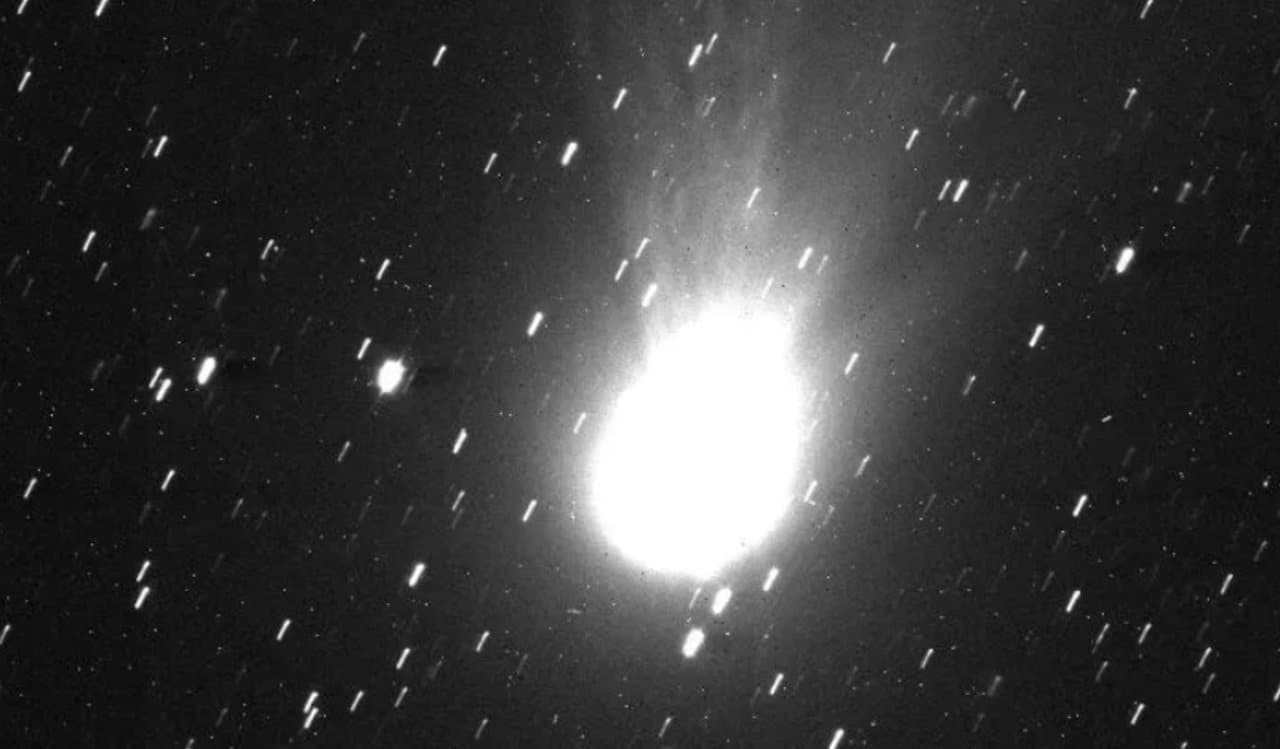
This data review scenario underscores the evolving nature of space science. The ability to reinterpret information based on new evidence allows theoretical models to be adjusted to more accurately reflect physical reality. The current study not only corrects route estimates, but also provides crucial clues about the internal structure and natural propulsion mechanisms that govern these traveling bodies.
The implications for modern astrophysics are extensive and touch on fundamental points about the composition of exotic objects:
– The need for new mathematical models to predict orbits of objects with asymmetric outgassing.
– Review of calculations on the density and porosity of the nucleus of interstellar comets.
– Improved understanding of how solar radiation interacts with surfaces of unknown materials.
Orbital dynamics and scientific divergences
The global astronomical community has turned its attention to discrepancies found between early models and more recent observations. The preliminary interpretation, which served as the basis for 3I/ATLAS tracking for months, considered a simpler propulsion physics, typical of comets that sublime ice relatively uniformly as they approach perihelion. Contudo, the detection of tangential and radial acceleration components with similar amplitudes indicates a much richer and more chaotic vector force scenario.
This non-gravitational acceleration is the direct result of the mass ejection. Quando an object heats up, it releases gases and dust that act as natural engines. The big question raised by the new study is the direction of these “engines”. Para there is a lateral push as strong as the backward push, the emission of material must occur in a highly specific and directed manner, challenging the idea of a homogeneous or simple spherical cometary nucleus.
Accuracy in reading these subtle forces is what separates a correct route prediction from an error of thousands of kilometers. By understanding that 3I/ATLAS experiences robust lateral influences, scientists can infer the distribution of mass within the object and the location of its pockets of volatiles. Isso turns trajectory analysis into a remote geological diagnostic tool, allowing you to “look” inside the object just by observing how it moves.
Jet structure and core rotation
The key to understanding this anomalous movement lies in the morphology of gas emissions. High-resolution Observações, processed with advanced glare removal techniques, revealed a complex system of collimated jets. Essas structures are not random; they exhibit an organization that follows the rotation of the celestial body, functioning as exhaust fans that modulate the speed and direction of the object as it rotates on its axis.
Detailed data indicates a rotation period of approximately 7.1 hours. Durante this cycle, the orientation of the jets changes relative to the Sol and the orbital trajectory, creating the observed lateral force vector. The identification of three symmetrically spaced minijets, in addition to a main emission known as the antitail, provides a visual map of the surface activity of 3I/ATLAS. The inclination of the rotation axis, estimated at up to 20 degrees from the solar direction, is another determining factor for the geometry of this propulsion.
The existence of these collimated jets at high latitudes suggests that the object’s core has distinct active regions, possibly craters or faults in the crust through which pressurized material escapes. Diferente of global evaporation, this punctual mass loss works as an orbital maneuver system, capable of altering the object’s course in ways that gravity alone could not explain. The analysis of these physical characteristics is essential to validate the transverse acceleration hypothesis.
Impact on astrophysics and future models
Confirming that the transverse acceleration (A2) has a magnitude comparable to the radial acceleration (A1) requires an update to the orbital simulation software. The orbital solutions tested in the study, which included variables such as symmetric radial dependencies and temporal displacements, showed that the lateral component is extremely sensitive. Pequenas changes in data selection or orbital phase coverage can drastically change the interpretation of lateral force, which makes this field of study an accuracy challenge.
Although the total magnitude of this acceleration is small in absolute terms — about one micrometer per second squared over the distance from Terra to Sol — its cumulative effect is of great scientific interest. The resulting spatial displacement, although minimal and equivalent to half the radius of Lua over the course of a month, serves as an undeniable physical signature of the object’s activity. Esse data is vital to narrowing down estimates about the size of the nucleus, currently estimated to be about 2.6 kilometers in diameter.
The 3I/ATLAS study sets a new standard for the analysis of interstellar objects. By proving that the dynamics of these bodies can significantly deviate from the behavior of solar system comets, the research opens the door to detecting other visitors with similar characteristics. Astrophysics begins to consider rotation and surface geometry variables more heavily when calculating the ephemeris of new targets, preventing erroneous interpretations based on simplified models.
Mysteries of interstellar composition and origin
One of the most intriguing aspects raised by the research is the configuration of the three symmetrical minijets, spaced at 120 degrees. Essa Peculiar geometry is rare and raises questions about the object’s formation processes in its home star system. The symmetry suggests an ordered internal structure or a process of spatial erosion that resulted in equidistant points of weakness on the surface of the core.
The analysis of these phenomena allows scientists to make comparisons between the materials that make up 3I/ATLAS and those found in local celestial bodies. If the sublimation that generates the jets occurs at the same temperatures and rates as in local comets, it can be inferred that the chemistry of ice and dust is universal. Caso Otherwise, we would be observing exotic materials with distinct thermal properties, which would offer clues about conditions in other regions of the galaxy.
Continued investigation into the nature of these minijets and lateral acceleration reinforces the importance of monitoring the sky for anomalies. Cada detail extracted from the behavior of 3I/ATLAS works like a piece of a cosmic puzzle, helping humanity understand not only the solar neighborhood, but the diversity of objects that navigate deep interstellar space. Science, therefore, advances not only by confirming expectations, but by embracing the surprises that complex and challenging data provide.



