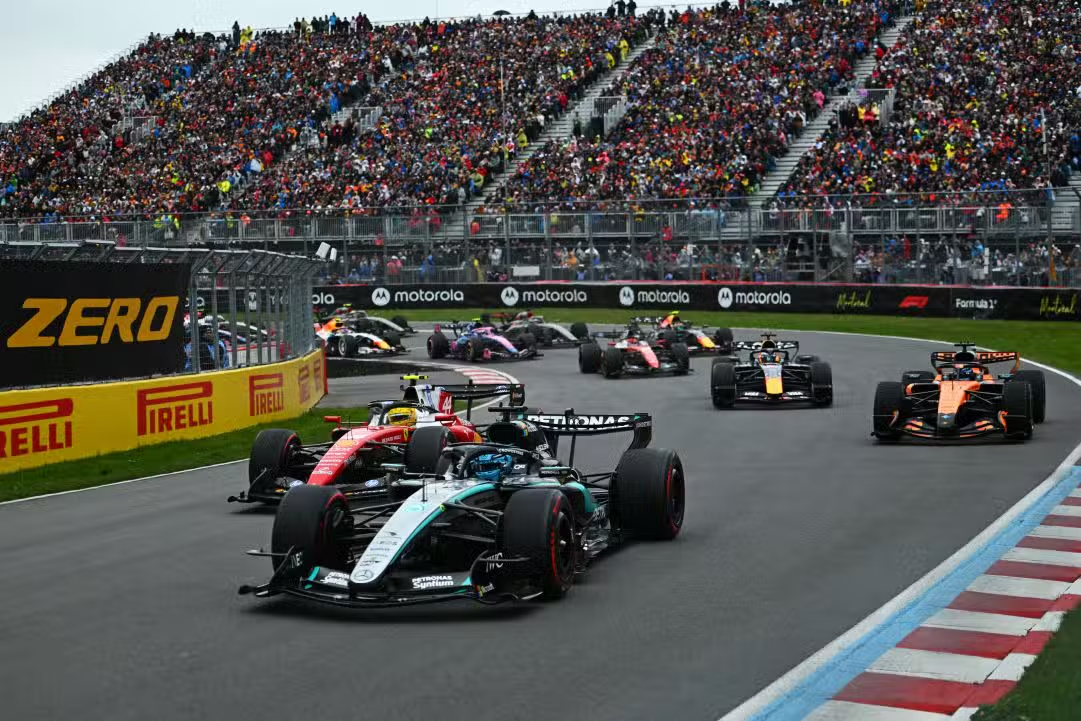
Argentine driver Franco Colapinto expertly avoided what could have been a catastrophic collision at the outset of the Formula 1 Australian Grand Prix in Melbourne this past Sunday. The harrowing incident unfolded within the initial moments of the season-opening race, demanding instantaneous reflexes from the Alpine pilot.
Lining up in 16th position on the grid, Colapinto faced an immediate threat when Liam Lawson’s Racing Bulls car, starting from eighth place, experienced significant difficulty in accelerating. Lawson’s slow departure created a perilous bottleneck, particularly for drivers on the inside line, just as the pack surged forward.
With split-second precision, Colapinto veered sharply to the right, skillfully threading his single-seater between Lawson’s nearly stationary car and the concrete pit lane wall. This astonishing maneuver allowed him to navigate the obstacle without severe damage, preventing a premature end to his race and continuing into the first lap relatively unscathed.
## A close call on the grid
The intensity of the moment was evident as the top three finishers of the race later reviewed footage in the cool-down room, reacting with palpable surprise to Colapinto’s daring escape. The near-miss underscored the inherent dangers and split-second decisions required at the start of a Formula 1 event.
Colapinto himself acknowledged the gravity of the situation after finishing the race in 14th place. “I was lucky to finish the race,” he stated, reflecting on the opening seconds. “It almost ended at the start with a scary moment trying to avoid Lawson, who came off the line very slowly.”
## Colapinto recounts the frantic seconds
The Argentine driver detailed the rapid sequence of events that unfolded. He described narrowly missing the rear of Lawson’s car, catching sight of the hazard at the last possible second. His instinctive reaction was crucial in preventing a heavy impact.
“I almost went straight into the back of him and managed to see him at the last moment. I swerved to the right and passed between him and the pit wall,” Colapinto explained. “I think I touched the wall, but luckily we didn’t have serious damage and we managed to complete the first lap.”
This quick assessment and decisive action highlight the high-pressure environment of a Formula 1 start, where fractions of a second can dictate a race’s outcome or prevent a major incident.
## Expert praise for driver’s instincts
The incident quickly became a talking point among commentators and former drivers. Anthony Davidson, a respected ex-Formula 1 driver and current analyst, lauded Colapinto’s exceptional reflexes during the Sky Sports broadcast. His comments emphasized the extraordinary nature of the save.
“Wow. It’s like he has cat-like reflexes here,” Davidson exclaimed, clearly impressed by the footage. He added, “How he avoided the rear wheel and the wall is something I cannot explain. It’s incredible. I could watch this a thousand times. I will never get over this.”
Davidson’s remarks underline the difficulty and rarity of such a maneuver, particularly given the high speeds and confined spaces typical of a Formula 1 grid start. The precision required to thread a car through such a narrow gap without significant contact is a testament to Colapinto’s skill.
## The critical elements of Colapinto’s escape
Colapinto’s successful avoidance was attributed to several key factors that aligned in a critical sequence, allowing him to navigate the perilous situation without incident:
- Rapid Visual Processing: Identifying Lawson’s slow start in a fraction of a second amidst a crowded grid.
- Instantaneous Decision-Making: Committing to a precise evasive maneuver rather than a more dangerous braking or wider swerve.
- Pinpoint Car Control: Guiding the Alpine between the stationary car and the concrete barrier with minimal clearance.
- Situational Awareness: Recognizing the proximity of the pit wall as an alternative route, despite the inherent risk of contact.
- Luck: As Colapinto himself noted, a degree of fortune played a role in avoiding serious damage, suggesting the fine margin for error.
This blend of skill, quick thinking, and a touch of fortune enabled Colapinto to continue his race, demonstrating why drivers at this level are often lauded for their unparalleled abilities under extreme pressure. The event served as a stark reminder of the unpredictable nature of Grand Prix racing.
## Broader implications of F1 start dynamics
Starts in Formula 1 are consistently one of the most unpredictable and dangerous phases of any Grand Prix. With 20 cars accelerating from a standstill, often side-by-side, the potential for collisions is exceptionally high. Incidents like the one involving Colapinto highlight the intense pressure on drivers to react not only to their own start but also to the performance and movements of their competitors.
Teams invest significant resources into optimizing launch control systems and driver training for grid starts, yet human error or mechanical issues can still lead to chaotic scenarios. The Australian GP incident with Colapinto and Lawson underscores that even with advanced technology, a driver’s raw talent and reflexes remain paramount for safety and competitive success.