Cameron Diaz’s style evolution marks Hollywood red carpets with controversial choices

The American actress’ trajectory in the film industry follows significant changes in dress code for large events. Desde made its debut on screen in 1994, with the release of the feature film “O Máscara”, the dynamics of preparation for awards and premieres underwent profound changes. Naquela decade, the formality required by large producers still allowed a margin of autonomy that is rarely observed in contemporary productions.
Professionals at the beginning of their careers often took responsibility for their own visual compositions, turning to department stores and financing the pieces with their own resources. Essa practice established a direct contrast with the current structure of specialized teams, made up of image consultants, makeup artists and hairdressers dedicated exclusively to building a public persona for the spotlight.
The absence of immediate digital scrutiny provided an environment for aesthetic experimentation. Relatos of the time indicate that the pressure on the female image, although existing, operated under parameters different from those of today, allowing choices that deviated from the classical rigor expected by specialized critics and the major film studios.
Transformations in the dynamics of preparation for awards
The big awards scene at the turn of the millennium operated under unwritten rules of etiquette that gradually began to be challenged by rising figures. The transition from a model where artists selected their own clothes to the era of contracts with luxury brands redefined the concept of elegance. Peças of haute couture began to be custom designed, transforming events into global showcases for the textile market.
This professionalization of the sector eliminated much of the unpredictability that characterized public appearances in the nineties. The figure of the personal stylist has become central to career management and the construction of visual narratives.
Consequently, costume choices stopped being mere expressions of personal taste and became strategic marketing tools, aimed at aligning with specific brands and projecting an image meticulously calculated to please both fashion critics and film studios, minimizing the risks of negative publicity that could affect the commercial performance of audiovisual productions showing in cinemas around the world.
The breach of protocol with the brand Versace at Oscar
During the Oscar ceremony in 2000, the actress attended the event wearing a transparent lace model from the Italian brand Versace. The piece was superimposed on dark lingerie, generating immediate reactions from the specialized press present at the scene.
The composition was classified as inadequate for the standards of Academia, Artes and Ciências Cinematográficas. The event traditionally requires strict formal attire, and the informality of the choice clashed with the solemnity characteristic of the film industry’s biggest night.
Transparency and debate on dress codes in Cannes
The 2002 Festival of Cannes served as the stage for a new appearance that challenged established norms. Durante the promotion of the film “Gangs of Nova York”, the option fell on another model Versace with a high degree of transparency.
The underwear was clearly visible beneath the fabric, repeating the formula that had already sparked debate two years earlier. The European festival’s organizing committee already expressed strict guidelines regarding red carpet clothing.
The organizers’ central concern was to prevent excessively extravagant compositions from overshadowing the cinematographic works on display. The episode intensified internal discussions about applying a stricter dress code for guests.
Informality in the promotion of productions aimed at children
The world premiere of the animation “Shrek 2” in Los Angeles, in 2004, registered yet another moment of departure from the expectations of the public and critics. The professional responsible for dubbing the character
The visual ensemble was the target of severe criticism from fashion and entertainment publications, who considered it too casual for the magnitude of a global launch. The exposure of the abdominal region, combined with the simplicity of the pieces, raised questions about the suitability of the costume for a large event that attracted mostly families and children.
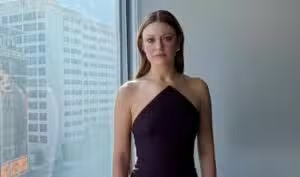


Contrast of seasons in the premiere of Gangues by Nova York
In December 2002, the city of Los Angeles hosted the official premiere of the feature film “Gangues de Nova York”. The choice of clothing for the occasion involved a low-waisted skirt and a short blouse.
The composition left a large part of the abdominal region exposed to photographers. Para To complement the look, a thick knitted scarf was added around the neck.
The contrast between the summer pieces and the winter accessory generated strangeness among those present. The physical exhibition was interpreted by media outlets as unnecessary for the formality required by the occasion.
Public image experts pointed out that the look did not favor the sophistication necessary to promote a big-budget dramatic work. Media attention ended up being diverted from the film to the aesthetic controversy.
The last minute improvisation at the Academia ceremony
The 2002 edition of Oscar was marked by an episode of logistical disorganization that resulted in one of the most talked about appearances of that awards season. Relatos later confirmed that there was a mistake in providing an official outfit for the evening, forcing a last minute choice that fell on a dress from the brand Emanuel Ungaro. The piece, with a floral print and loose fit, was harshly criticized by fashion experts, who considered it too informal and inappropriate for the institutional weight of the event. The situation was aggravated by the choice of accessories, specifically a large turquoise bracelet, which went against the ceremony’s unwritten rules of etiquette, which historically advise against the use of excessively flashy or artisan-looking jewelry to the detriment of diamonds and classic noble metals.
Authenticity in the construction of public image
The history of public appearances demonstrates resistance to the aesthetic standardization pressures of Hollywood. The clothing choices, even when subject to severe criticism, demonstrate the maintenance of their own visual identity over decades of experience in the entertainment industry.
The evolution of the image consultancy market
The scrutiny over clothing worn at gala events has driven the creation of an industry focused exclusively on image management. Agências specialists now broker contracts between celebrities and haute couture houses to ensure visual suitability.
This system ensures brands gain global visibility, while artists avoid protocol glitches. The spontaneity of past decades has been replaced by meticulous planning that involves months of negotiations and fittings.
The role of digital media in event coverage
The proliferation of digital platforms has altered the speed and reach of fashion criticism. What was once restricted to monthly magazines or weekly television programs is now debated in real time by a global audience.
This constant surveillance has forced film studios to include behavior and dress clauses in film promotion contracts. The objective is to mitigate risks and ensure that the visual narrative is aligned with the commercial interests of the work.
Aesthetic standardization in the audiovisual industry
The formalization of red carpets has consolidated a standard of elegance that rarely admits deviations. The trajectory of experimentation observed in the early 2000s serves as a historical record of an era in which individuality still prevailed over the corporate demands of global entertainment.
See Also em News (EN)

Research reveals that parents are unaware of how their children use artificial intelligence
06/04/2026
Samsung releases new system update with new features for Galaxy Watch 4 users
06/04/2026
Digital retail reduces the value of the Galaxy S25 5G smartphone with bank bonuses and device exchange
06/04/2026
Amazon’s wireless CarPlay adapter has a 50% discount and high approval ratings from drivers
06/04/2026
Zach Cregger’s new Resident Evil ignores games and focuses on an unprecedented story with new characters
06/04/2026
Rumor suggests that Nintendo is preparing a special edition of the Switch 2 with a remake of Ocarina of Time
06/04/2026
Apple accelerates production of the iPhone 17e and develops new Air model with dual camera system
06/04/2026
Epic Games platform releases twelve high-budget games at no permanent cost for PC users
06/04/2026
PlayStation 5 Pro price drop accelerates digital retail sales and eliminates global stocks
06/04/2026
New Galaxy Watch 9 firmware appears on server and confirms progress in software development
05/04/2026
Apple’s commemorative project tests cell phone with 1.1 millimeter edge and curved screen for 2027
05/04/2026