

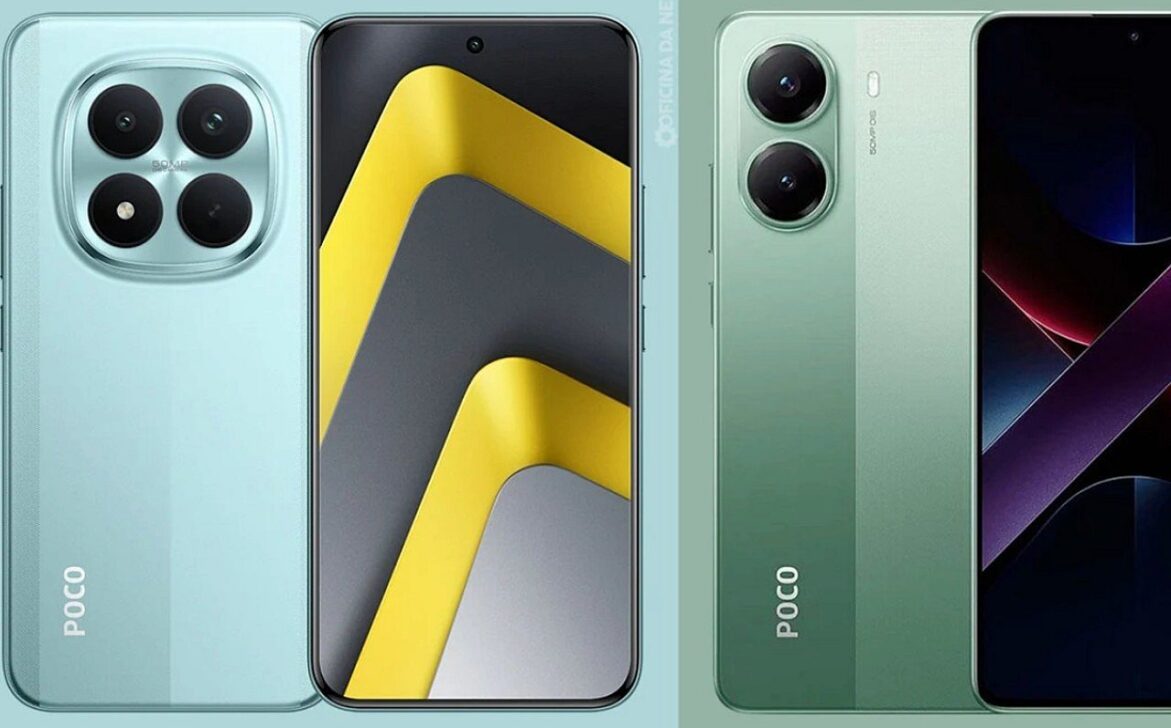
Xiaomi launched the POCO X7 Pro in January 2025 and presented the POCO M8 Pro in January 2026 as another competitive intermediary. The two models share several features, but exhibit clear differences in processor, battery, water protection and other aspects. Consumidores Those looking for a balanced device for daily use or gaming will find strengths in each option. Direct comparison helps identify which best meets individual performance or autonomy needs.
The design of both prioritizes plastic construction on the back and sides, with the M8 Pro measuring 163.3 x 78.3 x 8.3 mm and weighing 206 grams. The X7 Pro shows more compact dimensions of 160.8 x 75.2 x 8.3 mm and a weight of 195 grams, in addition to offering a vegan leather variant. Protection against water and dust varies between devices, while the front glass guarantees resistance to impacts and scratches at different levels.
- IP69K certification on the M8 Pro allows submersion up to 1.5 meters for 30 minutes.
- IP68 certification on the X7 Pro delivers solid resistance, but without the same extreme level.
- Gorilla Glass Victus 2 protects the M8 Pro screen against drops and scratches.
- Gorilla Glass 7i equips the X7 Pro with good everyday durability.
Design and construction
The two smartphones maintain modern lines and a practical finish for the intermediate segment. Usuários Those who value greater resistance to immersion find a clear advantage in the most recent model. The slight difference in weight and size influences comfort during prolonged use, especially in tasks that require holding the device for hours.
The M8 Pro features a robust construction that conveys a feeling of solidity, while the X7 Pro prioritizes ergonomics with smaller dimensions. Ambas options include stereo speakers with Dolby Atmos support for immersive audio playback. Recursos as a fingerprint reader under the screen, NFC and infrared are present on both devices without significant variations.
Screen
The AMOLED screen dominates the visual experience on both devices, with a refresh rate of 120 Hz and support for HDR10+ and Dolby Vision. Maximum brightness reaches 3,200 nits on both, which makes viewing easier even in intense sunlight. The main difference appears in the size and protection of the panel.
The M8 Pro has a 6.83-inch panel and a resolution of 1280 x 2772 pixels, protected by Gorilla Glass Victus 2. The X7 Pro uses a 6.67-inch display with a resolution of 1220 x 2712 pixels and Gorilla Glass 7i. The pixel density is very close, delivering sharp images and vibrant colors in multimedia content.
Processor and memories
The processor represents one of the biggest points of distinction between the models. The POCO Benchmarks indicate higher AnTuTu scores for this chip, which benefits users who run heavy titles with high graphics.
The POCO M8 Pro brings Snapdragon 7s Gen 4 da Qualcomm, sufficient for everyday tasks and most games available. The RAM memory options of 8 GB or 12 GB and storage of 256 GB or 512 GB are identical on both devices. Internal storage utilizes different technologies, with the X7 Pro leveraging UFS 4.0 for faster transfers in some scenarios.
Cameras
The photographic sets follow a similar configuration, with a 50 MP main sensor and an 8 MP ultrawide lens on the rear. Optical stabilization helps capture steadier images during movement. The front camera varies between models, influencing the quality of selfies and video calls.
The M8 Pro records videos in 4K at 30 fps and has a 32 MP front sensor. The X7 Pro films in 4K at 60 fps and uses a 20 MP front camera. Ambos support features such as HDR and panorama, delivering satisfactory results for the intermediate segment in good lighting conditions.
Battery and charging
The battery capacity favors the POCO M8 Pro, which incorporates a 6,500 mAh cell versus 6,000 mAh in the X7 Pro. The difference contributes to greater autonomy in mixed use, especially on days with intense browsing or video playback. Fast charging also varies, with the M8 Pro supporting 100W and the X7 Pro operating at 90W.
Practical tests show that both devices recharge efficiently, but the 2026 model completes the cycle faster. The silicon-carbon battery technology in both improves energy density and durability over time. Usuários Those who prioritize long sessions without needing an outlet find an advantage in the M8 Pro.
System and updates
Both smartphones leave the factory with HyperOS 2 based on the Android 15. The Xiaomi promises differentiated support in terms of system updates. The M8 Pro receives four major updates, while the X7 Pro has three, which could influence the longevity of the software over the years.
The interface maintains fluidity in both cases thanks to Xiaomi optimization. Recursos such as game mode, advanced gestures and integration with the device ecosystem complement the everyday experience. System stability appears consistent across both models, with regular security updates.
Other features
Complete connectivity marks both devices, including 5G, Wi-Fi 6, Bluetooth 5.4, GPS and NFC. Alto stereo speakers with Dolby Atmos ensure immersive sound for music and videos. Sensores how accelerometer, gyroscope, compass and proximity work identically.
The fingerprint reader under the screen offers fast and accurate unlocking. Ausência 3.5 mm headphone jack is common in both, reinforcing the focus on wireless solutions. Infrared allows you to control home appliances directly from your smartphone.
Pricing
Current values in the Brazilian market place the two models in a similar cost-benefit range. The POCO M8 Pro appears at retailers for around R$1,920 to R$1,930 in basic configurations. The POCO X7 Pro, originally launched for R$5,199, is now available in promotions close to R$1,910.
This price proximity makes the decision even more dependent on each user’s priorities. Versões with 12GB RAM and 512GB storage may vary slightly by retailer and promotional conditions. Acompanhar offers on trusted platforms helps you find the best deal.
The choice between the POCO M8 Pro and the POCO X7 Pro depends directly on the usage profile. Quem seeks superior gaming performance and heavy multitasking tends to prefer the X7 Pro thanks to the more powerful processor. Consumidores that prioritize a larger battery, faster charging and advanced protection against water lean towards the M8 Pro.
Both deliver quality screens, versatile cameras and durable construction for everyday use. The final decision also considers software support time and faster internal storage in the X7 Pro. Qualquer one of the options represents a good investment in the mid-range segment of 2026.