New data from the Gaia satellite confirms the likelihood of a collision between the Milky Way and Andromeda By Jeronimo Santos
5 min read
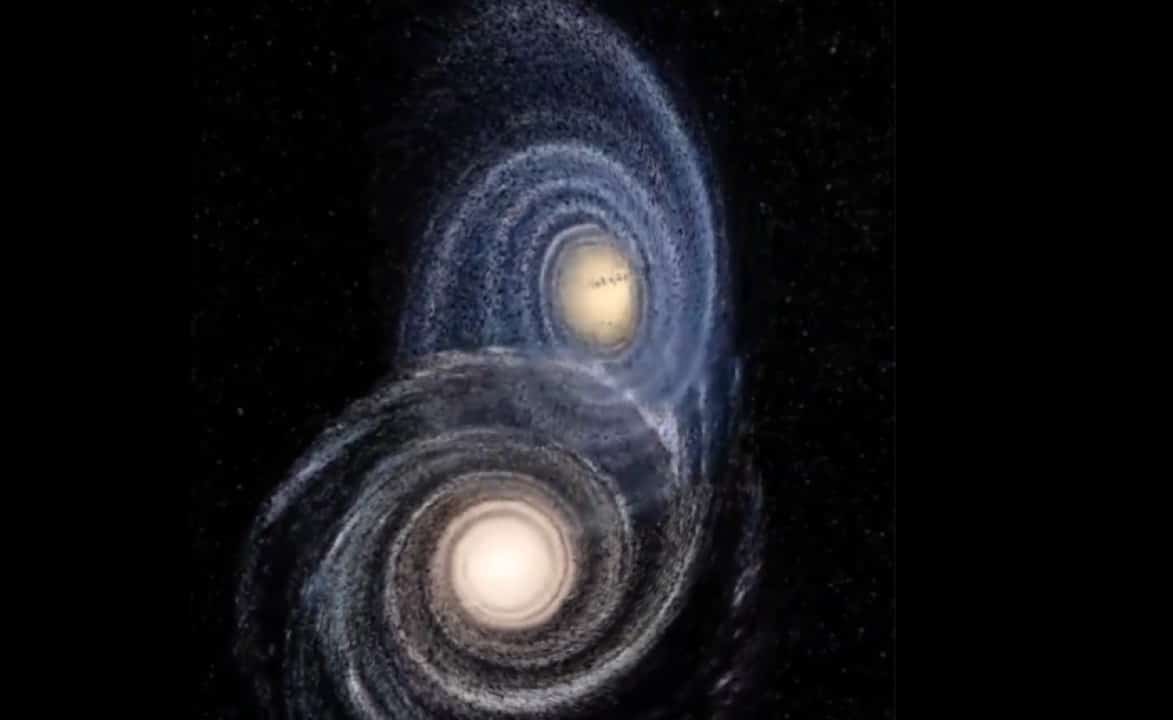 |
The probability of a massive encounter between our galaxy and its closest neighbor has risen dramatically. Pesquisadores used recent information from the Gaia satellite to map the movement of stars. Crossing these numbers reveals a 90% chance of frontal merger in the next 10 billion years, dispelling previous doubts. The median time for the event is around 6.5 billion years.
The two giant structures already interact invisibly in deep space. The dark matter halos that surround each of the galaxies have around a trillion solar masses and are currently touching. The relative speed of approach reaches the mark of 110 kilometers per second. The study published in March 2026 directly contrasts with surveys from the previous year. Análises from 2025 indicated only a 50% chance of collision due to uncertainties in the masses and positions of celestial bodies. Refined measurements have significantly reduced this margin of doubt. Scientists carried out 10,000 simulations of future trajectories to understand the behavior of the local group. Frontal and lateral projections show complex orbital patterns over time.
Meeting’s Dinâmica rules out direct collisions between stars
The process of galactic merger occurs on a size scale that is difficult to comprehend. The vast interstellar space ensures that stellar systems intertwine fluidly, without there being direct physical clashes between individual stars during the crossing. The distances between the stars within the spiral arms are immense, creating large voids that allow the safe passage of celestial bodies. The luminous disks slowly distort and mix under the relentless force of gravity over millennia. The end result of this cosmic ballet generates a much more spherical and compact elliptical structure, altering the original morphology of both galaxies.
Sol has a remaining life expectancy of approximately 7.6 billion years. Ele will still be in its active phase during the early stages of the galactic merger. An observer positioned on Terra, if the planet still harbors life, would be able to notice constantly evolving and dramatic stellar patterns in the night sky. The stars would fill the celestial vault with configurations totally different from the constellations mapped by humanity since ancient times.
Influência of neighboring celestial bodies changes trajectories
The movement of Via Láctea and Andrômeda does not occur in an isolated vacuum. Outras galaxies in the local group exert continuous gravitational attraction, affecting the path of the two giants in a subtle but absolutely decisive way for the cosmic outcome. Grande Nuvem of Magalhães and the galaxy M33 play key secondary roles in the computer simulations. The perpendicular orbit of Grande Nuvem from Magalhães introduces additional variables into the calculations. The inclusion of M33 in the mathematical models increases the overall probability of the encounter.
Simulated trajectories for one hundred randomly selected paths demonstrate variations in the separation between galactic centers. The most likely curve points to a progressive approach that culminates in the inevitable merger. The orbit lines highlight the probability density at different spatial positions over billions of years. Front and side projection panels illustrate possible variations in orbits, providing a detailed visual map of the future of our corner of the universe.
Elementos fundamentals mapped by numerical simulations
The researchers needed to feed the supercomputers with extremely specific data to reach the 90% rate. The margins of uncertainty reflect current technological limitations in observing the deep universe. The median time of 6.5 billion years concentrates most of the probable occurrences in the tests. The study establishes parameters:
- The current relative speed between the two galaxies reaches 110 kilometers per second.
- Invisible dark matter halos already interact gravitationally in intergalactic space.
- The cores of the spirals maintain a gradual approach path over billions of years.
- The simulations incorporate the refined proper motions of Andrômeda’s stars.
The complete melting process requires multiple passes before final stabilization. The galaxies involved maintain their structural identities for long periods before merging for good. Dark matter halos begin the large-scale interaction process long before direct visual contact between the luminous edges. The bright nuclei follow trajectories that lead to the progressive shuffling of gas and dust disks. The galaxy resulting from this process was given the unofficial name Milkomeda in previous academic work. Essa new supergalaxy will have twice the stellar mass of isolated Via Láctea. The rapidly expanding universe will leave the structure in an increasingly empty and dark environment.
Necessidade of continuous observations to refine calculations
Astrônomos reinforce the importance of measurements with uncertainties of less than two microarcseconds per year. Esses extremely high-precision data helps confirm current conclusions about the exact route of galaxies through the cosmos. Observatórios ground and space monitors the gradual approach uninterruptedly. Continuous observations with new generation instruments allow numerical simulations to be refined frequently. The merger represents the last major dynamic event in local cosmic history before absolute isolation.
Dentro hundred billion years, the giant galaxy will be surrounded only by regions of deep vacuum. Estrelas hypervelocities ejected during the gravitational shock serve as indirect evidence of universal expansion on extremely long timescales. The event occurs on immeasurable human temporal scales, defying the common perception of time and space. The simulations offer a detailed overview of the fate of our region in the universe, consolidating modern astrophysical knowledge. Current lines of research depend directly on the quality of data collected by missions such as the Gaia satellite. The improvement of space sensors guarantees increasingly safe projections of complex celestial mechanics.
Transformação visual of Earth’s night sky
The continued approach changes the visual perspective from our solar system. Andrômeda will grow progressively until it dominates the night horizon. The neighboring galaxy’s spiral arms will become visible to the naked eye in rich detail before the initial crossing. The gravitational interaction will rip out long bands of gas and dust, creating luminous bridges between the two galactic cores. The formation of new stars will experience a spike in activity due to the compression of molecular clouds during the encounter.