

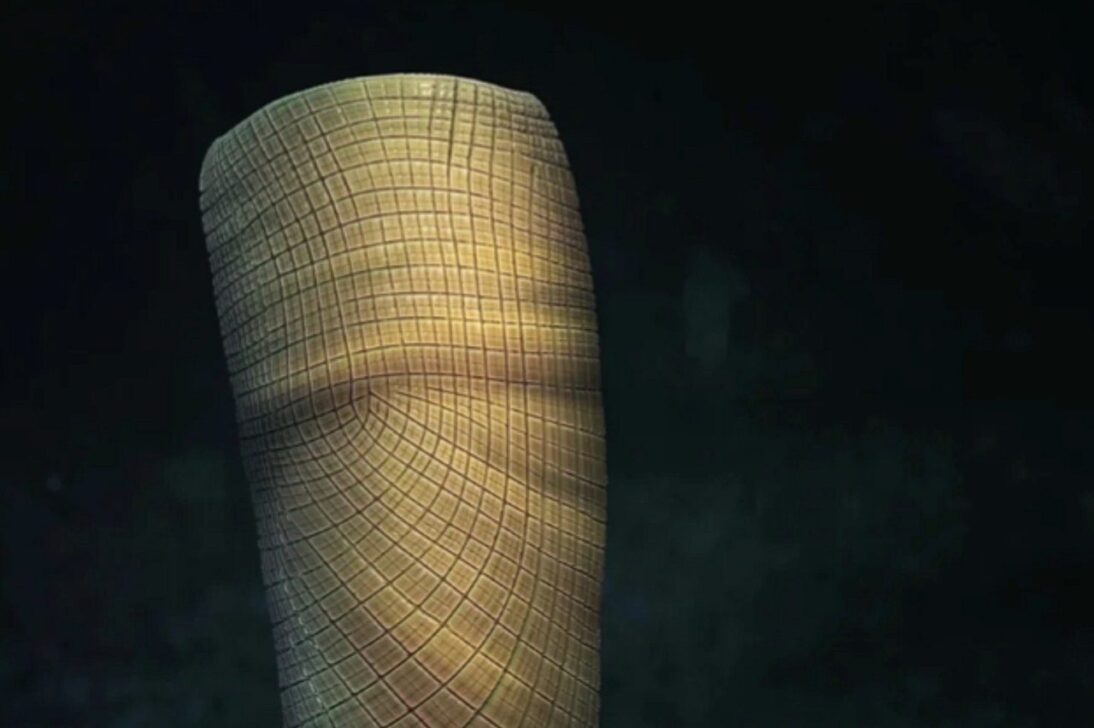
An international team of scientists has identified a 550-million-year-old marine sponge fossil on the banks of the Yangtzé river. The find occurred in the province of Hubei, in the territory of China. The discovery provides the first physical evidence of such an organism that lived during the Ediacarano period. Pesquisadores had been searching for traces of this nature for decades in Asian rock formations. The material presents an unusual state of conservation for soft-bodied primitive marine creatures.
The specimen solves a chronological mystery that has intrigued evolutionary biologists around the world. Métodos genetic dating indicated the emergence of sponges around 700 million years ago. The oldest physical records, however, dated back only 540 million years. The new fossil is positioned exactly within this 160 million year interval. The complete study was published in the scientific journal Nature. The analysis confirmed the hypothesis that the first representatives of this group had bodies entirely devoid of hard parts.
The enigma of the molecular clock and the unrecorded interval
Modern biology uses the concept of a molecular clock to trace the origin of species. Essa technique analyzes mutation rates in DNA over time to calculate when two lineages split. Genetic data consistently pointed to a very remote origin of sponges. The absence of corresponding fossils created a direct conflict in the academic literature. The material found in China provides the missing piece to this complex puzzle. Especialistas now has a solid material basis to validate the theoretical estimates.
Sponges are among the simplest animals on the planet. Elas survive without the presence of complex organs, brain or structured digestive system. The basic body structure depends on a network of specialized cells that filter water. The lack of rigid parts in ancestral lineages made the formation of fossils immensely difficult. Ossos and shells stand the test of time with ease. Tecidos Soft organics decompose quickly in nature. The Chinese specimen contradicted this relentless logic of natural degradation.
Anatomical Características surprises researchers
The size of the organism caught the immediate attention of paleontologists involved in the excavation project. The fossil measures approximately 38 centimeters in length. Cientistas expected to find microscopic or very small-sized creatures in this initial phase of terrestrial evolution. The animal’s conical shape also clashes with experts’ initial projections. The physical structure demonstrates an unexpected level of architectural complexity for the geological period in question.
The surface of the fossil displays a highly organized geometric pattern. The design resembles a grid formed by boxes subdivided into smaller, regular units. Essa structural repetition bears notable similarities to current glass sponges. Modern representatives of this group inhabit the icy depths of the oceans. The main difference lies in the composition of the skeleton. The extinct organism did not display the rigid mineralization characteristic of its contemporary relatives.
Condições rare geological features enabled conservation
Preserving a soft body for more than half a billion years requires an extremely specific sedimentary environment. The biota region of Shibantan offers exactly this type of rare geological formation. Camadas thin carbonate rocks enveloped the organism shortly after death. Rapid burial prevented the destructive action of decomposing bacteria. The chemical process gradually replaced the original tissues with durable minerals.
- The shallow marine environment of the time facilitated the rapid accumulation of fine sediments on the ocean floor.
- The absence of strong currents prevented fragmentation of the delicate body before fossilization began.
- The chemical composition of the water favored the precipitation of carbonates around the intact organic tissue.
- Isolation against scavenging predators ensured the integrity of the primitive animal’s conical structure.
Geobiologist Shuhai Xiao, from Virginia Tech, realized the scientific value of the material when he received a photograph sent by a collaborator. The image revealed the total absence of mineralized spicules in the fossil’s structure. Essas structures function like small support needles in newer sponges. The lack of these elements confirms that skeletal mineralization arose later in the evolutionary line. The transition from purely organic bodies to hard structures occurred gradually over millions of years.
Mudança paradigm in the search for primitive life
The discovery changes excavation strategies at paleontological sites around the world. Pesquisadores traditionally focused on rocks capable of preserving strong bones and shells. The new guideline requires increased attention to fine-grained sedimentary deposits. The search for ancestors of other animal groups must follow this same investigation logic. Muitos biology’s missing links may be hidden in similar geological formations on Ásia and other continents.
The identification work required years of rigorous morphological tests in the laboratory. The team had to rule out the possibility that the fossil belonged to other known biological categories. Análises comparative studies eliminated the relationship with anemones and ascidians. The joint effort involved researchers from Universidade of Cambridge and Instituto of Geologia and Paleontologia of Nanjing. International collaboration guaranteed access to different scanning and three-dimensional modeling technologies.
Impacto straight into understanding period biology Ediacarano
The Ediacarano period is home to nature’s first experiments with complex multicellular life. Most organisms from this era have unusual forms that have left no known direct descendants. The newly described sponge represents an important exception to this general extinction rule. Ela establishes a clear anatomical bridge between primordial fauna and present-day marine ecosystems. The fossil record gains a biological continuity that previously seemed nonexistent.
The data extracted from the Chinese specimen is now used to calibrate mathematical models of animal evolution. The chronology of the development of life in Terra receives an adjustment based on concrete and unquestionable physical evidence. Detailed mapping of the fossil’s surface will continue to yield additional studies in the coming years. The integration between advanced genetics and field paleontology reaches a new level of scientific precision. The find consolidates the importance of exceptional preservation for understanding the planet’s past.