

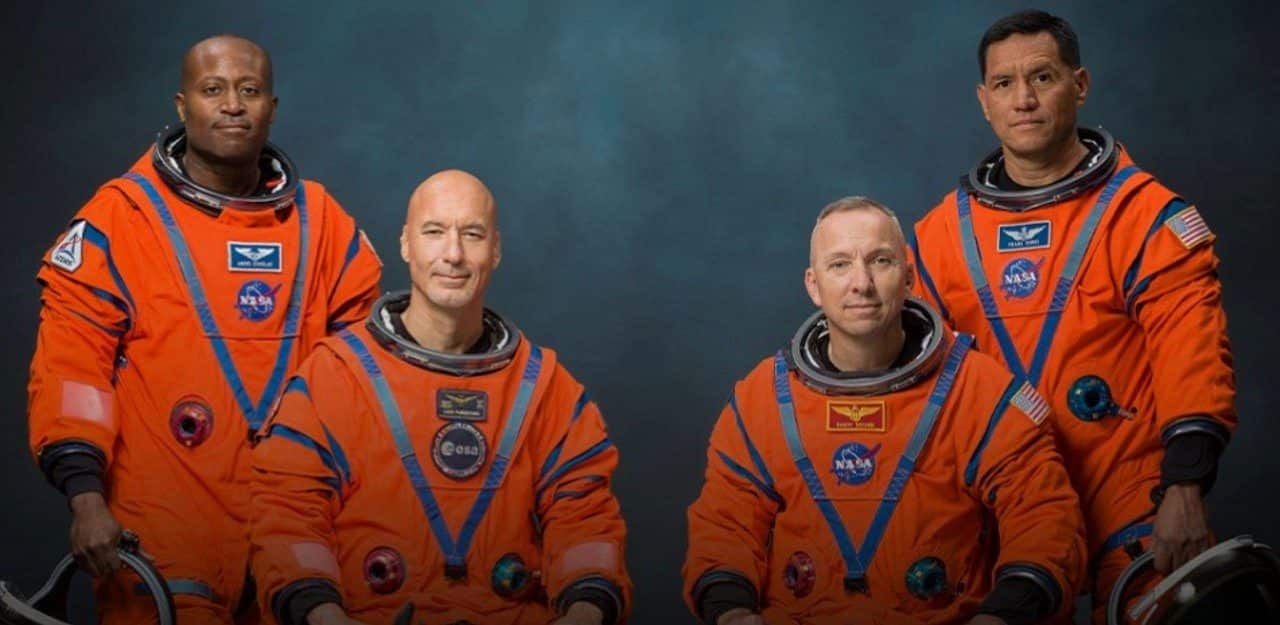
NASA announced this Tuesday, June 9, the four astronauts who will join the crew of the Artemis III mission, scheduled for 2027.
Randy Bresnik, Frank Rubio and Andre Douglas, all from the North American agency, and Luca Parmitano, from the European Space Agency, form the main team. It is the first time that a European astronaut has participated in a NASA lunar mission.
The announcement came about two months after the flight of Artemis II, which carried out a manned flyby of the Moon. On Artemis III, the crew will continue towards the natural satellite, but with a shorter route compared to the previous mission.
Central objectives include testing the performance of NASA’s Orion spacecraft and evaluating lunar landers under development by private companies such as SpaceX and Blue Origin.
“As a crew, we certainly feel honored to be able to be the crew that will execute this Artemis III mission in space,” said Bresnik, who will command Artemis III.
Missions specialist Andre Douglas added: “My brain is racing a mile a minute right now. But my heart is so warm. It’s so full.”
NASA administrator Jared Isaacman wished the team good luck: “To the crew of Artemis III, we wish you good luck on the journey ahead.”
First European on the mission
Luca Parmitano, the Italian who will be the driver, said he was thrilled to find out about the selection in advance. “I feel honored by the role assigned to me and the task that lies ahead,” he stated.
Frank Rubio stands out as the astronaut who accumulated the longest time on a single mission for the United States: 371 days, between September 2022 and September 2023. He returned to Earth on Soyuz MS-23 after problems with the original spacecraft.
“What an incredible blessing and honor that he’s here representing all of us,” Rubio commented during the crew’s presentation.
Space race
The Artemis III schedule faced a setback after Blue Origin’s New Glenn rocket exploded during a landing test in late May.
John Couluris, from Blue Origin, acknowledged the “significant anomaly” at an event at the Johnson Space Center, in Houston, but assured that the company’s landing module remains on the list for the mission. “We have redoubled our efforts and are moving forward,” he said.
Jeremy Parsons, from NASA, classified the incident as a learning opportunity and maintained confidence in the schedule.
Isaacman reinforced that the long-term goal is to build a lunar base as an initial step towards a future expedition to Mars.
In May, NASA awarded contracts worth hundreds of millions of dollars to four companies, including Blue Origin, to develop landers, rovers and drones for the future base.
SpaceX, owned by Elon Musk, and Blue Origin, owned by Jeff Bezos, compete to supply the landing modules. The demonstration, expected to last two weeks, is scheduled for 2027.
The Artemis missions
NASA announced this Tuesday, June 9, the four astronauts who will join the crew of the Artemis III mission, scheduled for 2027.
Randy Bresnik, Frank Rubio and Andre Douglas, all from the North American agency, and Luca Parmitano, from the European Space Agency, form the main team. It is the first time that a European astronaut has participated in a NASA lunar mission.
The announcement came about two months after the flight of Artemis II, which carried out a manned flyby of the Moon. On Artemis III, the crew will continue towards the natural satellite, but with a shorter route compared to the previous mission.
Central objectives include testing the performance of NASA’s Orion spacecraft and evaluating lunar landers under development by private companies such as SpaceX and Blue Origin.
“As a crew, we certainly feel honored to be able to be the crew that will execute this Artemis III mission in space,” said Bresnik, who will command Artemis III.
Missions specialist Andre Douglas added: “My brain is racing a mile a minute right now. But my heart is so warm. It’s so full.”
NASA administrator Jared Isaacman wished the team good luck: “To the crew of Artemis III, we wish you good luck on the journey ahead.”
First European on the mission
Luca Parmitano, the Italian who will be the driver, said he was thrilled to find out about the selection in advance. “I feel honored by the role assigned to me and the task that lies ahead,” he stated.
Frank Rubio stands out as the astronaut who accumulated the longest time on a single mission for the United States: 371 days, between September 2022 and September 2023. He returned to Earth on Soyuz MS-23 after problems with the original spacecraft.
“What an incredible blessing and honor that he’s here representing all of us,” Rubio commented during the crew’s presentation.
Space race
The Artemis III schedule faced a setback after Blue Origin’s New Glenn rocket exploded during a landing test in late May.
John Couluris, from Blue Origin, acknowledged the “significant anomaly” at an event at the Johnson Space Center, in Houston, but assured that the company’s landing module remains on the list for the mission. “We have redoubled our efforts and are moving forward,” he said.
Jeremy Parsons, from NASA, classified the incident as a learning opportunity and maintained confidence in the schedule.
Isaacman reinforced that the long-term goal is to build a lunar base as an initial step towards a future expedition to Mars.
In May, NASA awarded contracts worth hundreds of millions of dollars to four companies, including Blue Origin, to develop landers, rovers and drones for the future base.
SpaceX, owned by Elon Musk, and Blue Origin, owned by Jeff Bezos, compete to supply the landing modules. The demonstration, expected to last two weeks, is scheduled for 2027.
The Artemis missions
The Artemis program seeks to return astronauts to the surface of the Moon for the first time since the 1970s. A recent revamp, announced by Isaacman, picks up the pace in Apollo-era style, with an additional Earth-orbit flight before the planned 2028 lunar landing.