Ancient tectonic plates deform Earth’s deep mantle, reveals unprecedented seismic study
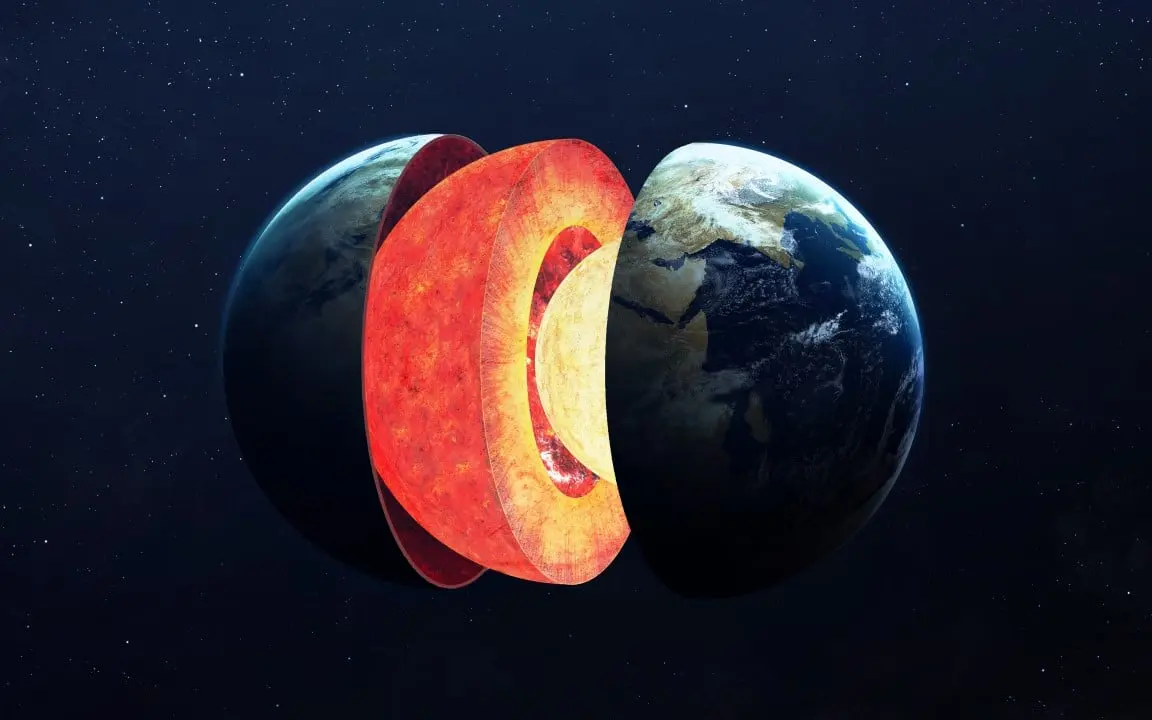
Cientistas mapped the deepest regions of the interior of Terra and discovered a dynamic scenario of continuous deformation. The study analyzed seismic waves on a global scale to identify complex patterns of underground movement. The results indicate that most of this distortion occurs right where ancient tectonic plates have sunk over millions of years. The discovery changes the understanding of the internal structure of our planet.
The research investigated about 75% of the lower mantle, a colossal layer located just above the border with the Earth’s core. Essa extreme region is approximately 2,900 kilometers deep. Shear waves generated by earthquakes travel through this environment at different speeds depending on the direction and properties of the rock material. Essa variation in direction, known in scientific circles as seismic anisotropy, serves as an accurate indicator of deformation in the mantle. The phenomenon reveals how Terra recycles its own crust.
On the same topic: Global mapping reveals how ancient plate tectonics alter Earth’s deep mantle
The largest seismic database ever compiled in history
Para reached these unprecedented conclusions, the team of experts gathered more than 16 million seismograms. Esses records were meticulously collected from 24 data centers spread across the world. The material analyzed includes multiple phases of waves that travel down through the mantle, reach the core and return to the surface. Essa methodological approach allowed mapping the distribution of structural stress over distances of hundreds of kilometers. Trata is a monumental information processing effort.
The set of information forms one of the largest collections of seismic data ever compiled to date. Pesquisadores of Universidade of Berkeley, at Califórnia, led this global effort in collaboration with several other geological experts. The complete study gained prominence and was published in the magazine The Seismic Record, linked to Sociedade Sismológica of América. The publication marks a significant advance in modern geophysics. Especialistas now has a robust tool for further investigation.
Learn more: Global study reveals deformation of the Earth’s mantle caused by ancient plate tectonics
Seismic data collection works very similar to a medical ultrasound exam, but applied on a planetary scale. Cada earthquake that occurs on the surface sends vibrations that pass through the inner layers of the globe. Quando these vibrations encounter materials of different densities or temperatures, they change speed and direction. Seismographs pick up these subtle echoes. By compiling millions of these records, scientists are able to create a three-dimensional model of the interior of Terra.
The direct connection to ancient tectonic plates
Deformation in the deep mantle is mainly concentrated in areas where ancient plates have dipped. Modelos theorists created by geodynamicists had already predicted this intimate relationship decades ago. However, the new mapping offers the first global view based purely on real seismic observations. The theory finally found support in concrete data. The plunge of these gigantic masses of rock irreversibly changes the internal dynamics of the planet.
The descending plates carry with them structures formed when they were still close to the surface. Over geological time, the extreme heat and crushing pressure of the depths can alter minerals. Esse process creates a new orientation in the rock material. Essa violent interaction also pushes and reshapes the mantle around the sinking plates. It’s a slow geological dance, but one of titanic proportions.
More on this story: Study explains how hidden mountains influenced the freezing of Antarctica millions of years before the Arctic
See Also

David Jolly secures Democratic seat to run for governor of Florida in 2026
Jolly wins Democratic nomination for governor of Florida in the USA

Meta (WhatsApp, Instagram and Facebook) is subject to trial in the USA for damaging the mental health of young people with fines of US$ 1.4 trillion
Jonathan Wolf, researcher and lead author of the study by Universidade of Berkeley, commented on the magnitude of the discovery. Ele noted that deformation in the upper mantle was already well understood by science due to the attraction of moving plates. Contudo, a similar large-scale understanding was lacking for the lower mantle. The current study moves exactly in this direction. The knowledge gap begins to be filled with solid evidence.
Mecanismos behind anisotropy and core discoveries
One of the hypotheses raised suggests that the surface phases of the plates preserve a type of fossil anisotropy. Outra theory, considered much more likely by scientists, points to intense deformation during the subduction process and direct contact with the core-mantle boundary. The process changes the mineralogical texture and creates a new internal structure. The crushing pressure rearranges the crystals into a specific pattern.
Full coverage: Latest News (EN)
- The analyzed data covers almost 75% of the entire lower mantle of Terra.
- Anisotropy was detected in about two-thirds of the regions investigated.
- Deformation patterns are much more evident in areas associated with ancient submerged plates.
- The waves studied include complex phases that interact directly with the boundary between the core and mantle.
- The total volume of seismograms processed exceeded the mark of 16 million records.
Nem all regions without a clear anisotropic signal are free of deformation. In some specific cases, the signal may simply be too weak for current methods to detect it. The researchers stress that the dataset will continue to be a valuable resource for future investigations. Detection technology still has room to evolve. Improved seismic sensors could reveal even finer details in the coming years.
Implicações for understanding Earth dynamics
Terra’s mantle slowly circulates through convection currents driven by the movement of tectonic plates. Essas currents not only move continental masses at the surface, but also stretch and distort the deep mantle material itself. The study confirms long-accepted theories and provides observational evidence on a planetary scale. The Terra works like a gigantic heat engine. The heat from the core drives all this colossal movement.
Conhecer these processes dramatically improve understanding of the long-term dynamics of our planet. Deep deformation affects the thermal and chemical behavior of Terra’s interior over millions of years. Additional Pesquisas with the same data set could provide even more information about underground flow patterns. The full article presents the methodological details and maps generated from the analysis. Ele reinforces the vital importance of global seismic databases for advances in geophysics.
Learn more: Research identifies reservoir in the Earth’s mantle with triple the volume of water in the oceans
The core-mantle boundary, located almost 2,900 kilometers deep, represents a transition zone where extreme differences in temperature and pressure are most evident. Submerged plates that can reach these depths interact violently with the surrounding environment. Isso directly contributes to the anisotropy observed by scientists. The authors emphasize that the absence of signal in certain areas does not mean stagnation. More sensitive Métodos or new data types could fill these gaps in the future. The larger goal involves even more precise mapping of the flow directions of the lower mantle.