Study explains how hidden mountains influenced the freezing of Antarctica millions of years before the Arctic
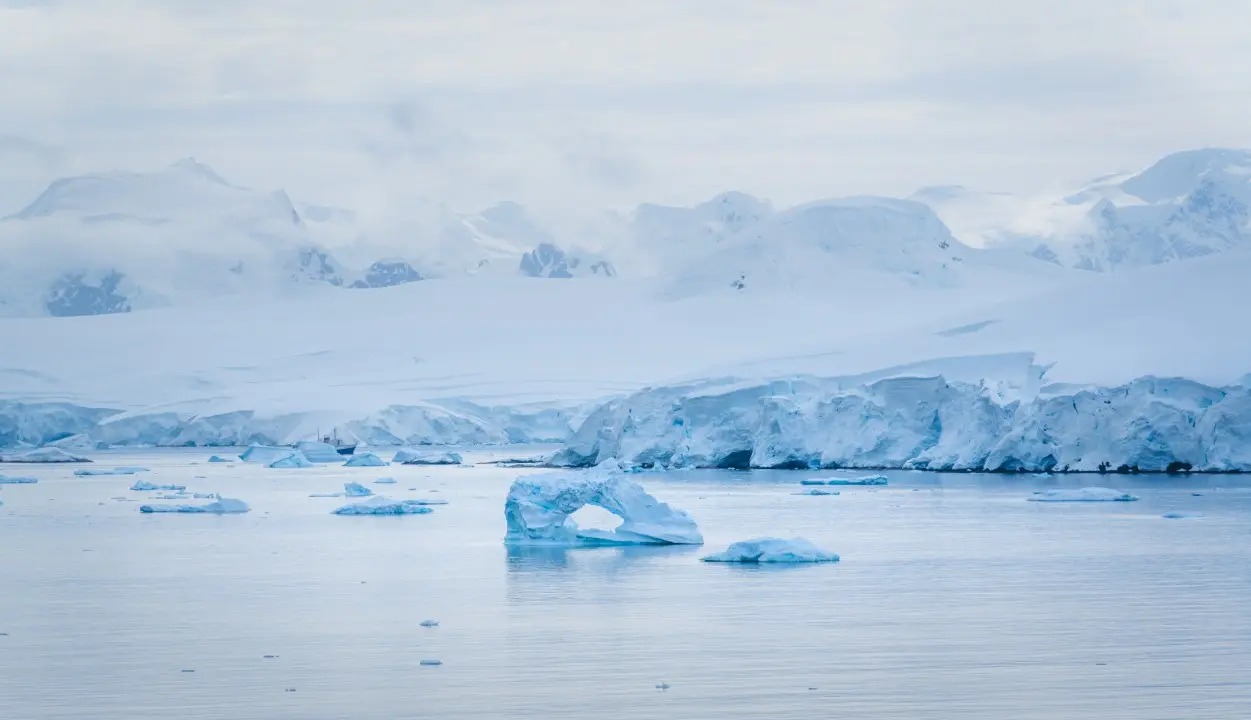
Scientists have revealed the million-year-old puzzle that explains why Antarctica turned into an ice-covered continent long before the Arctic, despite both poles being affected by a period of global cooling. The research challenges the notion that falling temperatures alone were responsible for the formation of permanent ice at both ends of the planet, introducing a crucial geological factor.
A recent analysis, published in the scientific journal Science, demonstrates that deep movements in the Earth’s mantle caused the elevation of a portion of East Antarctica over millennia. This rise in terrain created ideal altitude conditions for snow to accumulate and persist throughout the year, triggering the large-scale freezing process.
The land base and the formation of permanent ice
The central point of the study is that the existence of continuous ice, known as permafrost, is not determined exclusively by temperature. While it’s logical to think that ice forms where it’s cold, terrain plays a fundamental and often underestimated role in this process.
For snow to deposit and compact, creating layers of permafrost, adequate relief is necessary. At higher elevations, temperatures are naturally lower, which means snow melts less during summers and can become dense and persistent over time.
More on this story: Arctic icebergs fuel unexpected growth of deep-sea life
Permafrost is the subsurface layer that remains frozen continuously for a period of two years or more. It covers about 25% of the Northern Hemisphere’s land area and is a vast reservoir of billions of tons of carbon and ancient microorganisms.
In the case of East Antarctica, this elevated landscape was home to the Gamburtsev Mountains, a mountain range that today lies buried under miles of ice. Before freezing began, this mountainous relief served as an essential substrate for the development of the first glaciers.
Research indicates that a significant portion of Antarctic topography has risen progressively over approximately 100 million years. This slow movement resulted in the formation of plateaus, escarpments and mountains that had the ability to retain snow even at a time when the global climate was warmer than today.

Understand the deep wave movements of the Earth’s mantle
So-called mantle waves are not surface phenomena like ocean waves. They represent slow, deep movements that occur in the Earth’s inner layer, below the crust. These displacements can influence the weight and stability of continental plates.
The processes of these waves were activated when Antarctica and Africa began to move apart, during the fragmentation of the ancient supercontinent Gondwana. Over time, dense portions located under the continent were removed, resulting in a “lighter” and, consequently, elevated land surface.
Geoscientist Thomas Gernon, from the University of Southampton, summarized the phenomenon for the international press: “the land surface of Antarctica was gradually raised to the point where the ice could gain a permanent base”.
See Also

Learn how to identify intrusions on WhatsApp and avoid financial fraud

PlayStation 5 owners gain lifetime access to three great games

Russian Islam Makhachev dominates Ian Machado Garry and wins main fight at UFC 330
Learn more: Arctic melt stimulates new ecosystems and increases biodiversity in deep waters, study reveals
Reasons why the North Pole froze later
Unlike the south, the North Pole is located in the center of the Arctic Ocean, and not on a vast elevated continental mass. In practice, the region is predominantly an immense expanse of floating ice, which means that it did not have a large land surface to accumulate ice in a stable and lasting way.
This does not diminish the importance of global cooling. The reduction of carbon dioxide in the atmosphere was a crucial factor in the decrease in temperatures across the planet. However, this decrease in CO₂ alone did not contribute to ice formation in the same way as occurred in the extreme south of the globe.
“If the drop in CO₂ levels acted alone, it would be expected that the poles would respond in a more symmetrical way,” explained Gernon. Antarctica experienced an early freeze because its geology had already prepared the ground, creating favorable conditions for ice accumulation.
The role of submerged mountains in the process
The simulations developed by scientists indicate that, around 45 million years ago, important areas of East Antarctica had already exceeded a critical altitude. This limit was close to 2 kilometers, a height sufficient to encourage the formation and growth of mountain glaciers.
Over time, these early glaciers expanded, joined together, and contributed decisively to the formation of the vast ice sheet that now covers East Antarctica. Currently, this layer represents one of the largest reserves of frozen freshwater on the planet.
The international press points out that Antarctica began to freeze approximately 34 million years ago. The Arctic, in turn, took about 25 million years longer to develop large-scale permanent ice.
On the same topic: Researchers test technique to reinforce ice in the Arctic
How ice accelerates its own cooling
Once the ice formation process began to stabilize, it began to reinforce the continent’s own cooling. White surfaces, such as ice and snow, have the ability to reflect a greater amount of sunlight back into space, in a mechanism known as the albedo effect.
Additionally, colder air tends to retain less water vapor. As steam also acts as a greenhouse gas, a drier atmosphere helped to reduce the natural “blanket” that helped retain heat in the region, further intensifying cooling.