Observatórios spacecraft have detected drastic physical and chemical changes in the interstellar comet 3I/ATLAS shortly after its closest approach to Sol. The SPHEREx telescope, responsible for infrared mapping of the sky, recorded measurable transformations in the celestial body as it traveled through intergalactic space. Data collected by specialized equipment indicates that intense solar radiation penetrated the deepest layers of the icy core, completely altering the object’s internal structure.
Desde November, the instrument monitored continuous emissions of cosmic dust and various gases. The event marked the end of the distant visitor’s dormancy period, causing intense warming with consequences observable in ground-based telescopes around the world.
Composição chemistry revealed by observation
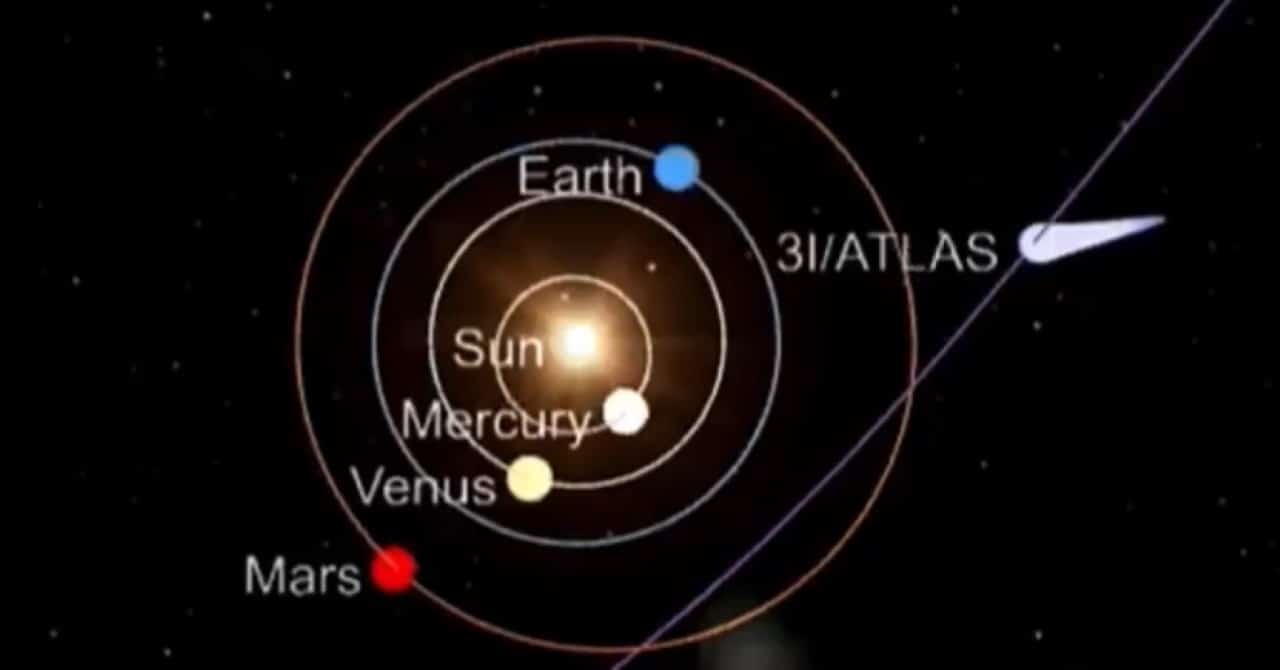
The ATLAS detection system was responsible for the initial identification of the comet in July 2025, marking the progress of modern astronomy. Equipes monitoring quickly determined that the object originated from outside the solar system, based on its unusual hyperbolic trajectory. Viajando at more than 57 kilometers per second, the trajectory follows a path that does not allow return, making it impossible to capture by solar gravity.
Spectroscopic analysis revealed the presence of volatile compounds never before documented in known comets. The spectrometers detected multiple complex organic molecules in the core’s composition. The simultaneous presence of ice and organic materials suggests sophisticated chemical processes operating in distant regions of the galaxy, regardless of the type of star or distance from the galactic center.
Emissões of gases and observed transformations
- Cianeto, indicating significant changes after sun exposure.
- Metanol, detected in unusual concentrations in the comet’s atmosphere.
- Formaldeído, serving as a marker of internal transformations.
- Metano and ethane, functioning as indicators of the primitive structure.
Detailed analysis of the gases revealed an increase of approximately twenty times in the amount of water released when compared to the initial records in August. Carbon monoxide also followed this upward pattern during the period of maximum approach.
Espectrógrafos coupled to ground- and space-based optical instruments identified different types of compounds present in the object’s structure. The spectral data showed the remarkable presence of primitive elements mixed into materials commonly found on celestial bodies.
Transformações structural core
High-resolution Imagens captured by optical telescopes in mid-November documented visible changes in the morphology of the comet’s coma. Enquanto gases maintained symmetrical distribution around the nucleus, the tail developed an asymmetrical and distinctive shape, easy to identify.
The unusual structure of the tail reveals the direct effect of non-uniform solar radiation on the newly released layers. The specific orientation of the tail, with its section closest to Sol, demonstrates how different portions respond to solar light pressure at varying intensities.
Comparação with previous cosmic visitors
The physical and chemical behavior of 3I/ATLAS offers significant scientific contrast to previously documented comets. The first confirmed visitor, known as 1I/Oumuamua, passed through the solar system with minimal activity. The second object, 2I/Borisov, presented moderate and predictable reactions according to conventional models.
The new visitor demonstrated a late and almost explosive activation, surprising monitoring teams who expected a more restrained response. The chemical composition between carbon dioxide, carbon monoxide and water was clearly different from expected patterns, raising new questions about the formation of celestial bodies in Via Láctea.
Trajetória future and scientific significance
Após the sublimation event close to Sol, the comet maintains its hyperbolic trajectory without changes until the limit of deep space. The escape velocity of more than 57 kilometers per second ensures that solar gravity will never be able to capture the object in a closed elliptical orbit, meaning that terrestrial observers will only follow its gradual weakening until it disappears completely.
The passage of 3I/ATLAS reinforces the importance of observing interstellar celestial bodies, providing measurable data to validate current cosmological models. The capacity for detailed analysis without the need to send probes represents an incalculable advance for modern science and understanding of the universe.