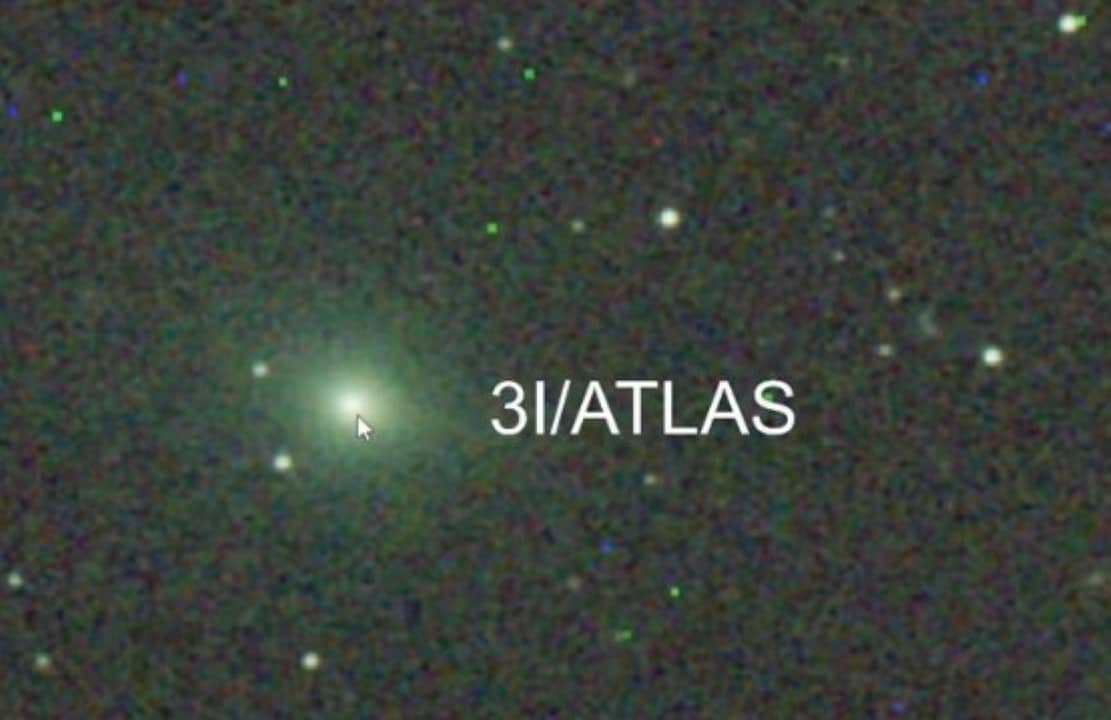
Cientistas confirmed that comet 3I/ATLAS, an intergalactic object that crossed the solar system in 2025, contains water with deuterium in a concentration 40 times higher than that of Earth’s oceans. The discovery, published in the journal Nature Astronomy at the end of April, offers unprecedented clues about the extreme conditions for the formation of planetary systems in other regions of the universe. The study analyzed data collected by the ALMA radio telescope, located on Chile, during the comet’s passage close to the sun in November 2025.
Comet 3I/ATLAS is only the third extrasolar object documented to cross the vicinity of the solar system. Pesquisadores estimate that it is more than 10 billion years old and preserves chemical records of the galaxy’s past, functioning as a cosmic time capsule that has traveled through interstellar space.
Descoberta of deuterated water breaks the paradigm of cosmic chemistry
The detection of deuterium in a rare isotope of hydrogen with an extra neutron marks the first time this element has been identified in an object outside the solar system. Deuterated water, known as HDO or semi-heavy water, differs from regular water in that each hydrogen atom contains an additional neutron, making it heavier. Enquanto traditional water is made up of two hydrogen atoms and one oxygen (H₂O), deuterated water replaces a common hydrogen with deuterium (HDO).
Luis Eduardo Salazar Manzano, lead author of the study, revealed that the abundance of deuterium in comet 3I/ATLAS significantly exceeds any known reference. The concentration is more than 30 times greater than that found in comets in the solar system and 40 times greater than that present in the oceans of Terra. Essa monumental disparity points to formation conditions radically different from those that shaped the celestial bodies known until then.
The importance of deuterated water lies in its ability to reveal the chemical environment where it originated. Quando water forms in cold molecular clouds in interstellar space, the process favors enrichment in deuterium. Este process occurs simultaneously with the formation of solar systems around other stars, making deuterated water a highly accurate geological marker of cosmic origins.
Forming Ambiente was cooler than the early solar system
Analysis of the comet’s chemical composition allowed astronomers to reconstruct the environment where it formed. The characteristics indicate an unusually cold system, with temperatures estimated at -243.14 degrees Celsius. Esse extreme cooling is even more intense than the temperatures present in the solar system during its own formation, suggesting a region of space particularly hostile to the development of conventional life forms.
The comet originated in a protoplanetary disk, the structure of gas and dust that surrounds a nascent star. It is precisely in this type of disk that planets form. The existence of a protoplanetary disk around the star that gave rise to 3I/ATLAS confirms that the process of planetary formation is not exclusive to our solar system, but a universal phenomenon that occurs in multiple regions of the cosmos.
Researchers deduced these conditions by studying the abundance of specific chemical elements and their isotopic ratios. Deuterium, being rare and sensitive to the thermal conditions of the original environment, functioned as a geological thermometer that revealed the particularities of the distant system where the comet was born.
Radiotelescópio ALMA revealed gases through sublimation
The ALMA radio telescope (Atacama Large Millimeter Array) was decisive for the detection of chemical elements in comet 3I/ATLAS. Scientists were able to observe the object at the moment of its closest approach to the sun, at a distance of 203 million kilometers. Quando the comet came closer to the star, the solar heat caused the sublimation of the ice and the direct transformation of solid into gas, releasing detectable molecules that were captured by the telescope’s instruments.
Este sublimation process is fundamental to cometary astronomy. Conforme the ice present in the comet’s nucleus evaporates, releasing gases and particles that form the visible tail and emit unique spectral signatures. The ALMA radio telescope can capture these signatures with extraordinary precision, allowing the identification of specific molecules and the quantification of their proportions.
The sensitivity of the instruments was sufficient to detect deuterated water, but it was not possible to locate ordinary water in measurable quantities. Esse apparently contradictory result turned out to be extremely significant for the interpretation of scientific data.
Interpretação’s results point to unusual object
Salazar Manzano explained that the absence of detection of ordinary water (H₂O) does not necessarily indicate that comet 3I/ATLAS does not contain it. The observations made may simply have been below the sensitivity limit of the available instruments. However, the successful detection of deuterated water, just when ordinary water was not identified, raised red flags for the scientific community.
The abnormal ratio of deuterium to the detectable absence of ordinary water immediately signaled that comet 3I/ATLAS was a truly exceptional object. Essa combination of features has not been recorded before on any celestial body studied. The discovery challenges existing theoretical models and forces astronomers to reconsider the chemical and physical possibilities present in the universe.
The researchers conclude that comet 3I/ATLAS offers a unique window to understand how matter behaves in extremely cold and distant environments. The data collected contributes to refining models of solar system formation and expands knowledge about cosmic chemistry in remote regions of the universe.
Cronograma and study methodology
Confira the main milestones of the research project:
- 2025 Novembro: Observações initials of comet 3I/ATLAS taken by the ALMA radio telescope as the object passed close to the sun
- Final April 2026: Publicação official results in Nature Astronomy magazine
- Maio of 2026: Divulgação of findings for the international scientific community
- Análise: Detecção of deuterated water in a concentration 40 times higher than that of Earth’s oceans
- Estimated origin Temperatura: -243.14 degrees Celsius in the comet’s formation environment
Comet 3I/ATLAS definitively left the solar system at the end of 2025, continuing its journey through still unknown spaces. Porém, the records collected during its passage will remain an essential source of data for future research into the origin and chemical diversity of the universe’s celestial bodies. The discovery reaffirms the importance of observational astronomy and cutting-edge technology in unraveling the oldest and deepest mysteries of the cosmos.