Lake isolated 12 thousand years ago is home to millions of unique jellyfish on the planet
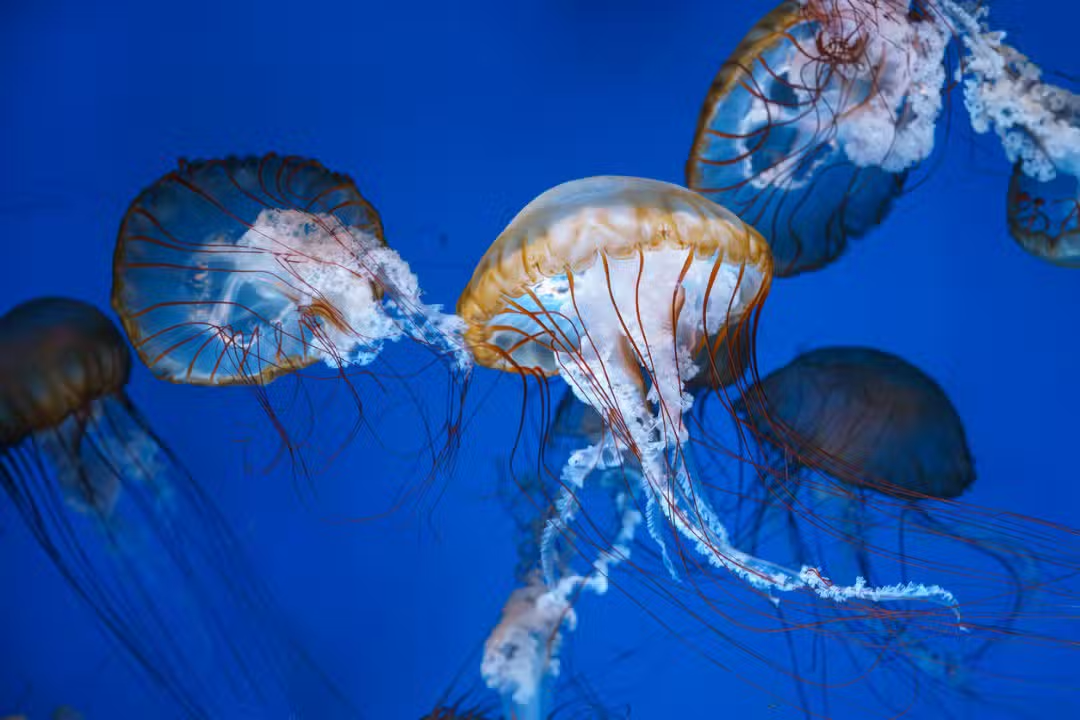
Sob the surface of Lago of Medusas, located on the uninhabited island of Eil Malk in Ilhas Rochosas of Palau, lives one of the most unusual wildlife populations of Terra. Milhões golden jellyfish evolved in isolation for about 12,000 years, forming a unique subspecies found only there. Nenhum another body of water on the planet is home to this specific type of jellyfish in such numbers and with such striking behavioral characteristics.
Esse isolation began when sea levels changed at the end of the last ice age. Nearby Lagoas and the open ocean were separated from the lake by a natural barrier. Over time, this separation created a closed ecosystem where species evolved under completely stable conditions. The result was a population of jellyfish with distinct traits from their relatives in the surrounding ocean.
Estrutura of the lake and its geological formation
Lago of Medusas, known locally as Quinto Lago, measures approximately 400 meters long and 30 meters deep. Sua topography was shaped by the geological processes that occurred after the end of the last ice age. The body of water is surrounded by mangroves that support a variety of marine invertebrates essential to the balance of the ecosystem.
The natural barrier that separates it from the open ocean has created unique conditions. Isolado thousands of years ago, the lake developed its own independent life cycle. Jellyfish have become the most dominant inhabitants of this closed environment, adapting perfectly to the specific characteristics of the water and the island’s climate.
The peculiar behavior of golden jellyfish
The lake’s most notable species is the golden jellyfish, scientifically known as Mastigias papua etpisoni. Seu behavior is particularly unusual: jellyfish migrate across the bay in response to Sol’s position throughout the day. At sunrise, they begin to swim eastward until they reach a line of shadow. Conforme the star moves across the sky, moving westward, creating synchronized movements that form dense aggregations of impressive visual appearance, similar to a floating wall of organisms.
Essa daily migration is not random. Está closely linked in a symbiotic relationship with dinoflagellates, microscopic algae that live in the tissues of jellyfish. Essas algae depend on sunlight to produce energy through photosynthesis. Cada As jellyfish glide through the sunny waters, they help the algae absorb the amount of light it needs. In return, the algae provide energy and nutrients that support both the jellyfish and the lake ecosystem itself.


Ciclos population and climate impact
The jellyfish population in the lake varies significantly over the years. Normalmente, the lake is home to around 5 million golden jellyfish. Contudo, in 2005, estimates suggested there were up to 30 million individuals at the site. Essa fluctuation drastically changed in 2016 when the number fell to critical levels. The situation was so serious that authorities temporarily closed the lake to visitors for two full years.
The researchers attribute this significant decline to the El Niño phenomenon. Esse weather event raised water temperatures beyond normal limits, harming the growth of symbiotic algae. With less algae available, jellyfish lost an important source of nutrients, directly contributing to the precipitous drop in population. As environmental conditions normalized, the ecosystem began a gradual but steady recovery.
Recuperação ecosystem and current diversity
By 2019, jellyfish numbers had returned by the millions, allowing the lake to fully reopen to visitors and researchers. Recovery demonstrates the resilience of the isolated ecosystem when environmental conditions improve. Além of the golden jellyfish, another species inhabits the lake:
- Golden Medusa (Mastigias papua etpisoni) – dominant species and main inhabitant
- Medusa-da-lua – present in significantly smaller numbers
- Dinoflagelados – microscopic algae in a symbiotic relationship with jellyfish
- Invertebrados diverse marine areas – supported by the surrounding mangroves
- Microorganismos from the bottom of the lake – essential part of the food chain
Esse set of organisms forms a self-contained system where each species plays a specific role in maintaining the general balance. The lake remains a natural laboratory where evolution continued its course without outside interference for millennia, creating one of the most unique ecosystems in Pacífico and the entire world.
See Also em Latest News (EN)

Vinicius Junior reaches 20 goals for the fifth time in a row and equals Cristiano Ronaldo’s record at Real Madrid
04/05/2026
NASA transmits 484 gigabytes from the Moon with laser communication system
04/05/2026
Free supernatural RPG dominates downloads on PlayStation and earns 86 points
04/05/2026
Astronomers reveal gigantic structures aligned with the Milky Way’s black hole
04/05/2026
Hailey Van Lith leaves Chicago Sky due to playing style preference
04/05/2026
Interstellar comet 3I/ATLAS helps astronomers reconstruct early Milky Way conditions
04/05/2026
Invisible energy from dark matter may explain rapid formation of black holes
04/05/2026
Steam’s share of Linux declines in April after an all-time high in March
04/05/2026
Researchers admit possibility of extraterrestrial artifacts in the solar system
04/05/2026
Samsung announces new stable release date for One UI 8.5 in May
04/05/2026
Apex Legends™: Overclock receives update with new tweaks and improvements
04/05/2026