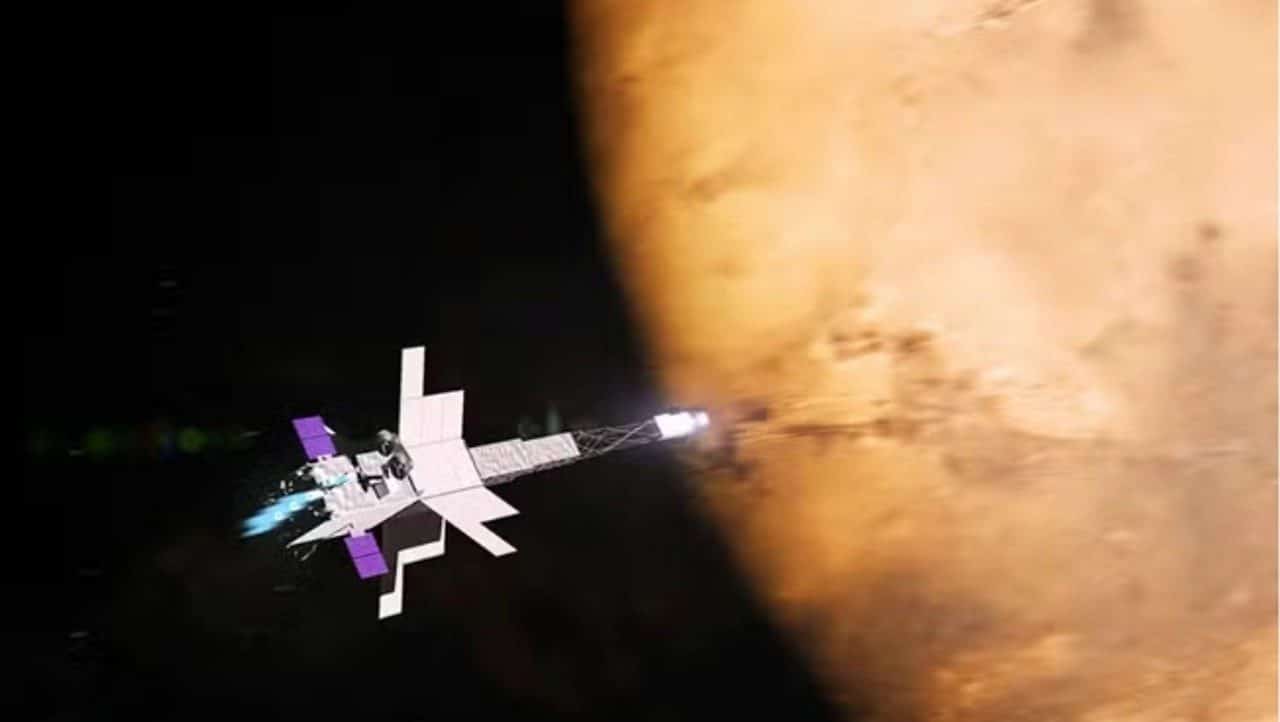
NASA has released plans to send Marte the first nuclear-powered spacecraft. The Reator Espacial-1 Freedom, named SR-1 Freedom, will be launched in December 2028 and will arrive on the red planet approximately one year later on the mission called Skyfall. The journey includes three small helicopters that have mapped Martian terrain and will explore possible sites for future human landing.
The announcement took place during the Ignition event, where the agency also redefined its overall space exploration strategy. Não is just another mission to Marte, but a milestone that will establish regulatory and launch precedents for nuclear systems in deep space. NASA describes the SR-1 Freedom as a turning point for both propulsion and construction of future missions.
Reator nuclear and revolutionary propulsion system
The heart of the mission is a fission reactor coupled to a system called nuclear electric propulsion, or NEP. Diferentemente of the thermoelectric generators used in classic probes like Voyager, this system not only provides power for instruments. Ele propels the spacecraft through deep space.
The operation is straightforward: the reactor generates heat, which is transformed into electricity, powering highly efficient thrusters. Isso eliminates dependence on large solar panels that operate poorly away from the Sol. A NEP-equipped spacecraft moves stably and continuously in deep space, enabling missions that were previously only theoretical.
The distinction is critical. Geradores radioisotope thermoelectrics provide onboard power, but do not propel anything. Sistemas NEP are active propulsion. Isso makes the technology especially attractive for regions of the solar system where sunlight weakens and energy demand grows rapidly. Para Júpiter and beyond, NASA claims NEP is the only viable option for high-power spacecraft.
Três helicopters searching for underground water
Quando o SR-1 Freedom reach Marte, will release three helicopters inspired by Ingenuity, the small aircraft that landed with the Perseverance rover in February 2021. Ingenuity performed 72 successful flights before ceasing operations in January 2024.
The new helicopters carry a more specific mission:
- Explorar possible landing site for future astronauts
- Mapear terrain using cameras and ground penetrating radar
- Identificar hazards and obstacles on the surface
- Localizar underground water ice deposits
- Determinar ice size, depth and characteristics
The purpose of ice goes beyond science. If humans are going to work for long periods on Marte, frozen water is a matter of survival. Fornecerá drinking water, will allow fuel production and enable daily operations. Steve Sinacore, program executive for NASA’s Escritório Reatores Espaciais, explained: The helicopters will map ice deposits by figuring out where they are, along with their size, depth and important features.
Após release the helicopters, NASA plans for the SR-1 Freedom to continue its journey through the solar system, although this step has not yet been completed. The agency apparently treats the reactor as a platform with growth potential, not simply a delivery system.
Redefinição broad priorities at NASA
Skyfall’s announcement was accompanied by a much larger shake-up within the agency. Entre biggest changes, NASA suspended development of Gateway, the space station planned to orbit Lua. Recursos were redirected to build a permanent base on the lunar surface.
The lunar plan has three phases: initial infrastructure with small habitats, expansion to semi-permanent facilities with international partners (Japão, Itália, Canadá), and finally continued human presence on the surface. Jared Isaacman, NASA administrator, described urgency in blunt terms: time is running out in this great-power competition, and success will be measured in months, not years.
The agency explores a new path for life after Estação Espacial Internacional. Instead of risking a gap in the US human presence in low orbit, it is studying a plan that would attach a central government module to the station, adding commercial modules over time. Essas commercial parts can then be separated and operate independently. Solicitação information was opened on March 25th.
Spatial Agenda replete in addition to Skyfall
Dragonfly, a nuclear-powered octocopter probe destined for Titã, is scheduled to launch in 2028 and arrive in 2034. Titã, the moon of Saturno, is known for its environment rich in organic material, making it one of the most intriguing places in the solar system for exploration of this type.
Outras missions include:
- Rover Rosalind Franklin from Agência Espacial Europeia to Marte in 2028
- Telescópio Espacial Nancy Grace Roman Launching This Fall (Focused on Dark Energy)
- Nova Terra science mission next year measuring convective storm dynamics
- Programa of Serviços Comerciais of Carga Útil Lunar aiming for 30 robotic landings from 2027
Why the reactor represents a paradigm shift
The practical importance of the SR-1 Freedom transcends the helicopters it carries. Nuclear electric Propulsão would make deep space cargo transportation much more efficient than current options. Para missions to Júpiter or beyond are the only viable option for high-power spacecraft.
Isso gives the reactor status other than ordinary scientific flight. Não is just about answering questions about Marte. Trata sets out to solve transportation problem that has prevented more ambitious missions for years. A spacecraft capable of generating its own propulsion energy independently of sunlight alters design choices across the board. Abre space for heavier payloads, enables missions with greater energy demands and helps create rules and supply chains necessary to make future nuclear systems less exceptional and more routine.
NASA’s official description makes this clear: the mission aims to create launch precedents, regulatory precedents and industrial capacity, not just collect scientific data. The SR-1 Freedom is expected to facilitate approval, construction and flight of future nuclear missions. Essa is a much bigger task than simply landing three helicopters on Marte.