

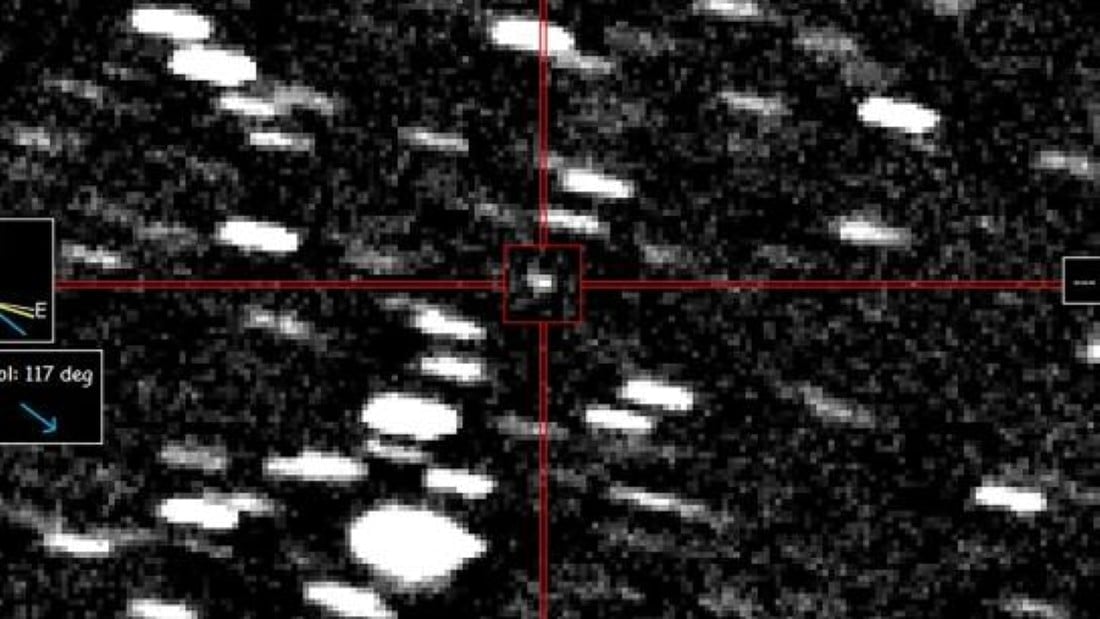
A rare interstellar comet called 3I/ATLAS will make its closest pass to Terra on December 19, 2025, maintaining a safe distance of approximately 270 million kilometers. The event represents a unique opportunity for astronomers to study the composition of celestial bodies originating outside the solar system and understand star formation processes in remote regions of Via Láctea. Descoberto on July 1, 2025 by the ATLAS system located at Havaí, the comet is only the third interstellar object confirmed in our cosmic neighborhood, after 1I/’Oumuamua and 2I/Borisov.
Descoberta and confirmation of interstellar origin
Astrônomos of the ATLAS observatory in Palomar, in Havaí, identified 3I/ATLAS through systematic analysis of the night sky. The comet’s hyperbolic orbit, with an eccentricity greater than 6, definitively confirmed its origin beyond the borders of the solar system. The object entered the solar system at a remarkable speed of 58 kilometers per second, surpassing the speed of previously observed interstellar comets and clearly indicating its origins in a remote region of space.

Subsequent Observações revealed the formation of a coma and tail, characteristics that led to its classification as an active comet. The detailed analysis of its trajectory provided information about the diversity of celestial bodies that transit Via Láctea, opening new fronts of investigation for the international scientific community.
Imagens of Telescópio Hubble reveals complex structure
Telescópio Espacial Hubble carried out a detailed study of 3I/ATLAS on November 30, 2025, when the object was 286 million kilometers from Terra. The images captured revealed a bluish coma and a gas tail, indicating intense activity from the comet. The Agência Espacial Europeia observation team detected bright, well-defined jets of material projecting from the tail, allowing precise analysis of particle and gas ejection dynamics.
The comet’s tail extended up to 56,000 kilometers in August, indicative of the intensity of the outgassing and the object’s complex activity. Missões spacecraft such as Psyche, Lucy and MAVEN also recorded orbital and trajectory data, providing robust basis for predictive models and comparative studies between different observatories.
Composição chemistry reveals distant formation environment
Pesquisas carried out at the ALMA observatory revealed the presence of large amounts of methanol and hydrogen cyanide inside 3I/ATLAS. The detection of these organic compounds suggests that the comet formed in an environment outside the solar system, offering crucial clues about the chemical conditions prevailing during the formation of other planetary systems. Because it is distant from Sol, the comet has low volumes of water ice and carbon dioxide, a fundamental characteristic for understanding how the composition of volatiles reflects the chemical conditions at the beginning of the formation of planetary systems.
- Metanol and hydrogen cyanide detected in large quantities.
- Baixos water ice and carbon dioxide volumes confirmed.
- Composição indicates formation in an extrasolar environment.
- Dados essential for reconstructing planetary formation scenarios.
The constitution of volatiles in comets like 3I/ATLAS works as a mirror of the chemical conditions present during the formation of planetary systems. Estudar these elements allow scientists to reconstruct scenarios and processes that shaped cosmic matter over billions of years.
Trajetória hyperbolic and motion dynamics
The comet reached its perihelion on October 29, 2025, the closest point to Sol, at a distance of 1.4 astronomical units. Após approaches Terra on December 19, 3I/ATLAS will continue its journey towards the outer solar system, following its hyperbolic trajectory. Sua peculiar orbit suggests origin in a remote region of Via Láctea, with a trajectory estimated between 760 thousand and 1.4 million years.
The comet’s relative speed in relation to Terra will reach 58 kilometers per second, highlighting the speed with which this celestial body moves through space. Pequenas particles are ejected at 22 meters per second, while larger ones move at 2 meters per second, demonstrating multifaceted dynamics that have surprised researchers. Apesar’s speed and trajectory, there is no possibility of collision with our planet, ensuring that its passage will be a safe spectacle for observation.
Desafios to scientific models and future perspectives
3I/ATLAS activity has remained unpredictable and unstable, challenging existing models and offering new data to refine theories about comet evolution. Observações planned by agencies such as NASA and ESA aim to improve existing orbital models, allowing even greater accuracy in predicting the trajectories of interstellar objects. Compreender how these materials are transported through interstellar space represents a significant advance for modern astronomy and for knowledge about the origin and composition of the universe.