

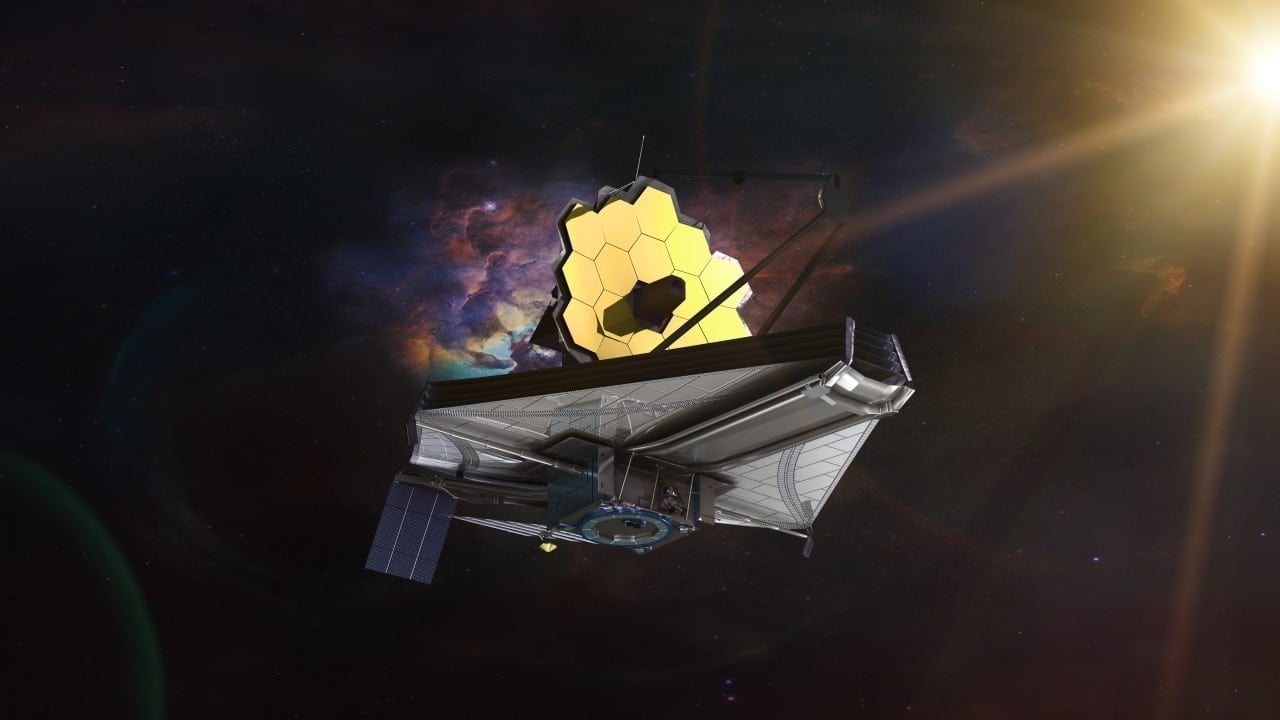
The James Webb space telescope recorded the first direct measurement of the mass of a supermassive black hole located at the dawn of cosmic history. The central object of the system known as Abell2744-QSO1 has a weight equivalent to 50 million times the mass of Sol. The colossal structure inhabits the nucleus of a red galaxy of reduced proportions. The scenario observed by astronomers corresponds to a period of just 700 million years after the Big Bang event.
The team of researchers managed to accurately map the movement of the gas that orbits the central region of the system. Analysis of the data demonstrates that the singularity absolutely dominates the total mass of the galactic ensemble. The scientific finding raises new questions about the mechanisms that allowed the emergence of such gigantic objects at such an early stage in the expansion of the cosmos. Space equipment continues to provide information that alters human understanding of the formation of the universe’s earliest structures.
The unprecedented mapping of the gas around Abell2744-QSO1
Detailed observation of Abell2744-QSO1 required the use of advanced infrared light harvesting technologies. Scientists focused on the dynamics of gaseous elements surrounding the event horizon of the supermassive black hole. The host galaxy has a very faint luminosity. The core of the system, on the other hand, shines brightly due to the heating of hydrogen and helium gas in an almost primordial state. The absence of heavier elements reinforces the thesis that the environment reflects the exact conditions of the early universe.
The black hole concentrates an amount of matter that far exceeds the sum of all the stars present in the galaxy around it. The proportion found by astronomers exceeds patterns observed in the current local universe. In Nas galaxies close to Via Láctea, the central black holes represent only a tiny fraction of the total stellar mass. The extreme imbalance detected in Abell2744-QSO1 indicates a different evolutionary path for structures formed in the first billion years after Big Bang.
Capturing light from this remote region of space requires long periods of exposure of the telescope lens. The photons travel billions of light years until they reach the hexagonal mirrors of equipment positioned in solar orbit. The level of detail achieved by the current mission surpasses all previous attempts carried out by ground-based observatories or space telescopes of past generations.
Keplerian Dinâmica and measurement with the NIRSpec instrument
The international team of astronomers used the NIRSpec instrument attached to the James Webb telescope to observe the gas in orbit. The near-infrared spectrograph has an integral field unit capable of capturing velocities at different distances from the center of the galaxy. The researchers compared the actual movement of gases with expected mathematical models for various mass distributions. The result pointed to an extreme point concentration.
The spectrograph recorded speeds that exactly follow the pattern known as Keplerian rotation. Apenas the presence of a singular and massive object at the center of the system can explain the observed physical behavior. The technique made it possible to abandon estimates based on secondary calculations.
- The gas rotation speed reaches maximum levels in the regions closest to the center of the system.
- The speed curve traced by the equipment confirms the existence of a strictly punctual gravitational attraction.
- Previous measurements of similar objects depended exclusively on indirect methods of astronomical calculation.
- The mass of the singularity was determined directly through the analysis of gaseous fluid dynamics.
The scientific collaboration responsible for analyzing NIRSpec data involved researchers from different parts of the world. Ignas Juodžbalis and Cosimo Marconcini led fundamental steps in processing the information captured by the space telescope. The joint work included the participation of experts from Universidade, Florença, Instituto Max Planck and Universidade Ben-Gurion.
The enigma of small red dots in the young universe
The Abell2744-QSO1 system belongs to a class of astronomical objects recently classified as small red dots. Essas compact, reddish structures appeared in large quantities in the initial images captured by James Webb. Observations indicate that such galaxies were extremely common during the first billion years of the cosmos’ existence. The presence of these celestial bodies becomes almost non-existent in the most mature and closest regions of the contemporary universe.
The identification of Abell2744-QSO1 marks a historic moment for observational astronomy. The system became the first representative of its class to have the mass of its central black hole measured directly and conclusively. The reddish color results from the redshift of light, a phenomenon caused by the accelerated expansion of the universe over billions of years. The cosmic dust present in the galaxy also contributes to obscuring visible light and only allowing infrared radiation to pass through.
Astronomers now plan to direct the telescope’s mirrors at other small red dots scattered throughout deep space. Applying the same spectroscopy technique to new targets will help determine whether Abell2744-QSO1 constitutes an isolated anomaly or whether it represents a common evolutionary pattern in the young universe. The expansion of the observational database will provide the necessary material to test current cosmological theories.
Evolutionary Descompasso between the galaxy and the black hole
Quantitative analysis of the system revealed that the supermassive black hole accounts for at least two-thirds of Abell2744-QSO1’s total mass. The stars that make up the galactic structure have a significantly lower amount of matter. The scenario directly contradicts the classic model of galactic coevolution. Traditional theory postulates that galaxies and their respective central black holes grow proportionally and simultaneously over billions of years.
The observed evolutionary mismatch raises the possibility that the growth of the singularity occurred at a much faster pace than star formation. The extreme gravitational force of the black hole may have quickly consumed the gas reserves available in the surrounding environment. The shortage of raw materials resulting from this process would severely limit the galaxy’s ability to generate new stars. The phenomenon would explain the reduced dimensions and low luminosity of the structure that houses the cosmic giant.
The discovery requires a profound review of the computational models used to simulate the evolution of the universe. Current mathematical parameters cannot reproduce the formation of a 50 million solar mass black hole in such a short time after Big Bang. The need to adjust equations drives the development of new theoretical approaches in the field of astrophysics.
Hipóteses formation and impact on modern cosmology
Data extracted from the observation suggests that some supermassive black holes may have emerged even before the galaxies that host them. Duas main hypotheses gain strength in the scientific community based on the information provided by James Webb. The first theory points to the direct gravitational collapse of gigantic, primitive gas clouds. The process would form large black holes without the need to go through the massive star phase.
The second line of reasoning mentions the existence of primordial black holes. Esses objects would have formed in the fractions of a second immediately following Big Bang, driven by extreme density fluctuations in the fabric of spacetime. Roberto Maiolino, Universidade researcher from Cambridge, highlighted the transformative impact of the discovery. The scientist stated that the finding represents a paradigm shift in classical structural formation scenarios.
The detailed research results were subjected to scrutiny by the international academic community. The scientific articles describing the unprecedented measurement were published simultaneously in two of the most prestigious journals in the field. Nature and Monthly Notices of the Royal Astronomical Society released the studies on the same day. Peer validation cements the space telescope’s position as today’s most important tool for exploring the origins of the cosmos.