

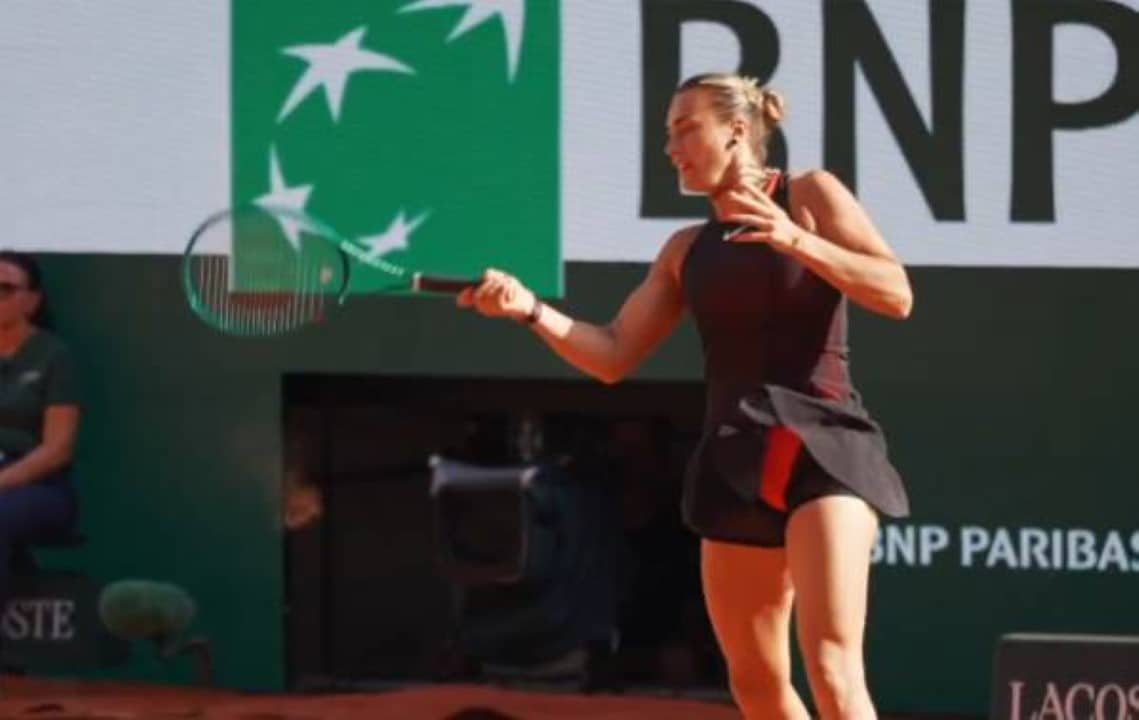
Aryna Sabalenka, current number one in the world rankings, demonstrates technical and tactical superiority in the quarterfinals of Roland Garros. The Belarusian tennis player opened a big lead against the Russian Diana Shnaider in Court Philippe-Chatrier, in Paris. With partials of 6/3 in the first set and 4/1 in the second stage, the leader of the women’s circuit is taking great strides to guarantee her place in the semifinals of the tournament played on French clay. Confrontation requires a high level of concentration. The weather conditions in the French capital also influence the speed of the ball during court changes.
The duel, which exceeds the one-hour mark, highlights the two athletes’ distinct moment on the professional tennis circuit. Enquanto, the favorite, uses her vast experience in large tournaments to dictate the pace of the actions, the young opponent looks for alternatives to break the solidity on the other side of the net. Diana Shnaider currently occupies twenty-third place behind Associação and Tênis Feminino. The official broadcast of the event takes place on the Disney+ streaming platform. The public closely follows each point played on the central court of the sports complex.
Aggressive Desempenho ensures control of the score in the second set
The start of the second half determined the scenario of absolute dominance for the main seed in the international competition. Aryna Sabalenka applied a service break in the first games, completely destabilizing the Russian opponent’s defensive strategy. Essa initial margin provided peace of mind for the Belarusian to risk deeper and more angled strikes. The score of 4/1 perfectly illustrates the efficiency of their returns. Constant aggressiveness prevents the opponent from being able to structure their attack moves with the necessary time.
Consistency in serving has been a fundamental pillar for maintaining the lead on the scoreboard. The world number one already has two aces in the match, while her opponent has not yet managed to score directly on this specific basis. Além’s ability to save four of the five break points faced proves the favorite’s mental resilience in moments of greatest pressure. Precision in crucial moments defines the course of the clash. The high success rate with the first serve makes it easier to execute the offensive tactics planned by the technical team.
Diana Shnaider faces difficulties imposing his playing style
Do On the other side of the court, Diana Shnaider deals with the immense challenge of facing an opponent in a state of grace and with total confidence in her strikes. The Russian tennis player tries to vary the effects and height of the balls to take the weight of the attacks she constantly receives from the baseline. Apesar from the disadvantage on the scoreboard, she maintains a combative posture and runs the entire length of the court. The physical effort is remarkable. Moving on clay requires specific footwork, with precise slides to reach the most difficult balls.
Durante In the first set, the young athlete achieved a break of service, indicating that she has the technical resources to upset the leaders of the world rankings. Contudo, the lack of regularity prevented this initial reaction from turning into a real threat to the Belarusian’s dominance. With a double fault recorded and a 76% success rate on the first serve, Shnaider needs to raise its level of accuracy to dream of an upset over the Parisian Grand Slam. The margin for error decreases drastically when facing the best player today.
Estatísticas highlights disparity in offensive actions
The official numbers of the confrontation reflect the aggressiveness imposed by the leader of the world rankings from the first minute of the game. The difference in the number of winning plays is the factor that most attracts the attention of experts present at the Roland Garros sports complex. The ability to generate power in defining strikes has been the big difference in the match so far.
The detailed analysis of the fundamentals reveals the paths that created the partial result in favor of the Bielorrússia athlete:
- Volume game: Aryna Sabalenka accumulates 28 winners against just seven for Diana Shnaider.
- Golpes right: The Belarusian’s forehand generated 12 direct points, surpassing the Russian’s five.
- Eficiência on the reverse: The backhand yielded 13 points for the number one, while the opponent scored just two.
- Unforced Erros: The constant search for lines resulted in 26 failures for Sabalenka, compared to 18 for Shnaider.
- Total of points: The overall count shows 53 points won by the favorite and 41 by the challenger.
Essa discrepancy in offensive statistics justifies the control of actions by the most experienced tennis player. Mesmo committing a greater number of unforced errors, the risk-taking strategy has proven to be highly profitable on Paris’s slow clay. The conservative stance does not usually yield good results against players with such physical power. The balance between risk and reward leans favorably towards the current leader of the circuit.
Sequência of points defines the dynamics of the second partial
The build-up of the score in the second set occurred quickly and relentlessly, without leaving room for immediate recovery. In just twenty minutes of competition in this stage, the dynamics of the confrontation were clearly established in favor of the athlete who serves with greater speed. The initial break in the first game acted as a severe obstacle to the Russian tennis player’s hopes of reacting. Constant pressure on returns forced crucial errors on the other side of the net.
Após confirmed his serve and opened up 2/0, Aryna Sabalenka saw Diana Shnaider win his first game and close the gap on the scoreboard to 2/1. However, the reaction stopped there. The Belarusian began a winning streak in the following games, taking the score to 4/1 with authority. At certain moments, the superiority was such that the leader of the ranking closed her service game at 40/0, without giving up any opportunity to compete. Houve also had tougher games that reached 40/40, but experience prevailed over the advantages.
Expectativas for the final stretch of the clash on French clay
The course of the next games at Court Philippe-Chatrier will define the future of the women’s group of the international tournament. The winner of this duel will guarantee the right to play in the semifinals of one of the most traditional and demanding championships on the world tennis calendar. The clay court requires impeccable physical preparation and a lot of patience to build points throughout the matches. Advancement in the main draw also guarantees valuable points for maintaining positions in the WTA rankings.
Para Aryna Sabalenka, closing the match in straight sets means saving vital energy for the decisive phases of the competition, where physical exhaustion is usually a determining factor. The baggage accumulated in grand finals acts as an important asset to manage the advantage built so far. In turn, Diana Shnaider plays his last chips in an attempt to prolong the dispute and force a third set. High-performance tennis requires absolute focus until the last point played, and the conclusion of this match will confirm who advances in the search for the coveted trophy in Paris.