
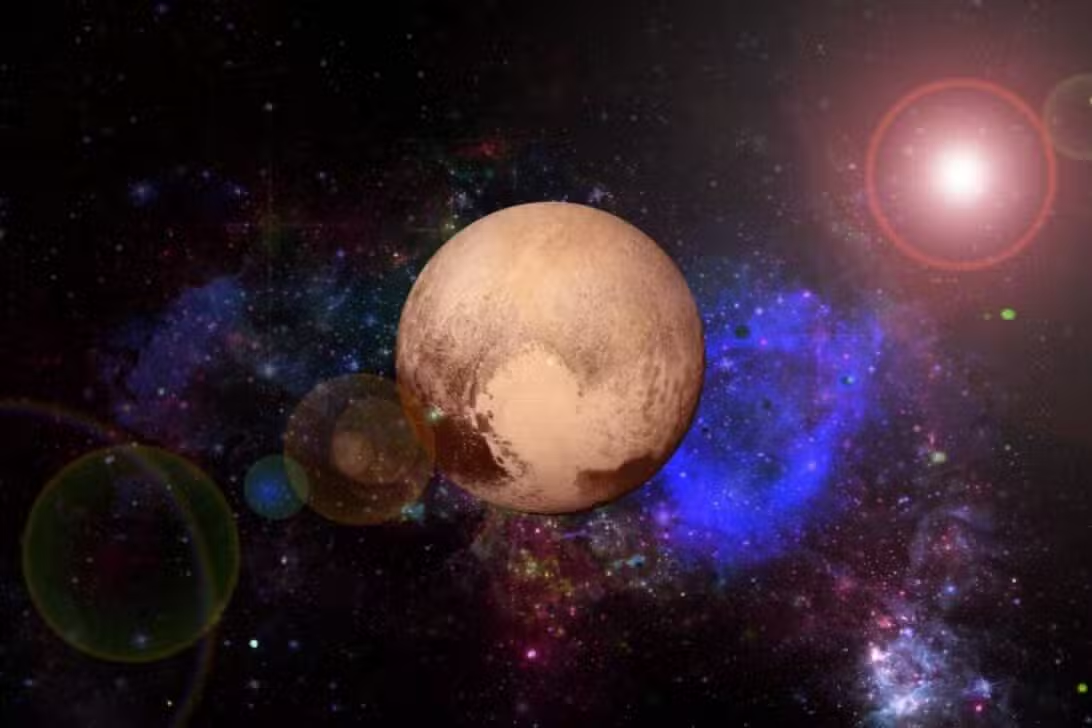
Pesquisadores of Observatório Astronômico Nacional of Japão recorded the presence of a gaseous layer around the trans-Neptunian object cataloged as 2002 XV93. The celestial body is approximately 500 kilometers in diameter. Ele orbits Sol at a distance of more than 5.5 billion kilometers. The discovery changes the understanding of the ability of tiny worlds to retain gases in extreme, frozen regions of the solar system.
The detection occurred during a specific astronomical event in January 2024. Equipes of professional and amateur astronomers monitored the object’s passage in front of a distant star from Japanese cities as Kioto, Nagano and Fukushima. Recording the gradual decrease in starlight provided the visual signature of the atmosphere. The complete study on the phenomenon is part of a recent publication in the scientific journal Nature Astronomy.

Mecânica from stellar occultation reveals gas layer
The technique used by scientists is called stellar occultation. The method works like a miniature eclipse. The telescopes point at a background star and wait for the exact moment the celestial body crosses Terra’s line of sight. The absence of an atmosphere would make the star’s light disappear abruptly and return with the same intensity instantly. The equipment registered a different behavior during the passage of the 2002 XV93.
Data collected at observation stations showed a smooth transition in luminosity. The star’s brightness gradually dimmed over the course of about 1.5 seconds before it completely blocked out. The light suffered refraction when passing through the gaseous envelope of the object. Researcher Ko Arimatsu led the analysis of the information and confirmed that the light pattern corresponds to the presence of volatile elements around the rocky surface.
The atmospheric pressure calculated for the object reaches extremely low levels. Mathematical models indicate a density between 5 million and 10 million times lower than the pressure found on the surface of Terra. The exact composition of the layer still requires additional investigations by astronomers. Scientists point to methane, nitrogen and carbon monoxide as the most likely gases in the region due to the low temperatures of the space environment.
Comparação with Plutão and breaking paradigms
Cinturão of Kuiper houses thousands of celestial bodies left over from the early formation of the solar system. Plutão represents the most famous and massive member from this distant region. The dwarf planet is 2,377 kilometers in diameter and maintains a tenuous atmosphere already confirmed by previous space missions. Astronomers considered Plutão’s gravity to be the minimum limit necessary to hold gases against dissipation in the vacuum of space.
The 2002 XV93 object has much smaller dimensions. The diameter of 500 kilometers generates a weak gravitational force. The discovery surprised the international scientific community. The current theory established that such small and cold bodies would quickly lose any gaseous envelope to outer space. The new record proves that atmosphere retention occurs on smaller scales than astronomical models have predicted so far.
Solar radiation reaches the region of Cinturão and Kuiper with minimum intensity. Temperatures on the surface of these celestial bodies are close to absolute zero. Maintaining a gaseous layer under these conditions requires complex physical dynamics. Breaking this paradigm forces theorists to review the equations on mass loss and retention of volatile elements on the periphery of our planetary system.
Características of the astronomical event in Japão
The observation required mathematical precision and coordination between different research centers. The cone of shadow generated by stellar occultation swept across a narrow strip of Japanese territory. The participation of citizens with amateur telescopes expanded the data collection network and guaranteed the success of the scientific endeavor.
- The celestial body 2002 XV93 orbits in a more distant zone than Plutão.
- The estimated diameter of the rocky object reaches the mark of 500 kilometers.
- The starlight transition lasted 1.5 seconds during occultation.
- The pressure of the gases is equivalent to a millionth fraction of the Earth’s atmosphere.
- Monitoring occurred simultaneously in the cities of Kioto, Nagano and Fukushima.
The union of efforts between professionals and amateurs made it possible to capture fundamental details. Ko Arimatsu highlighted that large space telescopes would have difficulty scheduling such a specific and rapid observation. The distributed terrestrial network ensured that local climate variations did not ruin the capture of the phenomenon. The refraction of light provided irrefutable physical proof of the existence of the gas layer.
Hipóteses on the origin of volatile elements
The continuous presence of an atmosphere in a body with low gravity requires a renewal mechanism. Gases slowly escape into space and need a constant replenishment source. The researchers work with two main hypotheses to explain the phenomenon detected in 2002 XV93. The first involves internal geological processes. Erupções cryovolcanism could expel volatile material from the object’s heated interior onto the frozen surface.
Cryovolcanism works in a similar way to terrestrial volcanoes, but expels liquid water, ammonia or methane instead of molten rock. The second theoretical line points to external and violent events. A recent kinetic impact with another smaller body Cinturão from Kuiper may have fractured the ice crust. The collision would release pockets of gas trapped underground for billions of years.
Ambas possibilities indicate that the outskirts of the solar system are home to dynamic worlds. The region is no longer seen as just a cemetery of inert rocks. Geological activity, or the frequency of impacts, actively shapes the surface and atmosphere of these small, distant worlds. Scientists prepare new computer simulations to test which of the two scenarios has the greatest mathematical probability.
Impacto in future space exploration missions
The confirmation of the atmosphere in 2002 XV93 changes the planning of future astronomical investigations. Space agencies are seeking priority targets for sending robotic probes in the coming decades. Trans-Neptunian Objetos with geological or atmospheric activity gain immediate scientific relevance. Eles function as intact time capsules. The preserved material stores information about the composition of the protoplanetary disk that gave rise to Terra and the other planets.
The study published in Nature Astronomy encourages the search for similar phenomena in other medium-sized bodies. Astronomers plan to use the same stellar occultation technique to map dozens of targets in Cinturão and Kuiper over the next few years. The discovery in Japão demonstrates that the edge of the solar system has unforeseen structural complexity. Continued analysis of collected data will help refine models of planetary formation and gas dynamics in extreme cold environments.