

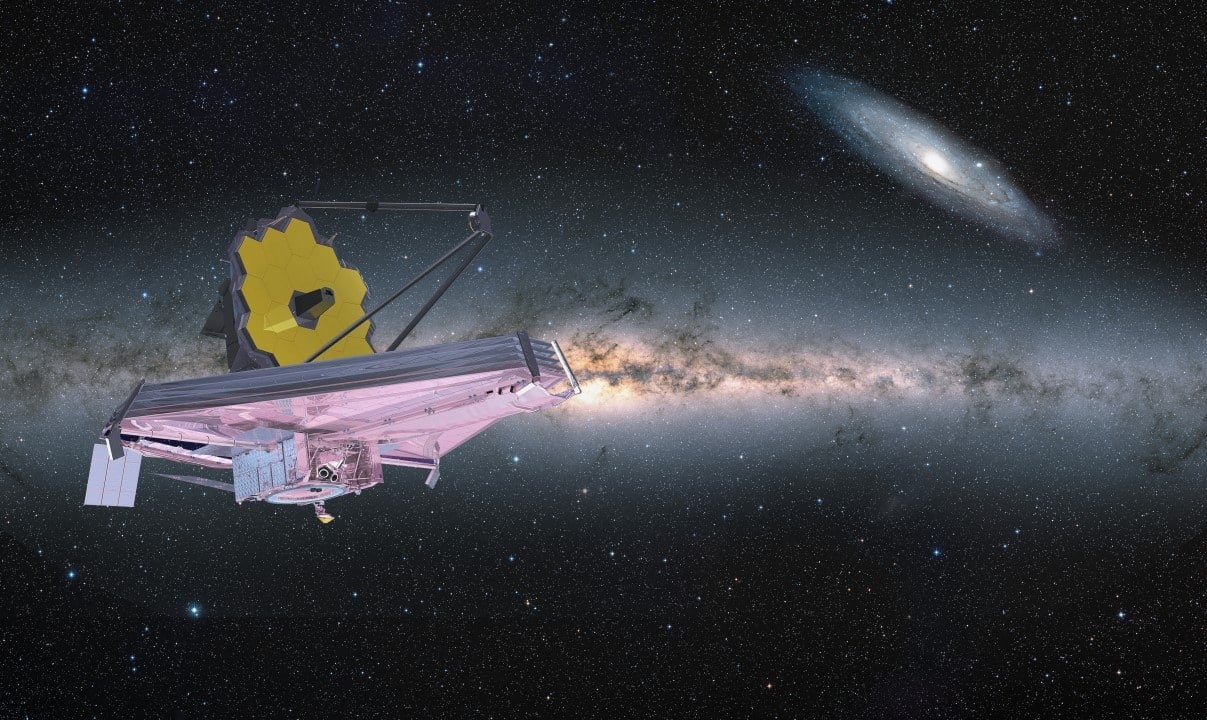
Telescópio Espacial James Webb has identified an unexpected chemical composition in the protoplanetary disk of the star XUE 10, located 5,550 light-years away from Terra. The inner region of the star system has a high concentration of carbon dioxide. Water, an element considered central in most discs ever observed, is almost completely absent in the place where rocky planets should form.
The discovery stems from precise measurements carried out by the space observatory. The finding calls into question the traditional models of planetary formation accepted by the scientific community. The data suggests that extreme stellar environments produce drastically different physical and chemical conditions than those observed during the creation of Sistema Solar.

Radiação extreme ultraviolet changes chemical composition of the system
The star XUE 10 is situated within NGC 6357, a region known as Nebulosa from Lagosta. Este stellar nursery harbors a highly turbulent and dynamic environment at Via Láctea. The site is home to hundreds of young, massive stars that sculpt the surrounding gas and dust with strong winds. The scenario contrasts sharply with the calm region where Sol developed 4.6 billion years ago.
The massive O- and B-type stars present in the cluster generate an extreme amount of ultraviolet radiation. Essa energy falls directly on the young protoplanetary disks in the vicinity. Radiation penetrates the dust structure from the outside to the inside. The process modifies the fundamental chemistry of the environment even before the grains coalesce to form planetesimals.
Molecular dynamics completely change under these harsh conditions. Water suffers a direct and rapid impact. The constant bombardment of photons breaks the chemical bonds of the primordial liquid.
- Molecular water dissociates extremely easily under the direct impact of ultraviolet radiation.
- Carbon dioxide demonstrates greater structural resistance and survives the hostile environment of the nebula.
- The physical result is a strong depletion of H₂O and an enrichment of CO₂ in the hot zone.
- The star XUE 10 amplifies the effect as it is a celestial body of the Herbig type with high luminosity.
Modelos Previous theorists did not predict such a high efficiency in the destruction of water resources in irradiated disks. The finding requires an in-depth review of the equations that describe the condensation and migration of material in deep space.
Instrumento MIRI captures rare variants of carbon dioxide
The detailed spectrum of the system was obtained using the MIRI instrument, coupled to the space telescope. The equipment operates in the mid-infrared range. Ele has exceptional sensitivity to detect specific molecules, such as carbon dioxide itself and water vapor, even at interstellar distances.
Data analysis revealed four distinct forms of carbon dioxide in the inner zone of XUE 10’s disk. Ordinary CO₂ appeared strongly in the graphs. The sensors also recorded rare isotopic variants that include carbon-13, oxygen-17 and oxygen-18.
The simultaneous detection of multiple isotopic forms represents an unprecedented milestone in the study of protoplanetary disks. Essas proportions function as true chemical trademarks of the system. Elas precisely pinpoint the exact temperature, density and radiation conditions under which the primitive material formed and evolved over time.
The equipment’s spectral resolution allowed the signatures of each element to be separated with unprecedented clarity. Sem this advanced technical capability, rare variants would go completely unnoticed by astronomers. Discos studied in calmer regions usually shows water vapor as the dominant component near the central star, but in XUE 10 carbon takes the absolute lead.
Impacto directly in the formation of rocky planets
The discovery changes the understanding of the distribution of essential elements in the universe. Most stars form in dense clusters characterized by high external radiation. Estimativas astronomical measurements indicate that between 50% and 90% of young stars experience environments very similar to that found in NGC 6357.
The statistical data points to a paradigm shift in astrophysics. Carbon dioxide-rich, water-poor Discos may represent the galactic norm rather than an isolated exception. Planetas rocks born in these systems would have initial compositions completely different from those found in Terra.
The scarcity of water incorporated in the initial phase of formation directly influences the geological development of the planet. The lack of the element affects the number of oceans that can appear on the surface. The phenomenon also changes the composition of the secondary atmospheres that form after the crust cools.
The scenario expands the scientific debate about habitability criteria in other solar systems. Terra formed in a relatively quiet and protected space bubble. If most planetary systems develop under strong radiation, rocky worlds with carbon-dominated chemistry may be the most common pattern in Via Láctea.
Astrônomos now question whether Sistema Solar’s chemistry is typical or whether it represents a particular and rare case. The answer to this question will directly affect future strategies for searching for biosignatures on exoplanets. The search for extraterrestrial life will need to consider carbon-rich atmospheres as primary targets.
Observational Programa maps nebula in search of patterns
The detailed observation of the star XUE 10 is part of the eXtreme UV Environments project. The international collaboration uses James Webb to study dozens of protoplanetary disks located within the same nebula. The central objective of the mission is to build a comprehensive comparative chemical catalog.
The researchers seek to determine whether the anomalous chemical pattern of XUE 10 is repeated in other stars in the same region. The team also looks at how the mass of the central star influences the final results. XUE 10 has a higher intermediate mass than Sol, a factor that could intensify the radiation effects observed in the data.
The team led by researcher Jenny Frediani, from Universidade and Estocolmo, continues to process the complete set of information generated by the program. Preliminary Resultados already indicate a significant chemical variation between the different disks observed in the nebula. Alguns systems show trace traces of water, while others reinforce the absolute dominance of carbon dioxide.
Additional Dados are expected to arrive at research centers in the coming months. The space telescope continues to observe previously selected targets in NGC 6357. Cada new spectrum captured helps refine computational models of chemical evolution of stellar disks.
The diversity of compositions suggests that planetary formation is a much more plastic and adaptable process than imagined in previous decades. Classical Teorias based exclusively on tranquil solar disks will need urgent adjustments to incorporate the reality of irradiated environments.
Continuous mapping of these extreme cradles helps chart the possible distribution of Terra-like planets in the galaxy. Research continues at an accelerated pace in the institutions involved. Cada new observation adds fundamental pieces to the complex puzzle of planetary formation in different cosmic contexts.