

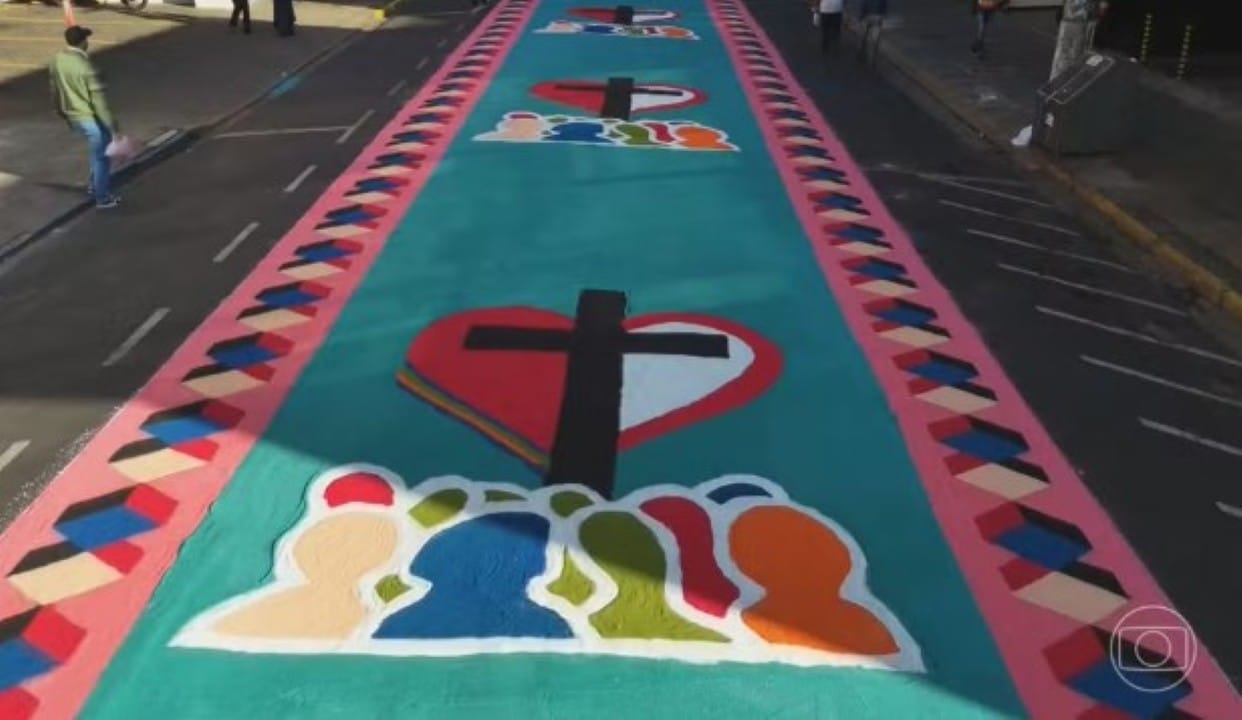
The Corpus Christi holiday, celebrated annually by Igreja Católica, will take place on June 4, 2026, marking the importance of Eucaristia to the faithful. The date, which means “Body of Cristo” in Latin, is dedicated to the solemnity of Santíssimo Corpo and Sangue of Cristo, remembering Última Ceia of Jesus with his apostles. The celebration is one of the pillars of the Catholic faith, reaffirming the belief in the real presence of Cristo in the bread and wine consecrated during mass.
Esta celebration is characterized by a series of rituals, including solemn masses, worship of Santíssimo Sacramento and processions through the streets, adorned with traditional colorful carpets. The Catholic community in several countries, notably in Brasil, is mobilizing to prepare the paths along which Santíssimo Sacramento will pass, expressing devotion and reverence. The tradition remains alive through collective participation, which ranges from children to the elderly, united by their faith.
Origens historical and theological celebration
The Corpus Christi party has its roots in Idade Média, emerging from a growing need to celebrate Eucaristia in a more explicit and solemn way. Embora to Última Ceia is celebrated on Quinta-Fair Santa, the penitential atmosphere of Semana Santa did not allow for a celebration of joy appropriate to the sacrament. Esta realization led to the desire to institute a specific celebration.
The decisive impulse for the creation of the party came from Santa Juliana of Cornillon, an Augustinian nun who lived in the 13th century in Bélgica. Juliana had visions in which a lunar disk, representing Igreja, had a dark spot, symbolizing the absence of a party dedicated to Santíssimo Sacramento. For years, she advocated the institution of such a party.
In 1246, the bishop of Liège, Roberto of Thourotte, heeded Juliana’s pleas and instituted the celebration in his diocese. Posteriormente, a Eucharistic miracle that occurred in Bolsena, Itália, in 1263, further boosted the cause. Durante a mass, a priest who doubted the real presence of Cristo at Eucaristia saw the host bleed, staining the corporal (liturgical cloth).
Esse event was investigated and recognized by Papa Urbano IV, who had previously been an archdeacon in Liège and was a friend of Juliana. In 1264, Urbano IV promulgated the papal bull “Transiturus de hoc mundo”, extending the feast of Corpus Christi to the entire universal Igreja Católica. Para the elaboration of the liturgical offices of the feast, Papa Urbano IV commissioned São Tomás from Aquino, one of the greatest theologians of Igreja, who composed hymns and prayers that are still used today, such as the “Pange Lingua” and the “Tantum Ergo”.
The institution of the feast was a milestone in the history of Igreja, consolidating the doctrine of transubstantiation and the importance of Eucharistic adoration. Desde then, Corpus Christi became one of the most significant solemnities of the Catholic liturgical calendar, reinforcing the centrality of Eucaristia as the source and summit of Christian life. The celebration offers the faithful the opportunity to publicly express their faith in the real presence of Jesus Cristo.
The moving date and its relationship with Páscoa
Corpus Christi is a moving date holiday, meaning its occurrence varies each year, although it always falls on a Thursday. Essa mobility is directly linked to Páscoa, which also has a variable date. The festival is celebrated 60 days after Domingo of Páscoa, that is, on the Thursday following the Sunday of Santíssima Trindade.
Páscoa, in turn, is defined as the first Sunday after the first full moon that occurs after the spring equinox in Hemisfério Norte (or autumn in Hemisfério Sul). Essa complex rule, established in Concílio from Niceia in 325 AC, ensures that Páscoa falls between March 22nd and April 25th.
- From the date of Páscoa, the liturgical calendar progresses:
- 40 days after Páscoa:Celebra becomes Ascensão from Jesus to Céu.
- 50 days after Páscoa:Celebra becomes Pentecostes, the coming of Espírito Santo upon the apostles.
- 57 days after Páscoa (first Sunday after Pentecostes):Celebra becomes the Domingo of the Santíssima Trindade.
- 60 days after Páscoa (Thursday after Santíssima Trindade):It’s Corpus Christi’s day.
The choice of Thursday for Corpus Christi is not random; it refers to Quinta-Santa fair, the day on which Jesus established Eucaristia during Última Ceia. Assim, Igreja dedicates a specific day outside of Semana Santa to celebrate the magnitude of this sacrament without the shadow of Paixão of Cristo. In 2026, Páscoa will be on April 5th, setting the date of Corpus Christi to June 4th. Essa systematically ensures the theological and liturgical connection between the main Christian festivals, maintaining the coherence of the liturgical year.
Tradições and rituals in Brasil and the world
Corpus Christi celebrations are rich in symbolism and tradition, varying slightly between different regions and countries, but maintaining the essence of Eucharistic devotion. No Brasil, the holiday is widely celebrated with great enthusiasm and popular participation, being one of the most visible religious events on the calendar.
The main manifestations include:
- Missas Solenes:In all parishes, special masses are celebrated before the processions, with homilies focused on the doctrine of Eucaristia and in the presence of Cristo.
- Procissões Eucarísticas:The central point of the celebration is the procession with the Santíssimo Sacramento, usually led by the priest in a monstrance (sacred vessel), through the streets of the cities. The faithful follow in prayer and songs, publicly demonstrating their faith.
- Adoração to Santíssimo Sacramento:Muitas churches promote moments of continuous worship, allowing the faithful to spend time in prayer and contemplation before the exposed Eucaristia.
- Tapetes Coloridos:Esta is one of the most striking traditions in Brasil. Entire Comunidades come together to make artistic rugs in the streets where the procession will pass. Utilizando materials such as colored sawdust, coarse salt, coffee grounds, sand, flowers, leaves and fabrics, the faithful create designs that depict religious symbols, biblical scenes and messages of faith. The making of the carpets begins in the early hours of the morning on the day of the holiday, being hard work and one of deep devotion.
- Altares and Enfeites:Além of the carpets, the streets are decorated with improvised altars, banners and other ornaments that prepare the environment for the passage of Cristo.
In other Catholic countries, the celebration also has its peculiarities. Em Portugal, the processions are equally important, with decorated streets and the participation of religious brotherhoods. Na Espanha, cities like Toledo and Ponteareas are famous for their floral carpets and grand processions, some of which attract tourists from all over the world. The tradition of decorating the streets for the passing of Santíssimo Sacramento is a common thread that connects the various manifestations of the holiday globally, reflecting the unity of Igreja in celebrating Eucaristia. The preparation of the carpets and the organization of the processions involve intense community work and a profound expression of faith.
Significado from Eucaristia for the Catholic faith
The Corpus Christi holiday exists to exalt Eucaristia, the central sacrament of the Catholic faith, considered the “summit and source” of all Christian life. Para Catholics, Eucaristia is not merely a symbol or a reminder of Última Ceia, but the real, true and substantial presence of Jesus Cristo — Corpo, Sangue, Alma and Divindade — under the appearances of bread and wine. Esta doctrine is known as transubstantiation.
Transubstantiation is the change of the entire substance of the bread into the substance of the Corpo of Cristo and of the entire substance of the wine into the substance of the Seu Sangue, only the appearances (species) of the bread and wine remaining. Esta transformation takes place at the moment of consecration, during mass, through the words of the priest and through the action of Espírito Santo. Faith in the real presence of Cristo is the heart of Eucharistic devotion and the reason why Corpus Christi is so significant.
Eucaristia is seen as the bloodless (bloodless) renewal of Cristo’s sacrifice into Cruz. By participating in Comunhão, the faithful join Cristo, receiving Sua divine life and strengthening their faith. It is also a sacrament of unity, which brings together the community around Cristo Eucarístico and a sign of the unity of Igreja.
Além Furthermore, Eucaristia is a glimpse of the heavenly banquet, the promise of eternal life. The faithful believe that by receiving Eucaristia, they are receiving the pledge of future resurrection and glorification in heaven. The feast of Corpus Christi is, therefore, a public manifestation of this deep faith, an occasion to witness the belief in the living presence of Jesus in the sacrament. Processions and worship are ways of honoring and glorifying Jesus present in Eucaristia, recognizing him as Rei and Senhor.
Impacto social and cultural Corpus Christi
Além Due to its deep religious significance, Corpus Christi has a considerable social and cultural impact on the communities where it is celebrated. Preparation for the holiday mobilizes volunteers, churches and community associations, fostering unity and teamwork. Este collective effort strengthens social ties and the feeling of belonging.
Carpet making, in particular, is a notable example of this impact. Crianças, young people and adults work side by side, often throughout the night, to create ephemeral works of art. Essa activity not only preserves a cultural tradition, but also transmits values of collaboration, patience and dedication to new generations. It is a time to share knowledge and experiences, where older people teach techniques and history to younger people.
In many cities, Corpus Christi becomes a tourist event, attracting visitors interested in appreciating the beauty of the carpets and the solemnity of the processions. Esse movement generates a small, but noticeable, local economic impact, especially for small businesses and service providers. Hotéis and restaurants may see an increase in demand, and local artisans have the opportunity to showcase their work.
The festival also serves as a moment to reaffirm the cultural and religious identity of a location. Cidades as Santana of Parnaíba (SP), Castelo (ES) and Pirenópolis (GO), for example, are known for the grandeur of their celebrations, which have become an integral part of the intangible heritage of these places. The art of the carpets and the route of the processions are distinctive elements that attract attention and recognition.
Corpus Christi, therefore, transcends the purely liturgical aspect, integrating itself into the social fabric of communities. Ele provides a space for artistic expression, social coexistence and the perpetuation of a cultural legacy that manifests itself in a unique way in each location. It is an occasion that celebrates faith and, at the same time, enriches community life, leaving a mark of beauty and devotion in the hearts of participants and spectators.
The famous artistic rugs and their production
Corpus Christi’s carpets represent one of the most visually striking and culturally rich aspects of the celebration, especially at Brasil. The making of these carpets is a manifestation of faith and popular art that transforms the streets into open-air galleries, through which the procession with the Santíssimo Sacramento will pass.
The tradition, which has European roots, was adapted and gained its own characteristics in Brasil, becoming a vibrant expression of local culture. The materials used to create these rugs are diverse and often organic and recycled, reflecting the creativity and sustainability of communities.
- The most common materials include:
- Colorful Serragem:Material predominant, dyed with anilines or food dyes.
- Sal thick:Usado to create textures and add shine, can also be dyed.
- Borra coffee:Confere dark tones and characteristic aromas.
- Areia:Colorida or natural, serves as the basis for many designs.
- Flores and leaves:Pétalas of roses, daisies and other flowers, as well as various foliage, add colors and freshness to the rugs.
- Tecidos and E.V.A.:Utilizados for details, outlines or large panels.
- Grãos and seeds:Arroz, beans, corn and other grains are used to create different textures and contrasts.
The process of making the rugs is a ritual in itself, which usually begins in the early hours of Corpus Christi day. Voluntários, in organized teams, work together to cover the streets with previously planned designs. Primeiramente, sketches are made on the floor with chalk or tape. Then, the areas are filled with materials, using sieves, molds and your own hands. Precision and coordination are essential so that the drawings are clear and the details are well defined.
The themes of the drawings are invariably religious, with representations of the chalice and host, Eucharistic symbols, biblical phrases, images of saints and elements that refer to the life of Cristo. In some cities, the carpets are so elaborate that they form gigantic panels that stretch for kilometers, making the procession experience even more memorable. The ephemeral beauty of these works of art is part of their charm, as they are undone by the passage of the procession, symbolizing the transience of life and the centrality of faith.