

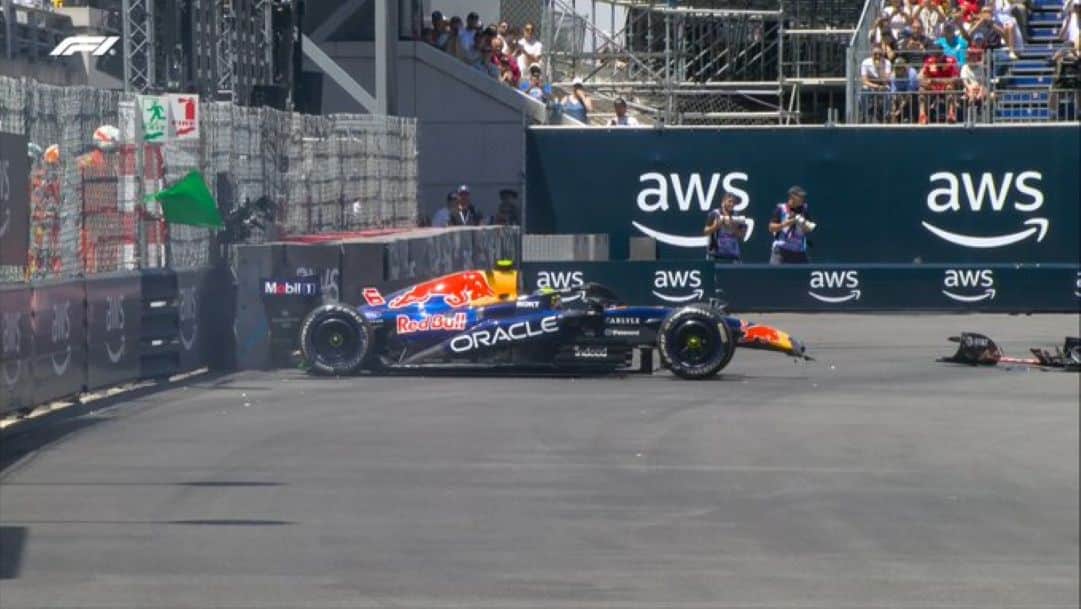
French driver Isack Hadjar suffered a serious accident this Friday morning during the first free practice session for Grande Prêmio of Mônaco. The competitor from the Red Bull Racing team lost control of the single-seater shortly after surpassing the 30-minute mark of activity on the Monte Carlo street track.
The impact against the protective barrier occurred at the exit of the Piscina complex. Este stretch represents one of the fastest and most technical points on the European urban route. The session had to be interrupted immediately by the race direction. The inspectors raised the red flag to allow the vehicle to be removed and the debris scattered across the asphalt to be cleaned.
Dinâmica of the accident on the high-speed section of the circuit
Red Bull Racing’s car jumped abruptly as it passed the inside curb at the tangent of the curve. The vertical movement completely destabilized the rear of the vehicle in a fraction of a second. Sem grip on the rear tires, the French driver became a passenger inside the cockpit itself. The car continued in a straight line towards the external protective wall. The side impact dissipated an enormous amount of kinetic energy against the metallic structure.
The team’s telemetry indicated a sudden loss of aerodynamic pressure at the time of the jump over the broker. The margin of error in the Mônaco circuit is practically zero due to the proximity of the guardrails. Qualquer oscillation in floor height compromises the ground effect generated by current cars in the category. The side impact severely damaged the structure of the car. The G-force recorded by the chassis sensors triggered security alarms at the track’s medical center.
Danos structural structures on the chassis and intensive work in the pits
The force of the collision immediately destroyed the entire suspension on the right side of the car driven by Isack Hadjar. The carbon fiber arms broke with the violence of the blow. One of the wheels detached from the hub and rolled across the asphalt track until it stopped in the escape area. The race inspectors had to collect the pieces of fairing quickly to avoid puncturing the tires of other competitors on the grid. The technical and financial loss was high for the Milton Keynes team’s garage.
The team’s engineers began a thorough assessment of the remaining components shortly after the tow truck returned the vehicle to the Monegasque pits. The main concern of technicians lies in the internal condition of the gearbox. The component received much of the energy resulting from hitting the barrier. Caso replacement of the part is confirmed by sensor data, mechanics will have to work extra hard. Assembling a new rear end requires hours of dedicated dedication from experts.
- The driver lost rear grip when touching the inner curb of the track.
- The side collision occurred exactly at the exit of Piscina’s fast S.
- The right front suspension was completely torn away from the survival cell upon impact.
- Componentes transmission internals undergo detailed evaluation by the team’s engineers.
- The track inspectors raised the red flag to completely sweep the asphalt.
The team of mechanics isolated the work area as soon as the car returned to the pit lane. The floor of the single-seater also showed deep cracks on the right side. Replacing this critical aerodynamic part takes up precious time during race weekends. The data collected in the first 30 minutes of the session was immediately transferred to the team’s base servers at Inglaterra.
Protocolos Competitor’s Safety and Physical State
Apesar due to the extreme violence of the crash on Monte Carlo’s circuit, Isack Hadjar did not suffer any bodily injuries. The young competitor demonstrated mental clarity by turning off the panel’s high-voltage electronic systems. Ele removed the steering wheel on his own and unfastened the six-point seat belts. The athlete managed to get out of the cockpit of the destroyed car without the need for direct intervention from Federação Internacional and Automobilismo doctors.
Max Verstappen’s teammate walked steadily and consciously across the asphalt escape area. Ele gave a positive signal to the packed stands, indicating that he was physically fine. The pilot entered the medical organization’s support vehicle to comply with the standard preliminary examination protocol. The integrity of the survival cell made of carbon fiber fulfilled its fundamental role. The structure prevented the Frenchman’s legs from absorbing the impact of the sudden deceleration against the metal barrier.
The halo frontal protection system also remained intact after the collision with the wall. The protective barriers absorbed part of the kinetic energy, deforming as designed by the track’s safety engineers. The quick response of the signal inspectors prevented other cars on a fast lap from being involved in a pileup in the blind section of the curve.
Impacto strategic for the weekend in Monte Carlo
The loss of track time represents a huge strategic loss for Isack Hadjar in the tightest and most demanding weekend on the calendar. The urban layout of Mônaco requires maximum mileage for the pilot to gain millimeter confidence near the walls. Sem the final minutes of the first free session, the Frenchman will begin the next training session at a clear technical disadvantage in relation to his direct opponents. The evolution of asphalt grip throughout the day could not be mapped by the competitor.
Red Bull Racing strategists will need to reorganize the entire soft tire testing schedule and race pace simulations. The focus on the affected side of the garage shifts entirely to rebuilding car number two. Mechanics race against the clock to ensure the repaired chassis is ready before the pits open for the second free session of the day. The lack of data on the wear of rubber compounds compromises planning for Saturday’s qualifying session.
The starting position on the streets of the principality defines a large part of the final result of Sunday’s race. Overtaking is notoriously difficult due to the reduced track width. The accident on the Piscina curve forces the pilot to adopt a more conservative stance at the start of the next activity. The technical team will analyze the images from the onboard cameras to understand if there was any previous mechanical failure or if the jump on the curb exclusively caused the loss of control.
Desafios urban track technicians for car configuration
The Monte Carlo circuit has unique characteristics that severely punish any piloting error. The aerodynamic configuration requires the maximum level of downforce available in the teams’ packages. The front and rear wings operate at extreme angles to ensure mechanical grip in low-speed corners. The Piscina section, however, contrasts with the rest of the route as it requires rapid changes of direction at speeds exceeding 200 kilometers per hour.
The cars’ suspension receives a specific adjustment to deal with the undulations of urban asphalt and welded manhole covers. The stroke of the shock absorbers is slightly increased compared to permanent tracks. Excessive touching of the inner curb, as occurred with the French driver, nullifies the efficiency of this mechanical adjustment. The flat bottom of the car loses its aerodynamic seal to the ground, resulting in an instant loss of directional stability.
The team is now focusing its efforts on the structural recovery of the equipment. The assembly work requires absolute precision in calibrating the new suspension’s telemetry sensors. Race management released the track after a 15-minute interruption for repairs to the protective barrier. The session timer continued to run during the red flag, reducing the useful testing time for all event participants.