

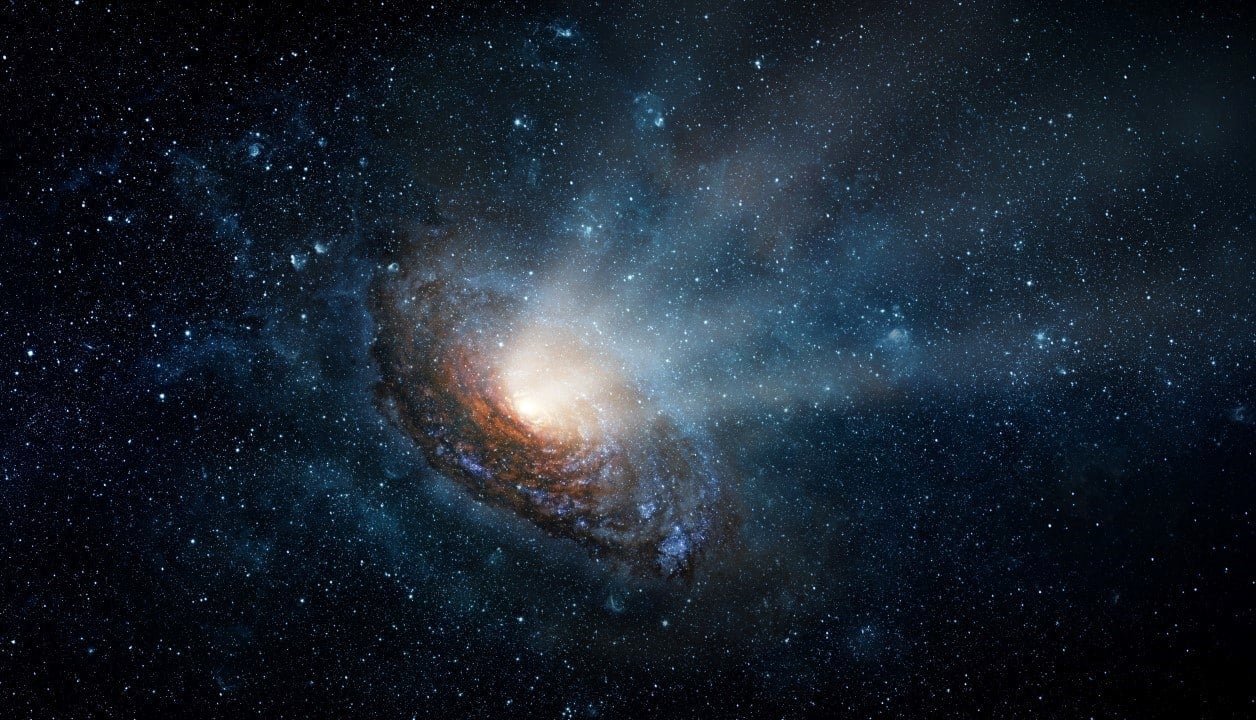
Telescópio Espacial James Webb has detected the most distant dormant black hole ever identified. The object is at the center of the MRG-M0138 galaxy, more than 10 billion light-years from Terra. The discovery makes it possible to directly measure its mass for the first time in such an ancient object.
Cientistas used natural gravitational lensing to magnify the image of the galaxy and track the movement of stars around the black hole. The study was published in the journal Science this Thursday, June 4th. The adapted technique paves the way to better understand how these objects formed and influenced galaxies in the young universe.
Buraco black idle defies conventional measurements
The black hole emits no detectable light because it is dormant, with no gas falling towards it. Isso makes you invisible at all wavelengths. Pesquisadores led by Andrew Newman of Carnegie Science adapted a method used in nearby galaxies to this extreme distance.
Gravitational lensing from a foreground galaxy cluster magnified MRG-M0138 by about 30 times. The effect allowed JWST to resolve the motion of stars in the central region of the galaxy. With this data, the team calculated the mass of the black hole to be approximately 6 billion times that of Sol.
- The galaxy MRG-M0138 appears magnified by gravitational lensing
- Estrelas orbit the central black hole with measurable speeds
- Massa determined by stellar dynamic analysis
- Técnica now viable for objects in the early universe
Essa approach bypasses the difficulty of observing inactive black holes directly.
Disrupted Stellar Formação in Ancient Galaxy
MRG-M0138 shows signs that star formation stopped abruptly in the past. Researchers suspect that an active quasar early in the galaxy’s history expelled gas needed for new stars. The process deprived the black hole of fuel and left the region quiet today.
Andrew Newman highlighted that the stars in MRG-M0138 are old. However, in other galaxies observed by JWST, star formation ceased later. The comparison helps map different rates of galactic evolution in the early universe.
The galaxy is seen as it existed when the universe was about 3 billion years old. Isso offers a window into processes that have shaped today’s cosmic structures. Equipes continues to analyze other similar objects from the telescope’s dataset.
Cosmic Lente expands view of distant objects
Gravitational lensing was essential to the success of the measurement. Sem she, JWST would not be able to resolve sufficient detail in the galaxy’s central stars. The magnification made it possible to track speed differences between stars closer and further away from the black hole.
Richard Ellis of University College London, senior author of the study, explained that the combination of JWST’s sharp vision and natural lensing allows for a more complete census of black holes over time. Futuras observations with telescopes such as Euclid and Nancy Grace Roman should identify more galaxies magnified in this way.
The galaxy cluster in the foreground acts as a powerful magnifying glass. Ele bends the light from MRG-M0138 and creates multiple enlarged images, making astronomers’ work easier. Essa configuration is rare and valuable for studies of objects in the distant universe.
Implicações for galaxy evolution in the young universe
The detection reinforces the role of supermassive black holes in regulating star formation. In MRG-M0138, the episode of intense activity appears to have accelerated the end of the star creation phase. Isso offers clues about how “dead” galaxies formed early in cosmic history.
Cientistas plan to expand the sample with more observations. The focus is on gravitationally lensed galaxies that show similar disruptions in star formation. Modelos theorists must incorporate these data to refine simulations of galactic evolution.
The stellar dynamic measurement technique, now tested at high distance, can be applied to other candidates. International Equipes continue analyzing the largest set of primordial galaxies observed by JWST last year.