

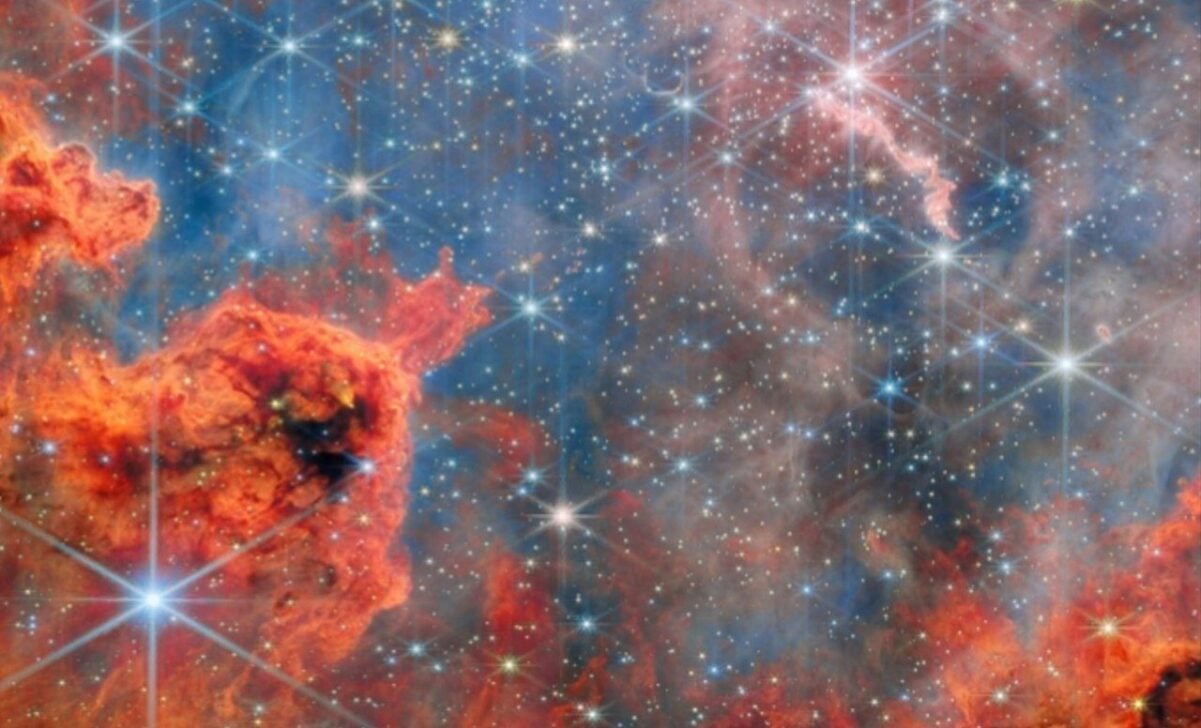
A new image released by NASA exposes Westerlund 2 in stunning detail. The star cluster is about 20,000 light-years from Terra, in the constellation Carina. Young Estrelas, between one and three million years old, appears neon pink in X-ray data from Observatório Chandra.
The composite brings together observations from Chandra with infrared images from the James Webb space telescope. Nuvens of brick-orange dust marks the raw material for new stars. The result offers an unprecedented view of a chaotic environment where star formation occurs at an accelerated pace.
Imagem combines X-rays and infrared to reveal energetic processes
Astrônomos use the combination of wavelengths to pass through dense clouds of gas and dust. Chandra records neon pink X-ray emissions, a sign of intense magnetic activity in young stars. Já or James Webb captures cooler material in red, orange, green, cyan and blue.
Essa approach allows mapping both hot, active stars and the surrounding environment. Muitos objects in the cluster are still in the early stages of development. Eles burn hydrogen and begin to influence the interstellar medium.
- X-ray Emissões indicates powerful stellar flares
- Orange Nuvens represent material for future stars
- Dados also reveals brown dwarfs in the cluster
- Imagem covers a region of approximately 12 light years
Westerlund 2 works as a laboratory to study young stars
The cluster resides in the Gum 29 region, known for high energy and rapid star formation. Massive Estrelas interact in a crowded environment, which helps to understand conditions similar to those at the beginning of Via Láctea.
Observações like this refine models of cluster and galaxy evolution. Cientistas measure temperatures, densities and radiation fields with greater precision. The work also contributes to understanding how dust can form planetary systems.
Wavelengths Multiplicidade Advances Knowledge About Stellar Nurseries
The image highlights the value of complementary observatories. The Chandra detects energetic processes invisible in other bands. James Webb penetrates dust and reveals cold structure. Juntos, they produce multidimensional view of the nursery.
Pesquisadores from the EWOCS project participate in the analysis. The combination of data makes it possible to study the influence of massive stars in the surroundings. Resultados help reconstruct the galaxy’s evolutionary history.
Detalhes capture technicians show complexity of processing
Processamento’s image involved teams from NASA, ESA and institutions such as SAO and Sejong University. Créditos include L. Frattare and K. Arcand for final treatment. The photo integrates data from multiple sources for greater scientific clarity.
Astrônomos continues to analyze the raw material. Novas publications should bring more insights into cluster dynamics. Imagens thus inspires both the public and the scientific community.
Imagem reinforces role of space telescopes in continuous exploration
Westerlund 2 offers a rare opportunity to observe stars still grouped together. Estudos from the site contributes to broader knowledge about star formation in different regions of Via Láctea.
NASA highlights that photos like this combine visual beauty and valuable data. Avanços technology promises even more detailed surveys of young clusters in the future.