

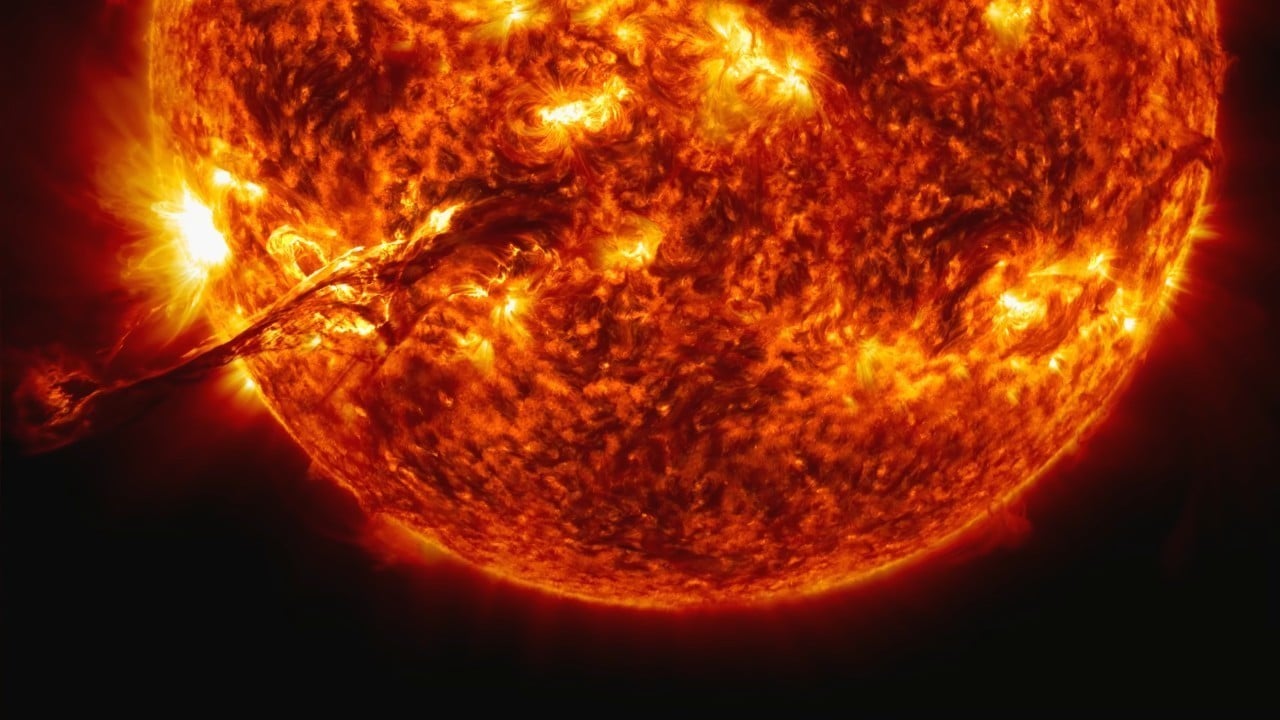
Sol released three powerful eruptions in a span of less than 24 hours. Sunspot region 4455, facing Terra, produced the events between June 2 and 3. The flares generated radio blackouts in several parts of the planet and boosted the arrival of coronal mass ejections.
Especialistas follow the displacement of plasma clouds. Pelo minus one of them should reach Terra later this week. The phenomenon increases the chances of geomagnetic storms and viewing the aurora borealis at lower latitudes than usual.
Região 4455 produces sequence of intense flares
Sunspot 4455 concentrated the star’s recent activity. The first event was an M9.3 class flare, which peaked at 9:36 pm EDT on June 2, equivalent to 01:36 GMT on June 3. Next came an M7.9 around 3am EDT. The third, class X1, the strongest possible, occurred at 7:28 am EDT.
Essas ratings indicate significant energy release. X1, in particular, represents the highest level on the scale. The unstable region remains under observation. Físicos from space warn of the high risk of new eruptions in the coming days.
- M9.3 caused a moderate R2 radio blackout in parts of Ásia Oriental and Austrália.
- M7.9 generated another R2 in portions of Europa and África.
- X1 caused strong R3 in areas of Europa and Ásia.
Blecautes radio affect communications
The flares interfered with radio transmissions on Terra’s illuminated face. Operadores of communications systems, aviation and emergency services recorded temporary outages. Nenhum structural damage has been reported so far, but the impact highlights the vulnerability of radio frequency signal-dependent technologies.
Agências space monitoring agencies, such as NOAA, track the effects in real time. The intensity varied depending on the location and time of the events. Técnicos evaluate possible repercussions on satellites and electrical networks.
Coronal mass Ejeções heads towards Terra
Cada eruption may have released coronal material. Analistas confirm at least a rapid and faint ejection associated with M9.3. Outras two are under evaluation for direction and speed. Modelos indicate that the structures can combine during the journey.
Arrival is scheduled for the late afternoon of June 4th, Brasília time, with effects extending until June 5th or 6th. Interaction with the Earth’s magnetic field can generate storms of intensity G1 to G3. Há isolated chance of G4 in stronger scenarios.
Previsão of northern lights in mid-latitudes
Tempestades geomagnetic waves energize the auroras. Observadores in polar regions are already preparing for intense displays. Under favorable conditions, the phenomenon may descend to the north of Estados Unidos, Canadá and parts of Europa. Clean Céus increases viewing chances.
Auroran Caçadores, like Vincent Ledvina, reports multiple ejections possibly targeting Terra. The combination of events raises the potential for vibrant colors in the night sky. Especialistas recommend locations away from light pollution.
Região 4455 Maintains Magnetic Complexity
Sunspot 4455 exhibits unstable beta-gamma configuration. Essa characteristic favors the release of accumulated energy. Físicos like Tamitha Skov highlight the growth in complexity. The risk of X flares persists for the next 72 hours or more.
NASA’s Imagens of Observatório of Dinâmica Solar captures the details of the eruptions. The activity is part of solar cycle 25, which is approaching its peak. Cientistas monitors Sol continuously to anticipate impacts.
Solar activity affects multiple sectors. Operadoras of satellites set protocols. Companhias airlines review polar routes. Usuários GPS and radio amateurs receive preventive guidance. Monitoring continues over the next few hours.
Impactos Potentials and Recommendations
Tempestades geomagnetic waves in G3 can cause fluctuations in power grids and orientation problems in spacecraft. Satélites face risk of surface loading. However, events of this magnitude rarely trigger widespread outages.
Cientistas encourage the public to observe the sky. Aplicativos and aurora forecast websites help identify visibility windows. Fotógrafos should use long exposure settings in dark environments.
Region 4455 remains highlighted. Novas eruptions could change the scenario. International Equipes share real-time data to refine forecasts.