

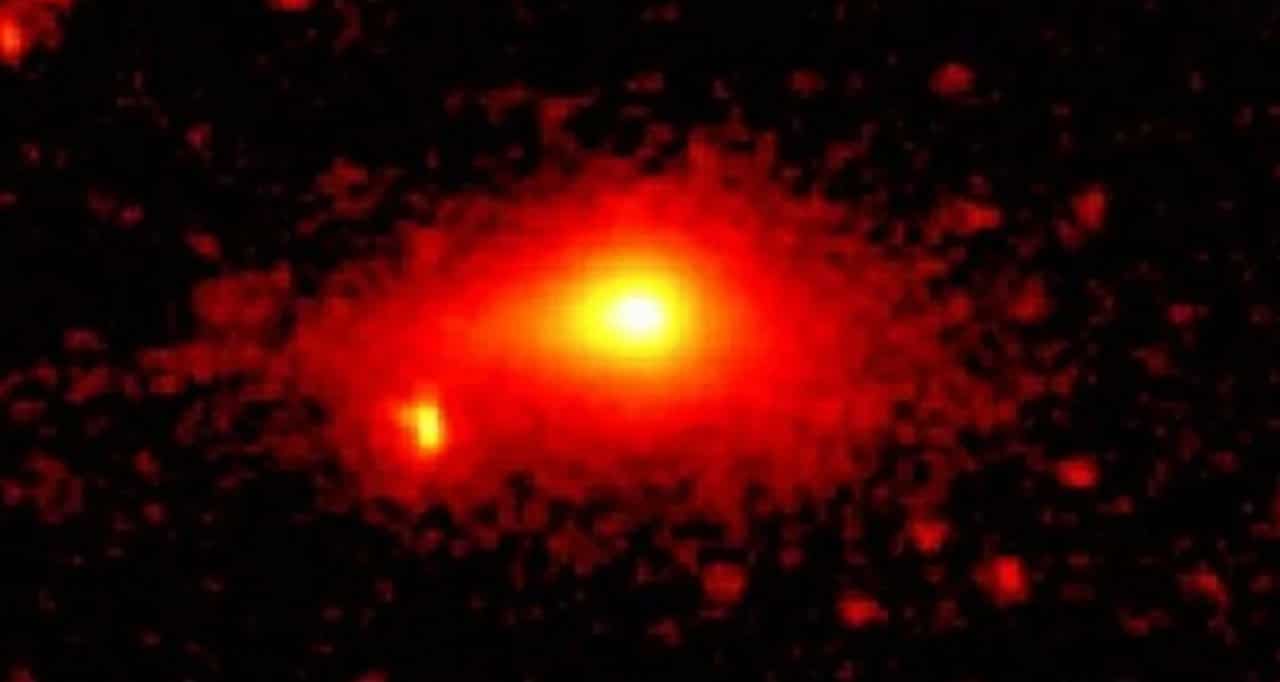
Telescópio Espacial James Webb identified the presence of methane in the interstellar comet 3I/ATLAS during its passage through our system. The detection marks the first record of this specific gas on a celestial body originating outside our cosmic neighborhood. The equipment captured chemical signatures in the mid-infrared region. The analyzes took place weeks after the object’s perihelion. The visitor was already on a trajectory away from the Sol at the time of the measurements.
Data collected by the MIRI instrument revealed significant changes in gas production as the celestial body traveled through space. The release of volatile materials highlighted profound chemical differences when compared to traditional Sistema Solar comets. Solar heat needed to penetrate the innermost layers of the core to activate methane sublimation. Pesquisadores noted that the heating dynamics changed the composition of the comet’s coma over the days.
Observações of the MIRI instrument millions of kilometers from Sol
The team of astronomers directed James Webb’s sensors to 3I/ATLAS initially between December 15 and 16, 2025. The comet sailed at a distance of 330 million kilometers from Sol in that time window. Problemas punctual technicians during two sessions forced scientists to program new capture attempts. The repetitions took place successfully on December 27th. The target had already moved even further away and reached 380 million kilometers from the central star.
The images obtained on these dates delivered a significant volume of unprecedented information about the thermal behavior of the object. The comet’s perihelion occurred on October 29, 2025. The extreme heating generated by the closest approach drove the ejection of dust and gases into space. The matter release process already showed signs of slowing down during the December observations. The thermal inertia of the core maintained active activity even with the drop in direct solar radiation.
The equipment tracked the presence of water vapor expanding at great distances from the comet’s center. Grãos of microscopic ice present in the coma underwent the process of continuous vaporization. The water vapor production rate registered an abrupt drop in the interval between mid- and late-December measurements. The celestial body crossed the so-called snow line at that time. Temperatures in this region of space drop to a point that forces water ice to refreeze.
Dinâmica of gases and the first detection of methane
The chemical signature of methane became evident only in the phase after the point of closest solar approach. The behavior differs radically from the two interstellar visitors previously cataloged by science. The objects 1I/’Oumuamua and 2I/Borisov did not present detectable emissions of this compound during their passages. The initial absence of gas in 3I/ATLAS indicates that the material remained isolated in deep pockets. The heat wave needed weeks to penetrate the crust and reach these internal reserves.
A group of researchers led by scientist Matthew Belyakov, linked to the Caltech institute, took responsibility for publishing the results. The team identified a pattern of delays in the production of specific compounds. Carbon monoxide accompanied methane in this delayed release dynamic. The concentration of carbon monoxide experienced a significant jump and increased 40 times in relation to carbon dioxide levels throughout the month of December.
The high proportion of methane in comparison to the amount of water ejected caught the attention of experts involved in monitoring. Carbon dioxide also presented levels that were unusual for known astronomical standards. The abundance rates of these elements break the rules observed for icy bodies orbiting Sol. The chemical discrepancy suggests a formation environment with unique physical characteristics. The stellar system that gave rise to the object had a very particular distribution of volatile elements.
- Water vapor production dropped dramatically as Sol’s thermal influence lost strength.
- Carbon dioxide maintained a constant level of activity by virtue of its lower vapor pressure.
- Methane emerged only when residual heat reached the deeper layers of the rocky core.
The fragmentary outgassing behavior provides an indirect map of the comet’s internal structure. Elementos with different sublimation points react at different times during space travel. Reading these delays allows you to calculate the thickness of the outer protective layer. Thermal analysis confirms that the celestial body has a complex geological architecture.
Origem in distant star system and primordial formation
3I/ATLAS carries the title of third object of interstellar origin with official confirmation from the astronomical community. The hyperbolic trajectory of the celestial body ensures that it will not be trapped by the gravity of our system. The comet is currently following an exit route towards deep space. James Webb’s spectroscopic readings act as a direct probe into primordial matter from another corner of the galaxy. The space rock acts as a chemical time capsule.
Estimativas based on isotopic composition and orbital dynamics point to an extremely old age. The material that makes up the core possibly formed between 11 and 12 billion years ago. The dust and ice aggregated there represent the building blocks of planets that orbit other stars. The study of this pristine matter offers real parameters to test theories of stellar evolution.
Photometric measurements have established limits on the physical size of the interstellar visitor. The diameter of the rocky core does not exceed the one kilometer mark in the most conservative estimates. The high-resolution images show intense activity in the coma around this small central structure. The equipment also detected the presence of nickel in a vapor state mixed with other gases. The metallic finding confirms previous observations made by ground-based telescopes.
Mapeamento chemical and technological importance of the telescope
The MIRI instrument generated detailed maps of the chemical signatures present in the cloud of gas and dust. The composite images reveal the exact spatial distribution of water, carbon dioxide and methane. Dispersion dynamics vary according to the molecular weight and volatility of each substance. The water forms a broad halo that spreads around the outer edges of the coma. Methane and carbon dioxide form a dense, concentrated cloud near the nucleus.
The accuracy of the data reinforces the irreplaceable role of James Webb in contemporary astronomy. The sensitivity of infrared sensors allows you to see through cosmic dust with absolute clarity. Telescópios of previous generations did not possess the technical capability to separate these molecular emission lines. The space observatory has opened a direct observation window into the chemical processes that shape the galaxy.
Centros research teams around the world maintain continuous monitoring of 3I/ATLAS during its departure voyage. The gradual retraction reduces the brightness of the object and requires increasingly longer exposure times on the telescope lenses. Novas rounds of observation can capture the exact moment when cometary activity ceases completely. Monitoring the freezing phase delivers the last piece of the thermodynamic puzzle.
Implicações for planetary formation models
The delayed release of methane raises hypotheses about the comet’s violent past in its home system. The current structure suggests that the celestial body lost its outer layers before beginning the interstellar journey. A severe warming event in the past depleted all available surface methane. Apenas the protected reservoir in the deep core survived ejection from its parent system. The heat from our Sol only served as a secondary trigger for this old reserve.
The observed sublimation dynamics mirror the physical behavior of carbon monoxide in a vacuum. Ambas substances share the characteristic of having an extremely low vapor pressure. Essa chemical property allows gases to remain active even at considerable distances from the heat source. The comet’s cooling does not immediately stop the release of these elements.
The set of data collected by James Webb forces the scientific community to refine current theoretical models. The chemistry of 3I/ATLAS proves that comet formation does not follow a universal recipe across the galaxy. The molecular abundance patterns in our cosmic backyard represent just one of many possible configurations. The crossing of information between different interstellar visitors builds an unprecedented catalog of the chemical diversity of the universe.