

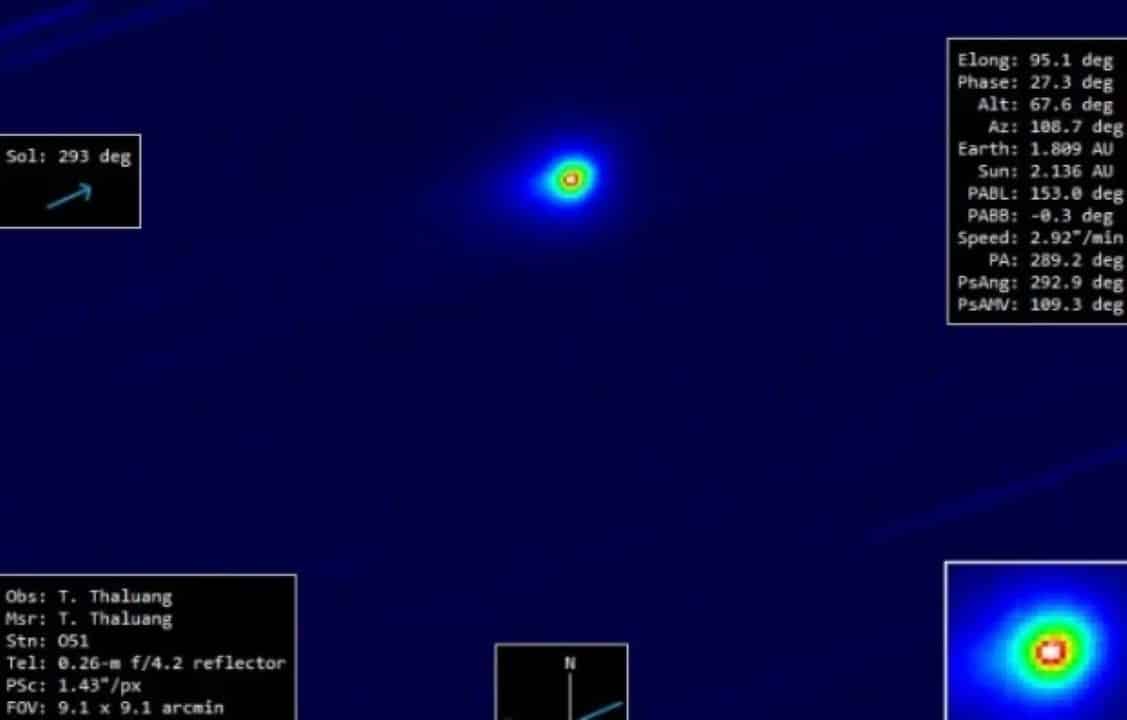
The Instituto SETI team of astronomers has completed an extensive radiofrequency scan aimed at comet 3I/ATLAS. The celestial body represents the third visitor from outside Sistema Solar already confirmed by scientists. Utilizando the structure of Allen Telescope Array, researchers looked for any hint of transmissions that could indicate the presence of extraterrestrial technology. The observation campaign lasted more than seven uninterrupted hours. The equipment covered a very wide frequency range, between 1 and 9 gigahertz. The data collected did not reveal any anomalies of artificial origin.
The result of the investigation was published in a detailed article in the magazine The Astronomical Journal. The analysis reinforces the scientific consensus that the object is a natural comet, formed in the depths of another star system before being ejected into interstellar space. The ATLAS system, located on Chile, performed the initial detection of the celestial body in July 2025. The object’s extreme hyperbolic trajectory and unusual speed served as definitive proof of its external provenance. The astronomical community quickly mobilized resources to study the phenomenon before it moved away from Sol.
Processamento data and terrestrial interference filtering
Durante hours of continuous observation, the receivers captured a massive volume of raw information. The team recorded nearly 74 million narrowband signals throughout the scan. Esse high number reflects the sensitivity of modern instruments and the amount of electromagnetic noise present in the space environment close to Terra. Técnicas advanced computational filtering kicked in to clean the data. The main objective was to separate possible genuine emissions from interference generated by communications satellites and terrestrial networks.
The process of elimination reduced the initial pool to a narrow group of approximately 211 promising candidates. Esses specific signals required a thorough visual examination in the time-frequency domain by experts. Detailed analysis revealed that all energy spikes corresponded to already cataloged human sources. Our planet’s radio frequency environment creates constant false positives during deep astronomical surveys. The ability to accurately rule out these interferences demonstrates the maturity of the data processing algorithms used in radio astronomy facilities.
Características physics confirm natural origin of the celestial body
The behavior of 3I/ATLAS during its passage through the inner Sistema Solar followed the pattern expected for icy bodies. The object developed a visible coma composed of gas and dust as solar radiation heated its surface. Complementary Observações performed at multiple wavelengths attested to a composition rich in volatile elements. The reddish color detected in the first records and the emissions of specific molecular lines consolidate the profile of a traditional comet. The perihelion, the point of closest approach to our star, occurred in October 2025.
Nesse moment of maximum approach, the visitor was approximately 1.356 astronomical units away from Sol. Telescópios optical, infrared and radio telescopes from different countries followed each stage of this journey. Cross-referencing data from different observatories eliminated any room for speculation about the nature of the body. The comet did not show anomalous non-gravitational accelerations, a factor that could raise suspicions about artificial propulsion systems. The core’s tentative rotation was calculated to be approximately 16.79 hours. Esse constant spin fits perfectly with the physical parameters documented in other objects of the same type.
Fast search Metodologia and set power limits
The agility of the scientific response marked a turning point in the observation of transient phenomena. The antennas began tracking the target less than 24 hours after the discovery was officially announced. Sofia Sheikh, the researcher who led the work, emphasized the need to subject all interstellar visitors to systematic scrutiny. The absence of prior suspicions should not prevent the application of rigorous protocols to search for technosignatures. The window of opportunity to study these bodies in detail is often extremely short.
The study defined important technical parameters for future investigations of the same type. Scientists established an upper limit of radiated power that ranged from 10 to 110 watts at the monitored frequencies. Essa amount of energy is similar to the consumption of common household appliances found in homes. The research adopted specific criteria to guarantee the accuracy of the results obtained:
- The systems applied continuous Doppler corrections to compensate for the object’s rapid movement in space.
- The scan prioritized narrowband signals as they are the most likely indicators of intentional technology.
- Nenhum of the initial candidates survived the final verification step against the interference database.
- Calibration of the instruments ensured the detection of extremely weak emissions coming from the direction of the comet.
The ability to detect such low levels of energy at astronomical distances proves the effectiveness of current infrastructure. Valeria Garcia Lopez, co-author of the research, pointed out that detecting real artifacts is a realistic scenario with the technology available today. The team works on the premise that Earth probes, like the Voyager missions, will eventually cross other star systems in the distant future. Compreender population of natural rocks and comets facilitates the identification of technological anomalies that may cross our path.
Visitor Histórico and the future of radio astronomy
The arrival of 3I/ATLAS adds a fundamental chapter to the study of wandering celestial bodies. The history of detections began with 1I/’Oumuamua in 2017 and continued with 2I/Borisov in 2019. Cada new visitor provides crucial pieces to refine theoretical models on the formation of planetary systems in the galaxy. The current comet has already delivered valuable data on the abundance of specific chemicals. The proportions of methanol and heavy water found in the ejecta show notable differences compared to comets originating at Nuvem from local Oort.
Allen Telescope Array operated from Observatório of Rádio of Hat Creek, located in Califórnia, to guarantee the necessary spectral coverage. The development of a new data processing pipeline made it possible to handle information much more efficiently than in previous campaigns. Negative Resultados in searches for artificial signals have great scientific value. Eles helps define clear boundaries for hypothetical broadcasts and calibrates expectations for upcoming events.
The global astronomical community will continue to monitor the celestial body as it travels back into deep space. Novas observations scheduled over the next few months will attempt to capture the latest details of its chemical composition and physical structure. The absence of technosignatures maintains coherence with all the evidence accumulated by science to date. The methodological protocol established by this research will serve as an immediate operational basis once the fourth interstellar visitor is detected by sky-scanning telescopes.