

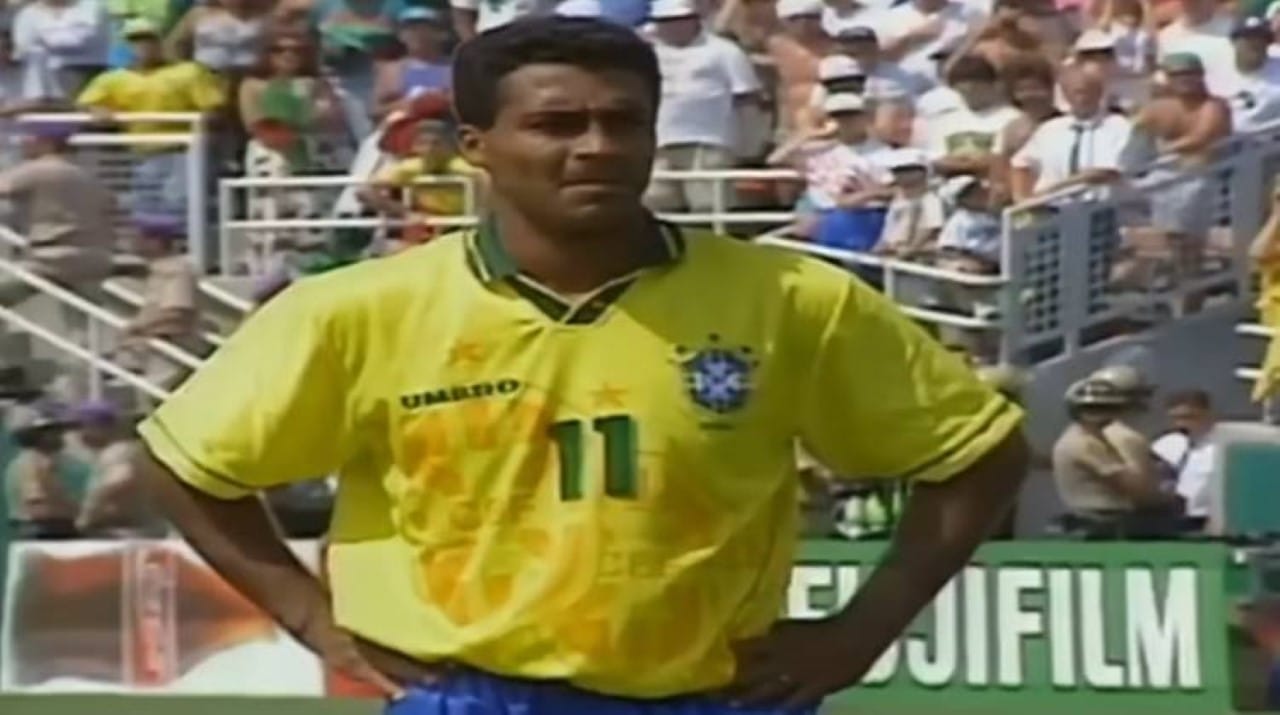
It was a scorching summer. A period of sun-drenched stadiums, sold-out tickets and striking uniforms, of individual brilliance and iconic goals, where events off the field resonated as much as the drama on the pitch. An event of stars, stripes and celebrity glamour, where football’s biggest stage took on a Hollywood glow.
It was the summer that “soccer” arrived in the United States, landing on an American glitz track, welcomed by famous faces of all genres – from Stevie Wonder to Robin Williams, Oprah Winfrey to Diana Ross.
“We created the impression that it was an unmissable event, and that people needed to get involved,” recalls Alan Rothenberg, former president of the American soccer federation. “The way we organized the entire World Cup changed everything.”
This is the story of the 1994 World Cup in the USA, a football summer that awakened a continent.
The draw and a dose of Hollywood glamor
Just nine years earlier, the country’s only professional league had gone bankrupt, ending a glamorous decade for the North American Soccer League that began with the New York Cosmos paying legendary Brazilian Pelé a world-record salary to bring him out of retirement in 1975.
Franz Beckenbauer, Carlos Alberto and Johan Neeskens followed the Brazilian to the packed Giants Stadium, where Bugs Bunny was the mascot and stars such as Barbra Streisand, Mick Jagger and Muhammad Ali mingled in the locker rooms with players and presidents.
George Best, Johan Cruyff, Gerd Muller. A wave of football greats crossed the Atlantic before over-expansion, excessive spending and falling attendance – coupled with the USA’s failure to host the 1986 World Cup – saw the Champagne era lose its luster.
However, he left embers of passion for the sport, enough to convince FIFA that the United States was still fertile ground for expanding the popularity of football, deserving to be the first nation outside of Europe or Latin America to host the sport’s main event.
This came with one condition: creating a new professional football league.

FIFA wanted Major League Soccer to start alongside the World Cup. Rothenberg – full of ideas for Americanizing the game, such as allowing players to circle the posts like in ice hockey – convinced then-FIFA general secretary Sepp Blatter that the league would be launched if the tournament was a success.
The first signs of the shine that the USA wanted to bring to the World Cup appeared during the draw at Caesars Palace, in Las Vegas. James Brown and Smokey Robinson performed, while comedian Robin Williams wore a surgical glove to draw the selections and joked with Blatter.
There was a week of shows at the iconic Hollywood Bowl, with everything from the Moscow Symphony Orchestra to the Red Hot Chili Peppers. Celebrities were taken to every possible event – Stevie Wonder, Enrique Iglesias, Barry Manilow, Liza Minnelli, Bryan Adams, even boxers Evander Holyfield and Oscar De La Hoya took part in the promotional tour.
“We didn’t think there was much awareness or interest in the World Cup in the US,” Rothenberg tells BBC Sport. “What we knew is that Americans love a big event, so we surrounded ourselves with celebrities and artists.”
“We did a lot of things that had never been done before. And it worked.”
An American dream that started in a trailer
The World Cup may have been dusted with stardust, but when Rothenberg arrived as president of the US soccer federation and then as chairman of the organizing committee, he found a volunteer-run “mom and pop” organization with no football infrastructure, operating out of a trailer rented free of charge by the US Olympic committee in Colorado Springs.
They took advantage of the World Cup to attract sponsorship and better facilities, and asked the host cities for first-class services, from transport and security to stadiums ready to fill. As Rothenberg remembers telling the mayor of Chicago, who had hosted the Pope the previous year: “More people care about the World Cup, so I expect the same treatment.”
The USA also needed to grow on the field. The team qualified for its first World Cup in 40 years in 1990, but lost every game.
“The presentation was pretty disastrous,” says Rothenberg. “We had to figure out how to make the team believable because if we fell flat on our face, it would increase the skeptics. We were so disrespected in terms of ability.”
Of those who formed the 1994 squad, seven played abroad, the rest were college or local league players under central federation contracts, under the guidance of experienced Serbian coach Bora Milutinovic, who had managed Mexico and Costa Rica in World Cups.
Milutinovic practically pursued the job on his own, tracking down Rothenberg assistant Steve Sampson in San Jose and insisting on being hired. In 1991, the nomadic coach, who American defender Alexi Lalas described as a mix of “Yogi Bear and Yoda”, beat out Rinus Michels and Carlos Queiroz for the job.
Milutinovic led the national team like a club team – setting up a 16-month residency outside of Los Angeles, where every training session included football and tennis. They played more than 90 games in three years before the tournament, beating Graham Taylor’s weak England in the 1993 US Cup. The “international football joke”, criticized the Independent.
Wales agonizingly missed out of the tournament. Scotland, Northern Ireland and England also did not qualify, and Rothenberg wrote in his book ‘The Big Bounce: The Surge That Shaped the Future of US Soccer’ that authorities were relieved not to have “UK hooligans arriving through the airports to wreak havoc”.
Oprah, OJ and the grand opening
The United States was experiencing a time of cultural change. The world had lost Kurt Cobain shortly before, Michael Jordan played baseball in the minor leagues and “soccer” needed to compete with a string of summer blockbusters – Forrest Gump, Speed, The Mask. The Lion King premiered on the day Brazil beat Cameroon 3-0, with Romário and Bebeto as the protagonists of their own blockbuster.
Oprah Winfrey received a worldwide audience of 750 million at the opening ceremony at Soldier Field in Chicago, but ended up falling on stage. Diana Ross kicked a penalty wide and the goalposts collapsed anyway, and Germany’s 1-0 victory over Bolivia became a footnote that night as squad cars chased O.J. Simpson for nearly two hours in a slow-moving manhunt through California.
Italian goalkeeper Gianluca Pagliuca and his teammates watched from the Somerset Hills Hotel in New Jersey as they prepared to face the Republic of Ireland the following day.
“We were shocked, and I remember it very clearly,” he recalls. “We saw the entire chase live on TV. It felt like watching a movie – something almost unreal. We were all glued to the television.”
The Azzurri received a warm welcome in New Jersey from a large Italian diaspora who followed their every move. “It was really wonderful,” adds Pagliuca. “There were always security guards controlling the situation because there were so many Italians living there who came to ask for photos and autographs.”
The Irish were undeterred by what was expected to be a predominantly Italian crowd, nor by the weather – some players lost eight to nine pounds in sweat-soaked training sessions – although coach Jack Charlton and striker John Aldridge had heated exchanges with the line officials later in the tournament.
“On the bus on the way to the stadium, we only saw Irish flags and shirts, which gave us a lot of hope,” Ray Houghton told BBC World Service Sportsworld.
Among them was future U.S. women’s national team star Heather O’Reilly, a nine-year-old girl inspired by a World Cup on her doorstep.
“With a name like O’Reilly, you can imagine the excitement of supporting Ireland,” adds the player with 230 caps. “I remember people doing potlucks in the parking lot, cooking food, listening to the drums – the whole occasion had a huge impact on me.”
Houghton’s curling volley secured a shock 1-0 victory at Giants Stadium, even though he almost came onto the pitch in the wrong kit – in the tunnel, Italy were also wearing white.
“We all looked at each other, saying ‘well, one of us is wrong, who is it?’” he explains. “We found out it was us. We had to run back. You can imagine Jack Charlton complaining to the wardrobe about making a mistake! It really calmed us down. We came out laughing and joking for the national anthems.”
The United States, in turn, debuted with a 1-1 draw against Switzerland. Eric Wynalda – with patriotic stars on his blue denim uniform – took a free kick from the corner after night practices under the roof of the Pontiac Silverdome, where the squad watched a motivational video.
“I asked the equipment manager to bring my cleats and some balls,” says Wynalda. “I wanted to see if I could take some free kicks. They both just flew. I thought, ‘man, the ball behaves differently in this stadium’.”
The roar when Wynalda’s shot came in made him feel “electric”, and when he returned to the hotel afterwards, one of his idols, who was on the broadcast, was waiting at the bar: “Chris Waddle waves at me and says ‘you’re paying for the next rounds here!’.”
Journalist Ledio Carmona, who followed Brazil at the tournament, found a “curious interest” among the American public. “There was a certain exoticism in their eyes”, he explains. “Like, what is this fascination that captivates so many people with this sport?”
Rothenberg says FIFA officials were “gobsmacked” by the large crowds: “I remember Sepp Blatter calling me, it was a group stage game and it was packed, he was just amazed.”
Maradona’s departure and the Colombian tragedy
The relentless Gabriel Batistuta scored a hat-trick as Argentina, who qualified via play-offs against Australia, flew early with a 4-0 victory over Greece. But the other goalscorer’s participation was the real story.
Diego Maradona served a 15-month ban after testing positive for cocaine in March 1991. He was overweight and out of shape when he returned, first at Sevilla and then briefly at Newell’s Old Boys, and looked unlikely to reach the World Cup before he entered a rigorous personal training regime, lost 12 kilos and declared: “I’m tired of everyone saying I was fat and no longer the great Maradona. They will see the real Diego at the World Cup.”
The 33-year-old’s sublime goal against Greece was a snapshot of his glorious past – quick exchange of short passes on the edge of the box, two subtle touches to create space and a left-footed shot into the corner. The celebration was even more iconic, running towards the camera and roaring at the lens – mouth open, eyes wide.
That would be Maradona’s last goal for Albiceleste, with the little wizard’s final act setting up Claudio Caniggia’s brace in a 2-1 win over Nigeria in the next game.
“I had to mark him man by man”, remembers Nigerian Sunday Oliseh. “I’ve never seen a player control the ball like that. He made the difference – pure genius.”
The Argentine Cup was thrown into chaos when Maradona presented urine samples from the game with traces of banned substances. He claimed innocence – his personal trainer bought the wrong supplement, Ripped Fuel, instead of the usual Ripped Fast. But the nation’s favorite son was suspended before the final group stage match.
“Diego was desperate, he was destroyed, he started crying, he locked himself in his room and didn’t want to talk to anyone,” Dr. Roberto Peidro, from the Argentine medical team, told BBC’s Sporting Witness, comparing the atmosphere in CT to “a funeral”.
Argentina were one of the favorites before Maradona’s suspension, but lost to a Hristo Stoichkov-inspired Bulgaria in Dallas and then fell in the last 16 to another surprise side, Romania.
It was Colombia, however, who qualified automatically after beating Argentina 5-0 in Buenos Aires the previous year – which inflated expectations for their chances in the USA. Pelé, Johan Cruyff and Arrigo Sacchi pointed to the Colombians as possible champions.
With their blue shirts reversed in Pasadena, Colombia also stumbled against Romania in their debut – Gheorghe Hagi surprised goalkeeper Oscar Córdoba, who had replaced René Higuita after his arrest the previous year.
Amid death threats to coach Francisco Maturana over the lineup, sent via TV screens at the team’s hotel and attributed to the country’s drug cartels, Colombia faced a fledgling US team next.
The task became tougher when defender Andrés Escobar sent the ball into his own goal in the first half. Earnie Stewart doubled for the hosts in front of nearly 94,000 fans at the Rose Bowl before Adolfo Valencia’s late consolation. The Cafeteros beat Switzerland in the last round, but were eliminated.
Upon returning to Colombia, Escobar wrote a column in El Tiempo saying: “Life doesn’t end here.” However, just 10 days after the own goal, the 27-year-old was shot dead outside Bar El Indio in Medellín following an argument in the car park.
It was portrayed as a revenge killing. Others, including coach Maturana, felt that Escobar was an unfortunate victim of Colombia’s violent society at the time. It proved to be a tragic end to the golden era of Colombian football.
A glorious exit for the hosts
Not only did the USA advance from the group, they also won an attractive round of 16 clash against Brazil – the excitement only grew because it would be played on July 4th.
“That was a war”, remembers journalist Carmona. “The Americans gave everything they could to win on Independence Day and the game was dramatic. A typical World Cup duel.”
Leonardo was sent off for elbowing American midfielder Tab Ramos late in the first half – the impact, Ramos said, made him feel like he was going to die, but coach Milutinovic tried to put him back in before doctors intervened and the remorseful Brazilian visited him in hospital afterwards.
“I came in as Tab’s replacement,” says Wynalda. “I didn’t know if he was going to survive that. He was terrible. He’s a great friend, and it was really difficult. We left the field really quickly, and the first question was ‘how’s Tab? Is he okay? Is he still with us?’ We were really worried.”
The home team resisted until Bebeto scored in the final minutes. For thousands of flag-waving American fans, it was a glorious exit, proof that the US had a credible team.
“As sad as we were, we went to an event right after the game and Robin Williams was there,” adds Wynalda. “In 30 seconds he made us laugh and forget. It just reinforced how proud he and America was of what we had done.”
For Rothenberg, the clash was “a turning point for soccer” in the USA. “Everyone knows the colorful enthusiasm of Brazilian fans. [But] there were an equal number of American fans with painted faces, waving flags, dancing in the streets.”
“That’s when I thought, ‘You know, we’ve become a soccer nation.’ I think it’s been like that ever since.”
Italy, meanwhile, progressed from the group in third place after the four teams finished level on points. Pagliuca received a two-game suspension for his expulsion against Norway – the first goalkeeper to be sent off in a World Cup –, which is why he missed the extra-time victory in the round of 16 against Nigeria.
Substitute Luca Marchegiani did well, leaving Pagliuca wondering if his tournament was over. He was in his hotel room watching golf with teammate Roberto Donadoni when assistant Carlo Ancelotti stopped by to confirm that the goalkeeper would return against Spain.
“For me, the World Cup really started that night,” says Pagliuca. “At dinner, I was obviously very happy, but I couldn’t show it.”
“Afterwards, we used to walk to digest. While I was smoking a cigarette, Marchegiani came and asked if I knew anything. I felt bad, but they had asked me to keep it a secret.”
The icons that defined a summer
The football summer of 1994 was shaping up to be one for iconic individual performances. Hristo Stoichkov guided Bulgaria to the semi-finals with six goals, sharing the Golden Boot with Russian Oleg Salenko, who scored five in a single game against Cameroon.
“Stoichkov was an exceptional player, very unique,” says Pagliuca, whose Italy ended the Bulgarian campaign that included eliminating champions Germany. “He was at the peak of his career and very dangerous, but we marked him extremely well.”
Stoichkov won the Ballon d’Or that year, but Italy had its own hero in Roberto Baggio. Divino Rabo de Cavalo was the one sacrificed when Pagliuca was sent off against Norway in the group stage, but he inspired the Azzurri in the knockout stages.
Baggio equalized late against Nigeria in the round of 16 and then qualified Italy on penalties in extra time. He dribbled past Andoni Zubizarreta to score in the final minutes against Spain in the quarters and produced two magical goals in the semi-finals against Bulgaria at Giants Stadium.
“From the round of 16 onwards he exploded and carried us to the final. He scored incredibly important goals”, recalls Pagliuca.
“He was not only a great player, but also a genuinely good person. He had a sunny personality, very playful, always joking and laughing – perfect for the locker room. We had a great group. We felt good together.”
On the other side of the bracket was the talented Romanian Gheorghe Hagi who, after leaving Real Madrid for Brescia, spent the season in Serie B and was unhappy with the club for turning down a transfer to replace Maradona at Napoli.
“The motivation of the World Cup made him reinvent himself. Out of nowhere, he started training harder and better than everyone else”, recalls Romanian journalist Emanuel Rosu.
“He said it was a ‘bomb’ before the Romanians’ trip to the USA, such was the preparation. He told people around him that Romania could win the tournament. He basically pulled the whole team in the right direction. And the nation too. We were coming out of the communist darkness.”
Romania’s campaign ended in a penalty shootout defeat to Sweden in the quarters, another of the tournament’s vibrant teams, but Hagi’s performances won hearts at home and impressed the world.
“It was the greatest joy of the 90s, after the bloody revolution that killed thousands and after the miners came to Bucharest twice, a few years ago, beating people and opponents of the regime”, adds Rosu.
“Romania 94 brought peace to society and enlightened us all. There were many hand-written votes for Hagi in the presidential elections that came a few years later. He was so popular.”
Bebeto and Baggio in tears
In a reference to Italia 90, the Three Tenors performed at Dodger Stadium, in Los Angeles, the night before the final in front of President George Bush and an audience with Arnold Schwarzenegger, Frank Sinatra, Nicole Kidman and Tom Cruise.
The leaders of the American federation, in turn, patted themselves on the back. This was a World Cup that delivered record crowds, with 3.6 million fans in 52 games, generated more goals per match than four years before and high profits.
Brazil, still mourning national hero Ayrton Senna after a fatal accident eight weeks earlier, staged a confrontation with Italy at the Rose Bowl in Pasadena, beating Sweden, after also eliminating the USA and the Netherlands – the latter remembered for Bebeto’s iconic “cradling the baby” celebration.
Two days earlier, the attacker received a call at his wife’s team hotel saying that their son had been born safely. Within an hour, the Globo network connected the Seleção player with his wife and newborn via video. Mattheus, currently a midfielder for the Tampa Bay Rowdies in the American second division, turns 32 this summer.
“It was completely spontaneous,” Bebeto later told FIFA. “I still get emotional talking about it.”
Brazil’s semifinal game was also at the Rose Bowl, while Italy had to fly in from the East Coast for a midday kickoff in the California sun. Journalists, says Carmona, “melted in the stands”, but Pagliuca felt it was cooler on the pitch.
“There was less humidity,” he says. “I remember it was much warmer in New York and Boston. There was even a breeze in the final.”
Brazil and Italy’s path to the final
The game, however, was a tense goalless draw. The most memorable moment was Pagliuca letting Mauro Silva’s speculative long-range shot slip through his fingers and hit the post. The goalkeeper kissed his glove and patted the wood in relief.
“I kissed the goalpost because it saved my career,” he smiles. “If that ball went in, I would be scarred for life. Everyone would remember Pagliuca’s mistake in the final.”
Instead, he is remembered for Baggio’s missed shot in the penalty shootout. Three players had already wasted – the Italian Franco Baresi and Daniele Massaro, and the Brazilian Márcio Santos. Brazil’s defining moment fell to the man who carried Italy to the final. Baggio sent it to the clouds. An agonizing end to your magical tournament.
“Obviously there was huge disappointment”, recalls Pagliuca, who hugged the attacker. “He felt particularly guilty, but we said he took us there so he had nothing to apologize for.”
“That’s football. You can be a hero one moment and something else the next. We tried to comfort him as much as possible. He was very shaken. Even today, when I see him, we sometimes talk about it. The emotions of that day will stay with me forever.”
There was relief in the Brazilian camp, but the debate over the team’s cautious style – which led to boos in the qualifiers – continued.
“The referees also received a lot of criticism, with one of them attacking a journalist during the title celebration”, recalls Carmona. “And there was also a power struggle between the media in Rio de Janeiro and São Paulo, each with their own technical and tactical preferences. It was a tense atmosphere, even during the celebration.”
Brazil coach Carlos Alberto Parreira remained unfazed, citing one of the great American artists to respond to critics. “Like Frank Sinatra in that song, I did it my way,” he said.
The birth of Major League Soccer
The World Cup was a success, and Major League Soccer was launched two years later.
“In my opinion, the 1994 World Cup played a big role in bringing Americans closer to football,” says Pagliuca.
Rothenberg adds: “There was a lot of skepticism from most football followers in the world who were scratching their heads saying, ‘How could this non-soccer nation organize this?’ I think we turned the skeptics into real believers.”
Eric Wynalda scored the first MLS goal when the San Jose Clash beat DC United 1-0 in April 1996 and received a celebratory call from Jürgen Klinsmann, who said, “I don’t think you realize how important that goal was.”
MLS today has 30 teams. It hosted global superstars such as David Beckham, Zlatan Ibrahimovic, Kaká, Wayne Rooney and Lionel Messi, but Rothenberg says it would have been “a disaster” if 1994 hadn’t gone well.
FIFA rejected some initial proposals like Rothenberg’s “ice hockey” idea or making the ball and goals bigger: “We thought about dividing the game into quarters. We considered wider goalposts, but in the end it was rejected. Sepp Blatter said: ‘We can’t change the size of the net in every country in the world!'”
Instead, Rothenberg and company realized they needed to focus on the “base fan.” Out came the countdown clocks and 35-yard shootouts: “Trying to convert fans who don’t like soccer would be a long, difficult struggle and we were offending the purists.”
It used to be difficult to even find “soccer” on American TV. Rothenberg says there was no English-language coverage of Italia 90 in the US. Now, with the 2026 World Cup approaching, both the men’s and women’s games are extremely popular and completely ingrained in American culture.
“We went from no television to complete saturation,” he reflects. “Now you drive around and see kids kicking a soccer ball, not throwing a pass!”
“If you walk through shopping malls, you’re more likely to see someone wearing replica shirts of their local team, Messi, Bayern Munich or Tottenham, Real Madrid and Barcelona. They dominate even in cities where baseball or American football are king.”
This, Rothenberg believes, is the true legacy of the 1994 World Cup.