
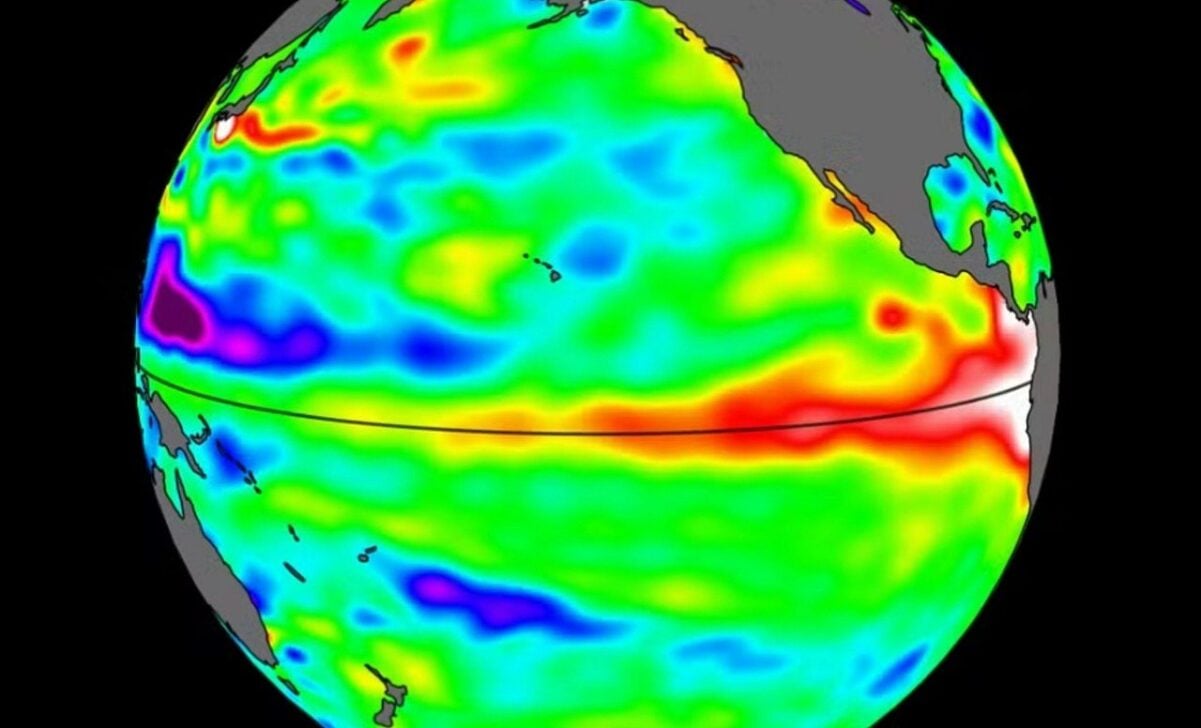
The United States Oceanic and Atmospheric Administration (NOAA) made official on Thursday (11) the occurrence of El Niño, a natural climate phenomenon caused by the anomalous warming of waters on the surface of the Equatorial Pacific Ocean.
The agency highlighted that “El Niño conditions are present and are expected to intensify during the winter of 2026-2027 in the Northern Hemisphere.”
Meteorologists were already anticipating this confirmation, after months of gradual rise in temperature in the Pacific and projections that indicated a high probability of the phenomenon developing in the first half of 2026.
In May, the agency estimated an 82% probability of the phenomenon occurring in the following months. With the June update, the event is formally established, and discussion now focuses on its possible intensity.
What are El Niño and La Niña

El Niño and La Niña represent the two phases of the climate cycle known as ENSO (El Niño-Southern Oscillation). El Niño is defined by the warming of the waters of the equatorial Pacific Ocean by 0.5°C or more.
On the same topic: El Niño intensifies: how submerged Pacific heat drives the phenomenon
It usually appears every two to seven years, with an average duration of twelve months, and directly influences the increase in global temperature. La Niña, on the other hand, is characterized by the cooling of the same waters, producing important but opposite effects.
In Brazilian territory, the effects are regional. Historically, El Niño intensifies rainfall in the South, which can increase the occurrence of storms and floods.
In areas of the North and part of the Northeast, the phenomenon generally reduces rainfall, potentially intensifying periods of drought.
In the Southeast and Central-West, the impacts are more unpredictable, with greater frequency of heat, poorly distributed rain and changes in the pattern of cold fronts.
Global impact and scientific alerts
The occurrence of El Niño is also a cause for concern, as the planet already has high temperatures as a result of climate change.
The phenomenon, in itself, does not cause global warming, being a natural variation of the climate system. However, when emerging in an already heated global scenario, it can intensify extremes such as heat waves, droughts and heavy rains.
For this reason, scientists are closely monitoring the evolution of this event, with a high chance of it becoming intense.
NOAA projects a “63% probability of a very strong El Niño during the November-January period, which would rank it among the largest events on record since 1950.” This projection gains relevance after 2023-2024 was a strong El Niño, contributing to the world recording, for the first time, a day with a global average temperature 2°C above the pre-industrial era, indicating the amplification of extremes on an already heated planet.
More on this story: Super El Niño alert: weather phenomenon could be among the most intense
A highly intense El Niño can impact agriculture, the level of water reservoirs, energy generation, the incidence of fires and even the cost of food in several locations.
However, there is still no confirmation whether the current event will reach the level of “super El Niño”, a non-scientific term used to describe episodes of very high intensity, such as those of 1982-83, 1997-98 and 2015-16.
The intensity of El Niño will depend on the rise in temperature in the Equatorial Pacific in the coming months and, crucially, on the atmosphere’s response to this warming. For the phenomenon to strengthen, it is essential that the ocean-atmosphere system operates in a coupled and continuous manner, and ocean warming alone is not enough.
Since 2006, a series of El Niño episodes have progressively altered the global climate, which is now warmer than in the past.
Learn more: Heat and drought in the world double frequency and duration by the end of the century, according to study
Even events classified as weak or moderate, when occurring in a global warming scenario, amplify the risk of climate extremes such as droughts, floods and heat waves. See the sequence of recent events:
- 2006–2007: El Niño of weak to moderate intensity.
- 2009–2010: Moderate El Niño.
- 2014–2016: Very strong El Niño, connected to record heat and more frequent occurrence of extreme events.
- 2018–2019: Weak to moderate El Niño, with shorter duration and more contained impacts.
- 2023–2024: Strong El Niño, one of the most intense ever documented, linked to new temperature peaks.
El Niño and its importance for global climate
El Niño consists of the anomalous warming of the waters of the Equatorial Pacific Ocean, in the region close to the Equator.
It is part of a natural climate cycle that alternates hot (El Niño), cold (La Niña) and neutral phases, with repercussions in different parts of the globe.
This phenomenon modifies atmospheric circulation, altering rainfall and temperature patterns in various regions of the world.
Learn more: Climate phenomenon: American agency predicts a 95% chance of a very strong El Niño
In Brazil, the effects tend to be uneven: the South generally receives more rain, while the North and Northeast can experience longer periods of drought.
El Niño also impacts global temperatures. During years of greater intensity of the phenomenon, the planet often registers above-average heat, which adds to the effects of global warming.
The intensity and impacts vary between events. With the planet constantly warming, even moderate episodes can result in more severe effects than in previous times.
Potential effects of El Niño in Brazil
Historically, El Niño changes rainfall and temperature patterns in the country, causing:
- Increased rainfall in the South, with greater risk of extreme events.
- Reduction in precipitation in the North and in areas of the Northeast.
- Greater irregularity in rainfall in the Southeast and Central-West.
- Growth in the frequency of heat waves.
Experts point out that one of the most expected effects is the increase in periods of prolonged heat, especially during spring and summer.
Despite the alternation between La Niña, neutral phases and El Niño, scientists emphasize that global warming remains the primary factor behind current climate change.