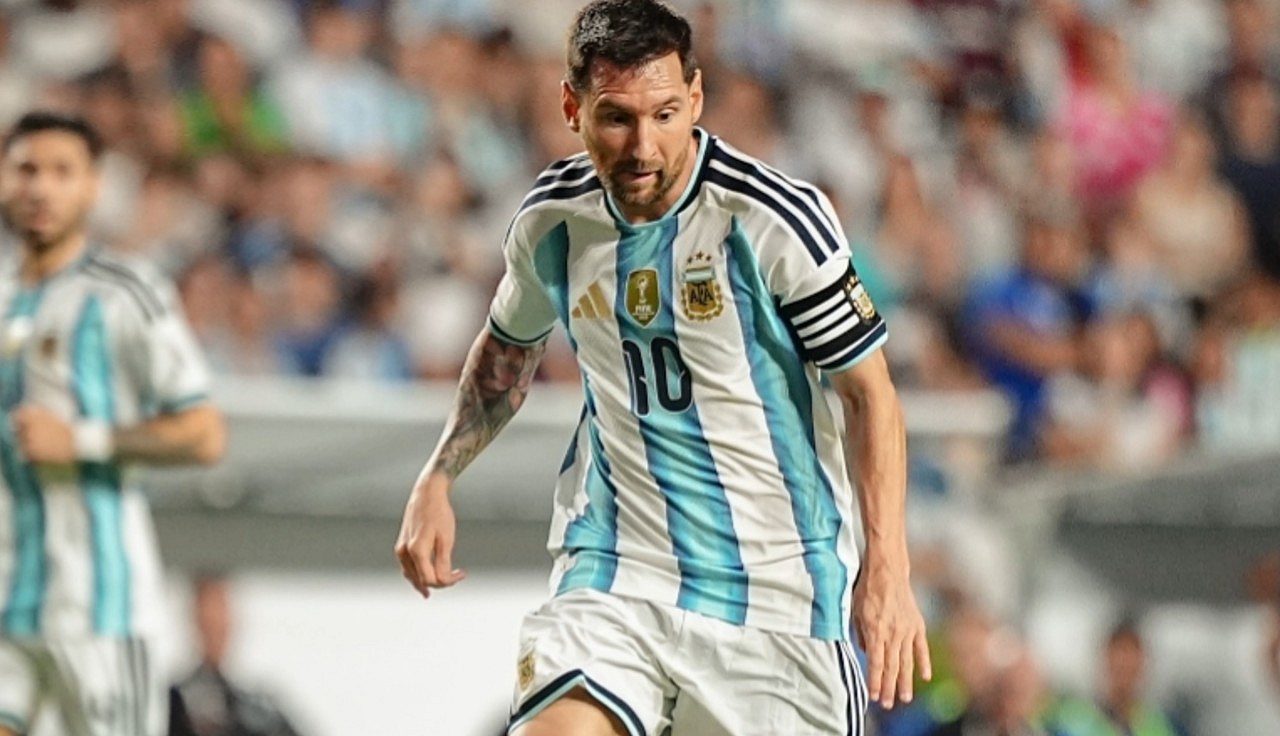
Argentina is preparing to achieve an unprecedented feat: becoming the first nation to win two consecutive World Cups since Brazil in 1962, and only the third in the entire history of the tournament.
If the feat comes to fruition, it is almost certain that the main protagonist of this journey will be the team captain, Lionel Messi.
At 38 years old, the Argentine star is about to participate in his sixth World Cup, a feat that puts him in a select group alongside Cristiano Ronaldo and Mexican goalkeeper Guillermo Ochoa, who will also achieve the triple record.
However, the version of Messi that will perform at the 2026 FIFA Men’s Football World Cup differs substantially from the athlete who began his career at Barcelona in 2003.
While most players show a natural decline as they age, high-performance athletes are looking for ways to adapt their styles to this reality – like Cristiano Ronaldo, who reinvented himself as an excellent penalty taker with the loss of speed.
Messi, on the other hand, transcends the need to adapt to decline. He continues to dominate and innovate in a sport that constantly poses new challenges.
Since making his debut for Barcelona, at the age of 16, in a friendly against José Mourinho’s Porto, playing on the right and dribbling towards the center, Messi has undergone at least five major reinventions, shaping himself into the multifaceted player he is today at Inter Miami and the Argentine national team.
The reasons that led Pep Guardiola to change Messi’s position
When Ronaldinho Gaúcho, then the world’s most acclaimed player, first watched Messi in training, his prediction was clear: “He will be excellent.”
Two years later, in August 2005, Messi made his big introduction to the world at the Joan Gamper Trophy, facing Juventus Turin. The Italian team’s coach, Fabio Capello, was so impressed with the 18-year-old that, according to reports, he even tried to sign him.
With Messi at 21 years old, Ronaldinho was already at the end of his prime, and the transition of protagonism to new talents was evident. Frank Rijkaard, Barcelona coach at the time, explained what he expected from the Argentine.
“Straight down the middle,” instructed Rijkaard. “The more he touches the ball, the better for the full-back.”
In the first months of Pep Guardiola’s management, in 2008, the right side of the field was the Argentine’s exclusive domain, his favorite route towards the goal.
Guardiola then decided to move Messi from the wing for the first time for defensive tactical reasons. The absence of his contribution in marking created problems for the team’s full-backs.
Even so, the Catalan coach knew that the number 10 would always find his way to the center of the action. From this point on, the team’s structure was completely reorganized around Messi’s new position, prepared for the most crucial moments and the biggest stages.
The creation of the “false nine” and the transformation of the tactical scheme
On May 2, 2009, at the iconic Santiago Bernabéu Stadium, in Madrid, Spain, a landmark clash between Real Madrid and Barcelona, valid for the Spanish Championship, La Liga, became the stage for a historic decision by Guardiola.
In that match, the coach moved Messi from the right wing to the front of the attack, but without assigning him the traditional roles of a center forward.
Samuel Eto’o started to play on the right and Thierry Henry on the left. The primary instruction for Messi was clear: retreat, receive the ball and decide the plays.
The classic ended in a crushing 6-2 victory for Barcelona, with two goals from the Argentine. There, again, the concept of the “false nine” was born.
This strategy, however, was not completely new in football. Hungary, under the command of Gusztav Sebes (1906-1986), had already used similar tactics to defeat England on its own territory, in 1953.
Sebes frequently dropped Nandor Hidegkuti (1922-2002) into midfield, attracting opposing defenders and opening crucial spaces for Ferenc Puskás (1927-2006) and Sándor Kocsis (1929-1979), resulting in a 6-3 victory over the English.
In the 1970s, Johann Cruyff (1947-2016), initially under the direction of Rinus Michels (1928-2005), already acted as a striker with great freedom of movement, incorporating the famous Dutch carousel philosophy.
At first, Messi became a tactical enigma for his opponents.
When he retreated between the defensive lines, Real Madrid’s defenders were faced with a dilemma: follow him and create a void in his position, or maintain it and give him more space.
Both choices proved to be ineffective, allowing Messi to move around the field with complete ease.
With the presence of Xavi, Andrés Iniesta and Yaya Touré in midfield, and Henry and Eto’o opening the opposing defense, the opponents’ defensive systems were constantly disorganized.
Weeks later, Guardiola replicated the successful strategy in the Champions League final against Cristiano Ronaldo’s Manchester United. Messi scored a header in the 25th minute of the second half, sealing the Spanish team’s 2-0 victory.
Between 2011 and 2013, Messi racked up an impressive 96 goals in 69 games in the Spanish league.
The Ballon d’Or he received in 2009 became an almost constant award throughout his career. He won the trophy again in 2010, 2011, 2012, 2015, 2019, 2021 and 2023, totaling eight awards.
His first Ballon d’Or was at the age of 22, and the most recent, at the age of 36.
“I didn’t use to pay much attention to tactics,” Messi confessed to Argentine journalist Juan Pablo Varsky in 2024.
“But with Guardiola, my understanding deepened. I started to decipher spaces, to dominate possession, to truly understand how the game works.”
The change of profile and the new responsibility in the team
When Xavi left Barcelona in 2015, and Iniesta followed three years later, the Spanish team’s landscape changed significantly.
Messi was always the decisive player, but from that moment on, he needed to assume the role of the team’s central engine.
The midfield safety net, made up of players who kept the ball moving and opened spaces for their brilliance, was no longer present.
There was a period when Messi was expected to embody Xavi, Iniesta and the goalscorer, all simultaneously, an excessive burden for any athlete.
He found the solution to this challenge by evolving once again.
The top scorer and number 10, or false nine, became the team’s “hook”. Retreating further on the field, he became the great organizer, responsible for starting and, often, finishing the plays.
With this change, the number of assists in his statistics began to approach his total goals. In the 2019-20 European season, for example, he registered 25 goals and 22 assists in 33 games for the Spanish Championship.
Messi again had a high goalscoring record in his last season at Barcelona (2020-21), with 30 goals and 11 assists in 35 La Liga matches.
However, his first season at Paris Saint-Germain consolidated the new phase: 11 goals and 15 assists in 34 games in all competitions. For the first time in his career, the Argentine recorded more assists than goals while playing for one club.
“A goalscorer who became Iniesta”, defined an Argentine commentator about this phase.
His career as captain: from the weight of defeat to consecration
Parallel to his continuous tactical evolution, another aspect of his career took longer to consolidate: Messi’s identity with the Argentine national team shirt.
He assumed the role of captain of the national team in August 2011. It was from then on that the notable defeats followed.
Argentina lost the 2014 World Cup final to Germany at Maracanã, 1-0 in extra time. Then, the 2015 and 2016 Copa América finals, both for Chile, decided on penalties.
These three lost finals in a three-year period have intensified the pressure and expectations on their captain.
After the third defeat, he announced his retirement from the national team, a decision he had already considered on two other occasions. However, upon his return, Messi was a transformed player.
At the 2019 Copa América, held in Brazil, after the controversial elimination of Argentina by the Brazilian team in the semifinals, Messi gave a press conference and directed strong criticism at Conmebol, the South American Football Confederation.
Messi was no longer the same player who, at other times, seemed to retreat into silence when the burden of leading Argentina became too heavy. He had become a leader determined to no longer be defined by his defeats.
The 2021 Copa América represented an immense relief. Argentina beat Brazil 1-0 in the final, at Maracanã, ending a 28-year drought without significant titles for the main team.
Messi’s speech to the team before that final match moved the dressing room, bringing many to tears.
The Messi who performed at the 2022 World Cup was, once again, a reinvented player, the synthesis of all his previous experiences.
In the semi-final against Croatia, he surpassed Josko Gvardiol in speed, a move that recalled the 2009 right-winger in a moment of pure genius.
He demonstrated the precision of an organizing midfielder in the quarter-final game against the Netherlands, with his masterful pass to Nahuel Molina. In the grand final against France, he ran tirelessly to force the rebound that resulted in Argentina’s third goal and converted two penalties in decisive moments.
“Football has changed a lot,” Messi told Zinedine Zidane in an interview in 2023. “The way of playing, the systems.”
“The game today is much more tactical and physical than before. In times past, we found more spaces.”
Messi made this observation with the ease of someone who has lived through three distinct tactical eras of modern football: the more physical midfielders of Porto and Chelsea, the golden age of positioning and passing, and the complex post-Guardiola tactical contests characterized by rapid transitions.
He emerged victorious from them all.
Messi’s uniqueness: “The last Messi is always the best”
At Inter Miami and during the 2024 Copa América, Lionel Messi walks more than he runs.
In the past, critics used this characteristic against him. Today, it is a sign of his genius and mastery. Messi can read the game exceptionally well, reserving his energy for the truly crucial moments.
“The last Messi is always the best Messi”, declared on one occasion his childhood idol, the former player and current assistant coach of Argentina, Pablo Aimar. And Aimar’s statement probably remains current.
Over two decades, Messi has not only accumulated a vast collection of trophies and statistics. He represents the redefinition of what a football player can be at each stage of his career.
From the teenage winger who captivated Capello, to the “false nine” who revolutionized the tactical map of European football, to the “hook” who learned to elevate the performance of his teammates.
He was the captain who finally became the figure his country longed for — the organizer of a world champion team. And now, he is the veteran who runs little, but observes and anticipates everything with a privileged vision.
The next World Cup will certainly bring numerous accolades to Messi. However, most of these analyzes may deviate from the central question.
The most significant thing is not just Messi’s undeniable quality as a player, but his unique ability to reinvent himself and transform into a completely new version of himself, over and over again.