
Rock fragment found in the Sahara Desert proves the existence of an extinct planet in the Solar System
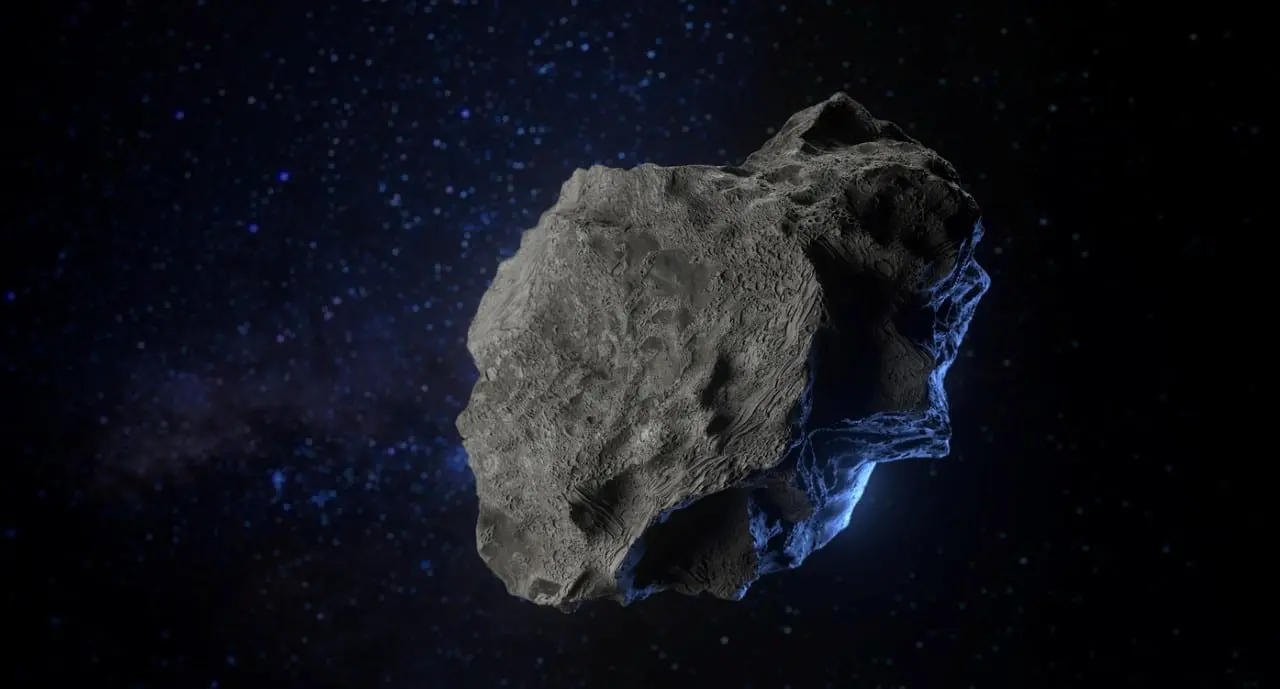
Traces of a massive celestial body that inhabited the early days of our cosmic neighborhood have just been confirmed thanks to a fragment recovered from the sands of the Sahara desert. The space object had intermediate dimensions, being on a size scale between our Moon and the planet Mars, but ended up completely annihilated by violent dynamics that astronomers are still trying to unravel. One of the most robust hypotheses points to a disintegration generated by a colossal impact, an extremely common event during the chaotic youth of the universe, a period in which planetary embryos frequently collided to form the worlds we know today.
Unique characteristics of the oldest volcanic rock ever cataloged
The artifact that triggered this discovery goes by the technical name of NWA 12774, consisting of a piece of space rock weighing around 454 grams, collected by explorers in 2019. Experts classified the material as an angrite, a very rare strand of meteorites of volcanic origin that is among the oldest samples ever documented by modern science. Its crystallization occurred in a very restricted time window, a few million years after the birth of our main star, dating back to an impressive 4.56 billion years ago.
Read also: Volcanic meteorite recovered in the Sahara desert confirms existence of extinct giant protoplanet
To understand the magnitude of this rarity and the weight of the discovery, it is necessary to observe the current scenario of astronomical records maintained by research institutes:
- There are more than 80 thousand meteorites duly cataloged in institutions around the globe.
- Of this gigantic amount, less than 70 specimens belong to the specific class of angritos.
- The sample analyzed carries thermal signatures of rapid cooling that do not exist in most known fragments.
This specific piece of interplanetary debris preserves a completely atypical chemical signature inside. The structural anomaly clearly demonstrates that a significant portion of the first celestial bodies developed under thermodynamic rules that were very different from those that shaped the rocky planets that currently orbit the Sun, requiring a review of planetary formation models.
New research from the University of Colorado changes scientific understanding
For decades, the predominant academic consensus argued that angrites were fragments resulting from the explosion of a medium-sized asteroid, with an estimated diameter of around 200 kilometers. However, a recent survey conducted by geoscientist Aaron Bell, a researcher at the University of Colorado, presented a completely new scenario for the astronomical community. Detailed laboratory analyzes detected the presence of aluminum-rich clinopyroxene in the depths of the rock, a mineral whose formation requires absurdly high levels of compression to stabilize.
Extreme pressures surpass the depths of Earth’s oceans
By simulating in a controlled environment the exact thermodynamic conditions that gave rise to the meteorite, the team of experts found that the mineral could only have developed under a minimum pressure of 17.5 kilobars. For practical comparison purposes, this index exceeds by more than 17 times the crushing force recorded at the bottom of the Mariana Trench, the deepest abyss of all the Earth’s oceans. A compression force of this magnitude would never exist in the core of a small asteroid, which unquestionably proves the existence of a celestial body of gigantic proportions, as detailed in the article published in the scientific journal Earth and Planetary Science Letters.
Size projections of lost world before fatal collision
Based on this extreme compression data, scientists calculated that the angrite formed in the surface layers of a spherical object at least 1,800 kilometers in diameter, making it slightly larger than our natural satellite. The most optimistic estimates of the mathematical model indicate that this protoplanet could reach up to 3,200 kilometers in length, remaining on a scale smaller than the size of Mars, but large enough to have a metallic core and complex geological activity.
Understand the case: NASA photographs giant eye in the Sahara desert 50 kilometers wide
Researcher Aaron Bell highlighted the fascination generated by this revelation, highlighting how surprising it is to see that a world of such vast dimensions orbited our system and simply disappeared without leaving a visible trace. The geoscientist pointed out that humanity only knows about the existence of this extinct giant because, by a cosmic chance, some fragments of its destruction survived the long journey through the vacuum and fell to the Earth’s surface billions of years later.
Laboratory files may hide other forgotten planets
The authors of the study are keen to emphasize that an incalculable quantity of meteorites remains stored in drawers and safes in university laboratories, awaiting appropriate technology for verification. The continued advancement of spectrometry equipment and high-pressure simulations indicates that future scans of these archived materials have enormous potential to reveal the existence of several other lost worlds that helped pave the early stages of our solar architecture.
More news in Latest News (EN)
See more → Next-generation servers gain the new Arm Neoverse CSS N4
 OpenAI signs with Firmus in Malaysia as total tops 900 MW
 Reusable rocket maker Stoke Space secures $1 billion round
 WeChat flaw lets worm hijack accounts through phone calls
 Multimodal DeepSeek V4.1 Flash model opens for beta testing
 Samsung launches semiconductor research hub in Yokohama
 Investors commit $450 million to The Exploration Company for Nyx
 Harvey reaches $15.5B valuation with fresh $550M funding
 Unit 42 discovers automated AI agent breaches corporate network
 Amazon and Qualcomm partner on AI chips for data centers
 Cognition raises $2 billion round at $48 billion valuation
 Microsoft rolls out Windows 11 security update KB5124008
More news on Mix Vale
- 1OpenAI system presents solution to Navier-Stokes problem
- 2Google DeepMind maps 9 billion human DNA variants at scale
- 3Researchers discover atomic catalyst structure for methane
- 4Finland secures €13 billion from Google for data centers
- 5Most astrobiologists doubt recent findings of alien life
- 6Diabetes slows long COVID recovery and harms heart health
- 7Meta launches Muse personal AI agent to execute daily tasks
- 8MeerKAT telescope traces ancient hydrogen radio emissions
- 9Central and South America collided earlier than expected
- 10New study traces Britain’s Devil’s Arrows to Brimham Rocks