
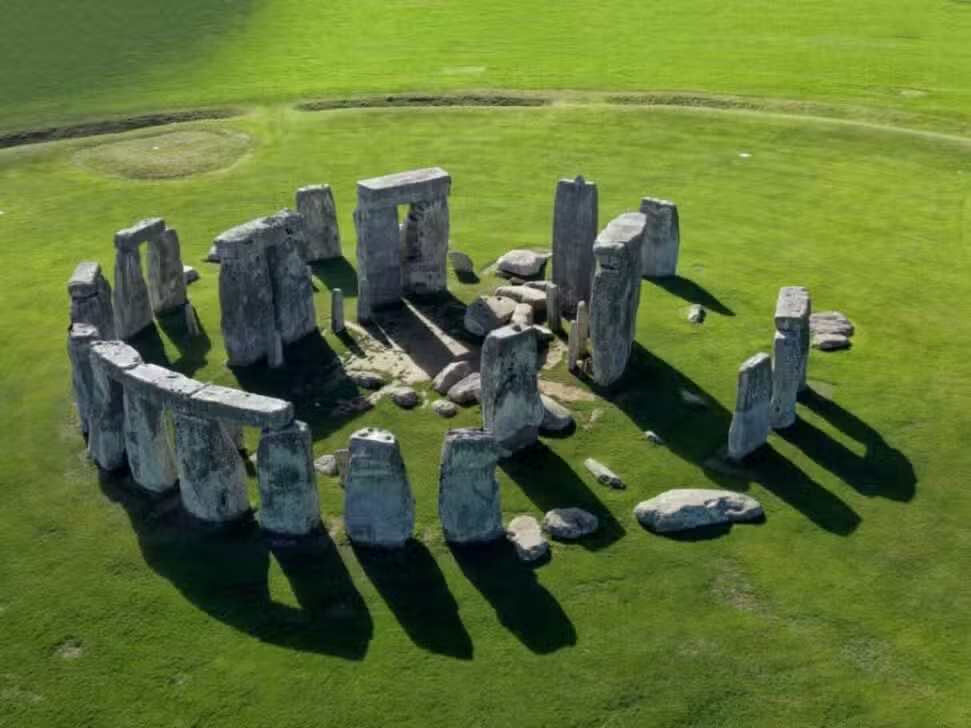
Archaeologists have announced the discovery of a prehistoric structure that predates Stonehenge, located a short distance of approximately five kilometers from the iconic monument. This new building, which appeared to be more rudimentary, was identified by underground remains that reveal its purpose and age.
The only visible signs of the ancient construction are two holes in the ground, but researchers confirm that these points housed wooden posts. The arrangement of these stakes demonstrated a precise alignment with the Sun during the summer and winter solstices, the longest and shortest days of the year, a pattern reminiscent of that observed at Stonehenge.
Dating of the site indicates an age of around five millennia, placing it approximately 500 years before the construction of Stonehenge. This chronology suggests a continuity or evolution in the development of astronomical and ritual practices in the region.
Additionally, several artifacts were unearthed at the site, such as pieces of pottery, flint tools and animal bones. These findings point to prehistoric human meetings and activities at the site, indicating its importance as a social and perhaps spiritual meeting point.
Phil Harding, from Wessex Archaeology, the company that led the excavations, expressed his enthusiasm, calling the discovery one of the most significant of his extensive career in the archaeological field.
For Harding, the simplicity of the two post holes offers a revealing window into the life and thought of communities five thousand years ago, providing a deeper understanding of their culture.
He highlighted that the evidence found allows us to infer aspects of the social organization, beliefs and reverence of ancient people for the heavens, crucial elements for the survival and worldview of these early civilizations.

The gigantic stones that make up Stonehenge, positioned with remarkable precision, are recognized for their alignment with the movements of the Sun, an impressive feat of engineering and astronomical observation for the time.
Observers located in the center of the Stonehenge circle during sunrise on the summer solstice witness the star appear over the “heel stone”, a specific stone located northeast of the structure, demonstrating the intentionality of the alignment.
Similarly, on the winter solstice, from the central point of the monument, it is possible to observe the sunset over the “altar stone”, located to the southwest, demonstrating a deep knowledge of celestial cycles and their seasonal markings.
The new structure, found in the village of Bulford, was considerably simpler in design, consisting of just two wooden posts, which disappeared over time due to natural decay.
These posts were 120 meters apart and it is estimated that their height varied between two and four meters, dimensions that gave them an imposing presence in the scene at the time.
Upon encountering the enigmatic holes, Harding realized that they held a solar alignment, a feature shared with Stonehenge, which is just a few kilometers away, connecting the two sites for a common purpose.
He reported using a pencil and ruler to connect the dots, confirming the general alignment of the holes with the direction of sunrise on the summer solstice, a key moment for ancient communities.
The remains of this earlier structure in Bulford were initially discovered a decade ago when the area was being prepared for the construction of new military housing, revealing secrets hidden beneath the ground.
However, only recently has a thorough analysis of astronomical alignment been conducted, requiring a complex reconstruction of celestial patterns from very ancient times.
Fabio Silva, archaeoastronomer at Bournemouth University and Skyscape Academy, explained that the positions of celestial bodies, such as the Sun, Moon and stars, change imperceptibly over the centuries, requiring detailed study.
He emphasized the need to reconstruct the sky as it was five millennia ago, determining the exact positions and times of sunrise at these ancient locations for accurate analysis.
Silva confirmed that, considering the width of the poles, the alignment of the structure is perfect, accurately corresponding to the sunrise on the summer solstice and the sunset on the winter solstice.
The holes supporting the posts weren’t the only revelations; Dozens of other holes containing artefacts belonging to Bulford’s prehistoric inhabitants have been found nearby.
The analysis of these objects was essential to determine the age of the site. The team used radiocarbon dating, a technique that evaluates the decomposition of a carbon isotope, confirming the structure’s five thousand years old.
Among the artifacts unearthed are a horn, probably used for excavations, other worked animal bones and ceramic fragments with elaborate decorations, demonstrating the skill of ancient artisans.
Tools made from flint were also recovered, including a Neolithic discoidal knife, a particularly rare find of great archaeological value.
“It was, I think, our main discovery,” said Harding, from Wessex Archaeology, highlighting the value and uniqueness of the piece among other finds.
“What makes it so special is the work involved — it’s a true work of art,” he said, praising the technique and dedication that went into making the knife.
Harding noted that the knife was found in an upright position, as if it had been intentionally deposited, raising questions about its possible symbolic or ritualistic meaning.
“Maybe this discoidal shape is some kind of reference to the Sun, who knows?”, conjectured Harding, opening space for interpretations about the piece’s connection with the people’s solar worldview.
The Bulford monument shares the same chronology as the initial phase of activity at Stonehenge, the period in which the first earthworks were carried out, half a millennium before the installation of the famous stones.
Jennifer Wexler, curator of history at English Heritage, suggested that the discovery at Bulford indicates that the communities responsible for the early phases of Stonehenge could have resided there or gathered seasonally to assist in the construction of the larger monument.
A central question is the reason for such fascination with the Sun on the part of these prehistoric societies, which invested so much effort in structures aligned with celestial movements.
Wexler clarified that the builders of Stonehenge and the inhabitants of Bulford were primitive farmers, and their livelihoods were intrinsically linked to the cycles of the seasons and the path of the Sun, which made celestial observation vital.
Currently, the summer solstice attracts thousands of tourists to Stonehenge, who gather to watch the sunrise aligned with the monument, transforming the event into a significant cultural attraction.
However, Wexler pointed out that five millennia ago, the winter solstice, the shortest day of the year, held even greater importance for ancient communities, marking a crucial transition period.
She explained that winter, with its diminished light, perhaps required rituals or celebrations to invoke the return of light and the arrival of spring, a time expected for the prosperity of crops and animals, fundamental to the survival of these agricultural societies.