

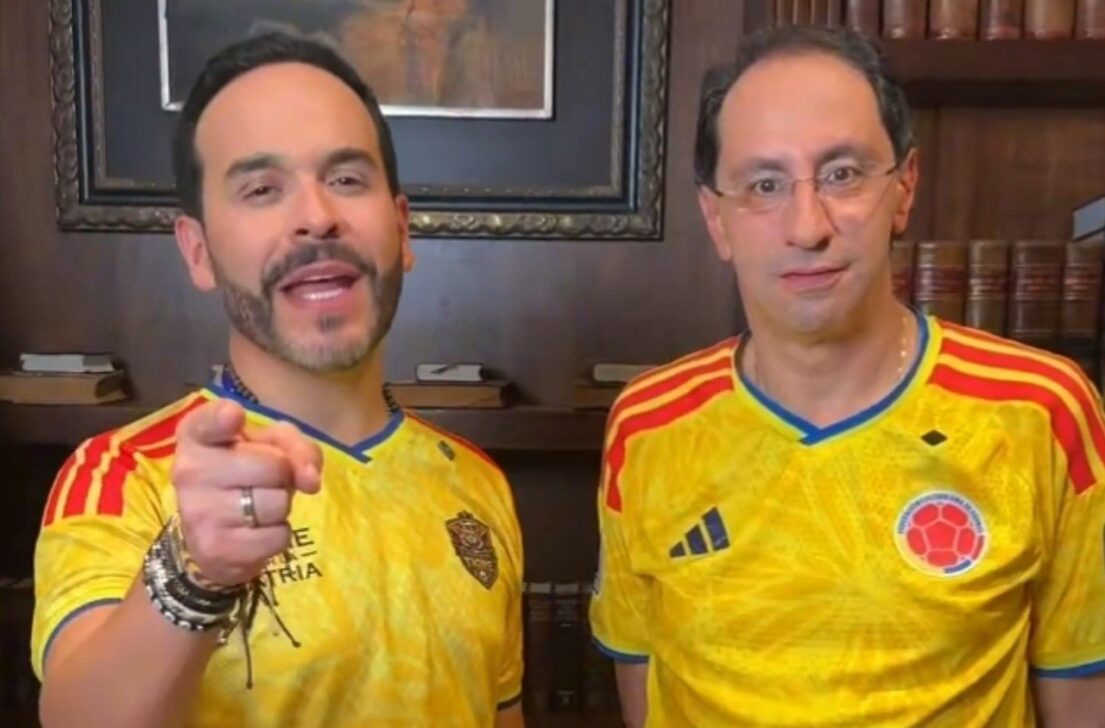
Abelardo de la Espriella, a 47-year-old lawyer and businessman with no prior political experience, won the preliminary vote for the presidency of Colombia this Sunday (21). The candidate, identified with the extreme right, surpassed left-wing senator Iván Cepeda by a margin of less than 250,000 votes.
In a released recording, de la Espriella celebrated his victory dressed in the Colombian team’s shirt, highlighting the need for agreements with the United States to combat organized crime. “Today, Colombia won its most important game”, declared the politician.
The official and definitive count of votes is scheduled to begin this Monday (22). If Espriella’s victory is confirmed, his inauguration as president is scheduled for August 7.
Profile of the victorious candidate in Colombia
Known by the nickname “El Tigre”, Espriella was born in Bogotá in 1978. He is married to Ana Lucía Pineda Aruachan and is the father of four children. In addition to his professional career, Abelardo is also a singer of vallenato, a traditional folk musical genre from the region.
The businessman captivated the electorate by presenting himself as an “anti-establishment savior” and reiterated campaign promises in line with far-right figures in Latin America. Its rise in the first round was driven by rigorous proposals to combat organized crime, cuts in government programs and taxes, as well as a revitalization in oil exploration.
Espriella is the founder of De La Espriella Lawyers Enterprise, a recognized corporate law firm in the country. His work goes beyond law, with a vast business empire that covers sectors such as wine, rum, clothing and real estate.
The lawyer has already faced criticism for his legal representation of Alex Saab, who is accused in the US of money laundering for Nicolás Maduro, former Venezuelan president. He has also defended individuals involved in corruption scandals, embezzlement and right-wing paramilitaries, but ensures that his professional relationships as a lawyer do not imply any complicity or wrongdoing.
The victory of the right-wing de la Espriella signals a significant change in the Colombian political scenario, after the government of Gustavo Petro, the first left-wing president in the country’s history. Abelardo is a member of the National Salvation Movement (MSN), a far-right Colombian political party founded in 1990 by Álvaro Gómez Hurtado, who was assassinated by the Revolutionary Armed Forces of Colombia (FARC) in 1995.
Espriella also has naturalized citizenship of Italy and the United States, having lived in Miami and being a member of the Republican Party, the same as Donald Trump.
Expressing admiration for the policies of Trump and the president of El Salvador, Nayib Bukele, the ultra-rightist candidate promised a strong military offensive and the construction of ten mega-prisons in the country.
“In my government there will be no peace processes. Criminals who do not submit will be eliminated, as permitted by law,” declared Espriella during his election campaign.
The right-wing candidate’s speech found great resonance among voters in the first round. Opinion polls have indicated that violence is the main reason for concern among Colombians, surpassing the economy – which has been weakened by the pandemic and the increase in the fiscal deficit, even with the current government raising the nominal minimum wage by 75% and reducing unemployment.
Espriella blames Gustavo Petro, the current president of Colombia, for the country’s economic and security problems. He promised to reduce the size of the state by 40%, expand the tax base and cut corporate taxes to stimulate private sector employment.
One of the symbols adopted by the businessman during the campaign was the Colombian team’s shirt, which has also established itself as an emblem of the right in the country. Many of his supporters showed up to the polls in the first round wearing shirts with the names of players like James Rodríguez and Luis Díaz.
Even though he has no military training, Espriella, when finishing his interventions, often puts his right hand to his forehead, lowers it quickly and exclaims: “Stand firm for the country!”. This gesture and slogan inspired his supporters to salute as a form of greeting.
Regarding his nickname, “El Tigre”, the politician’s official website reports that the nickname arose from a statement by former president Álvaro Uribe, who governed between 2002 and 2010. The leader of the Colombian right, who supports the ultra-right after the defeat of his own party in the first round, stated in 2024 that Colombia needed “a tiger” or “a tigress” in the Presidency.
Espriella incorporated the image of the feline, similar to what presidents such as Argentine Javier Milei, with the lion, and American Donald Trump, with the bald eagle, did.
Uribe used social media to celebrate the preliminary result. “We are sure that Dr. De la Espriella will create a government of democratic recovery, useful for all Colombians,” he posted on his account.
Javier Milei also celebrated another victory for the right in Latin America. “Freedom advances throughout Latin America and there is no turning back,” the Argentine president posted on one of his social networks.
The president of Ecuador and Trump ally, Daniel Noboa, also congratulated the businessman. Espriella also declared that he received greetings from the former president of the United States, Donald Trump.
Next steps for electoral confirmation
On digital platforms, President Gustavo Petro declared on Sunday night that no results should be considered official before the conclusion of the vote.
In Colombia, the electoral counting process is divided into two stages. The initial phase, known as “preconteo”, is a preliminary count made from the minutes of the polling places, used to project the result. However, according to the country’s legislation, the official result is only announced after “scrutiny”, when judges and other authorities review the minutes to correct possible inconsistencies.
The electoral dispute turned into a political clash between the country’s current president, Gustavo Petro, and the former US president, Donald Trump. While Cepeda was the candidate supported by Petro, the ultra-rightist Espriella received declared support from the North American leader.
“No president can be proclaimed. It is the scrutiny that determines who is president. I obey the judges. Peace of mind for the citizens, please. Reality shows us a country split in two, and foreign interference takes away our freedom. A national agreement is necessary if we want to maintain the country and peace in the years to come”, wrote Petro.
Iván Cepeda had led voting intention polls before the first round. For this reason, Espriella’s victory in the first round surprised many, to the point that Petro initially contested the result, which was later recognized by Cepeda himself. In the first round, Cepeda received 41% of the vote, while de la Espriella won 44%, according to official results.
The outcome of this election could consolidate the trend of right-wing governments in Latin America. Espriella’s rise aligns with a group of Latin American countries that have elected right-wing leaders in recent years, such as Chile, with José Antonio Kast.
The National Electoral Council (CNE) reported that the vote took place calmly and without major incidents, with the presence of international observers, including representatives from the OAS and the European Union.
The Colombian Electoral Court appealed this Sunday for all parties to respect the final result.
Expansion of the right in Latin American politics
Abelardo de la Espriella’s victory reinforces a political wave that has brought other right-wing leaders to power in Latin America, marking his biggest advance to date, isolating left-wing governments in the region and redefining the continent’s geopolitical alliances.
This result supports a movement that includes, among its main exponents, Nayib Bukele, in El Salvador; Javier Milei, in Argentina; and José Antonio Kast, in Chile.