

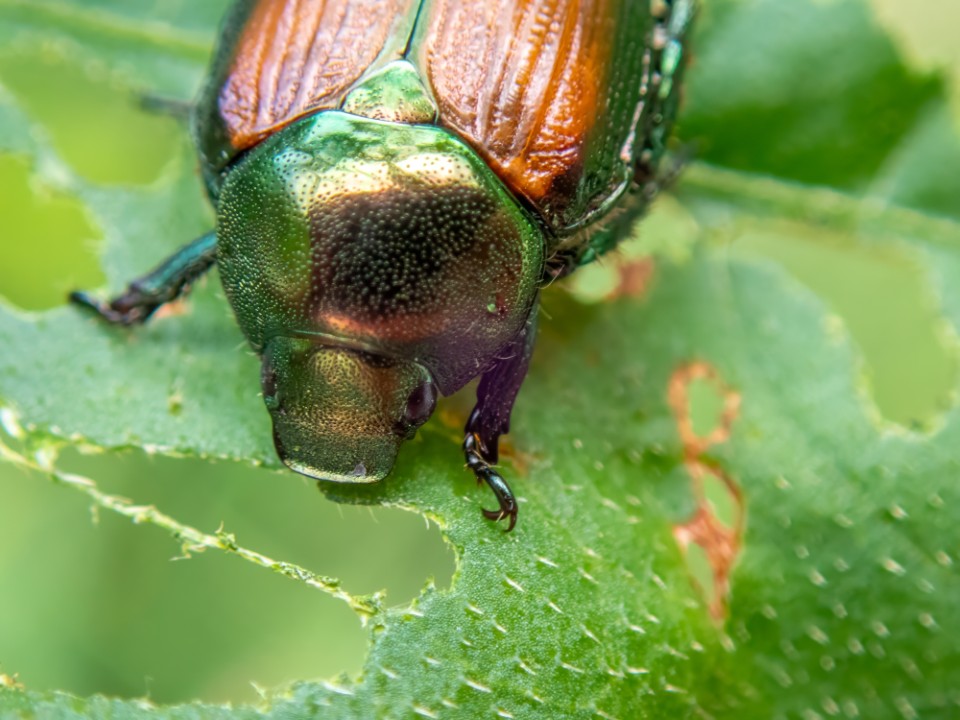
New records of Japanese beetles have been confirmed in traps installed in the city of Freiburg, generating concern among local farmers. The finding, released by the Augustenberg Agricultural Technology Center (LTZ), indicates a recurrence of the pest in the region, although without an immediate change in the control area.
Four specimens of the invasive insect were identified in pheromone traps in the German city, making this the first sighting of the year. The information, coming from the LTZ, in Karlsruhe, points out that the locations of the beetles are located within the same zone already delimited the previous year, preventing, for now, the expansion of the infestation area.
Strict measures implemented to control the pest in affected areas
The previous year, the Freiburg plant protection team recorded the capture of 31 Japanese beetles. In view of this incident, the authorities of the districts of Breisgau-Hochschwarzwald and Emmendingen published a joint regulation with restrictions.
During the period of insect flight activity, which occurs from June to September, there are a series of prohibitions in force. Irrigation of lawns in the delimited area is prohibited, and any plant residue must be ground before being removed from the perimeter. The legislation also prevents the transport of topsoil from construction sites outside the restriction zone, in order to prevent the spread of beetle larvae.

Remembering the mobilization against the plague in previous years
Previous reports have highlighted “Japanese Beetle Hunt” operations in Baden-Württemberg, showing the historical concern for the species.
News coverage on the topic generally lasted approximately two minutes, highlighting public interest.
Real threat to crops: damage caused by the pest Popillia japonica
Of Asian origin, the Japanese beetle (Popillia japonica) is known for its ability to infest a wide range of plant species, exceeding 400, as detailed by the LTZ. Its presence poses a considerable risk to fruit plantations, vines, cornfields, as well as ornamentals such as rose bushes and trees such as lime and hazel trees. Intense infestations can cause large-scale economic losses in the agricultural and horticultural sectors.
For experts, early identification of the Japanese beetle is crucial, increasing the prospects of total eradication of the species. Intensifying supervision is especially important at the beginning of the holiday period. The insect can be inadvertently carried by people in personal items such as luggage and vehicles. It is therefore recommended that travelers thoroughly inspect suitcases, cars and camping equipment upon returning to their homes. Experts advise avoiding transporting plants, soil or seeds, especially after visits to northern Italy and southern Switzerland, in order to prevent the beetle from spreading.