

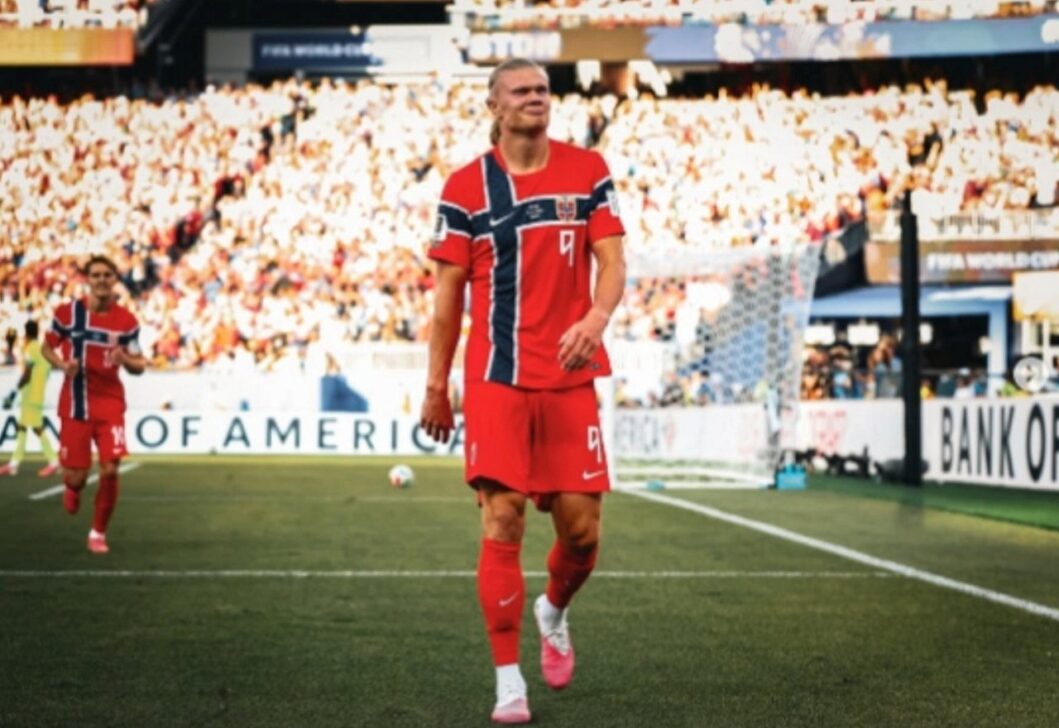
The Norwegian team, considered one of the biggest surprises of the World Cup, faces the Senegal team this Monday night. Expectations are high for the clash in New Jersey, which will kick off at 9pm (Brasília time).
With Martin Odegaard and Erling Haaland at the helm, the Nordics are looking to secure an early place in the round of 16. They are coming off an impressive 4-1 victory over Iraq in their opening match, but their current good performance goes beyond the presence of Arsenal’s captain and Manchester City’s top scorer.
Although Odegaard grew up in Drammen and Haaland took his first steps at Bryne FK, a low-key club on the southwest coast, their football paths converged. Both were deeply influenced by a sports educational project developed by the country itself.
In 2013, the Norwegian Football Association established the Landslagsskolen, or “National Team School”, with the aim of improving the most promising young players. This initiative not only built a robust national team, but also shaped the culture and collective development of Norwegian football. The program focuses on identifying talents, both male and female, aged 12 to 16 across the country, establishing a clear path for their participation in youth teams.
Hakon Grottland, the school’s current director of athlete development, recalled that the creation of Landslagsskolen was motivated, in large part, by Martin Odegaard’s observation. “Everyone looked at him and said: ‘He has to be a national team player’. If he didn’t reach that level, it would be our fault. His mind was something special. He found solutions that no one else saw. Small physically, but very intelligent”, highlighted Grottland to the American website The Athletic.
The manager met Odegaard when the future captain was just 11 years old. In addition to the national team’s number 10, many other athletes also benefited from the program, including Erling Haaland, who participated long before reaching global stardom, Antonio Nusa (currently at RB Leipzig), Jorgen Strand Larsen (from Crystal Palace) and Andreas Schjelderup (Benfica).

Grottland highlighted his pride in the developed culture. “There is no room for inflated egos, only good people. Haaland and the others love being in the team because they feel part of a group,” he explained of the close-knit environment.
The country has made significant investments in the construction of numerous synthetic turf fields open to the public and small indoor arenas. This infrastructure allowed children from all regions to play football for thousands of hours, overcoming the harsh winters that previously made the sport unfeasible for much of the year.
In an interview with UEFA, Grottland emphasized the importance of the project: “The Landslagsskolen was absolutely crucial. It created a bridge across the system and defined a common direction for football knowledge, training methodology and playing principles.”
For two decades, Norway faced consecutive eliminations from important tournaments, following their participation in the 1994 and 1998 World Cups – in the latter, including defeating Brazil in the group stage. After a 28-year hiatus without playing in a World Cup, the nation is now proud of the new generation, led by Haaland, 25, and Odegaard, 27. Both were born without ever having seen the main team in a World Cup.
Director Grottland revealed that there was great frustration in Norwegian football. “Nobody talked about player development, but between 2010 and 2020 there was a revolution in knowledge. There was a change. The most important thing was to look at our training methodology. Today we see football as a sport of intelligence, a cognitive sport, of resolving situations. That’s where the skill lies. We were successful in the 90s based on defense and discipline, but then we changed the focus to the development of many offensive players”, he detailed.
Currently, Escola da Seleção employs 700 professionals. Each Norwegian district has a specialist dedicated to operations, and coaches from the youth teams of local first division clubs are also part of the system. With very few exceptions, such as Odegaard’s case, young athletes remain in their neighborhood clubs until they turn 12.
Grottland added that, in the Norwegian model, talent is intrinsically linked to the love of sport. “Players who sleep with the ball in bed, who charge themselves and learn from mistakes. It’s not just about technical ability, it’s about their own development and the development of their team. We are always interested in knowing how young players are as human beings and as teammates”, he stated, highlighting the importance of personal and collective values.
This strong sense of belonging is cultivated from younger ages and connects players deeply. The final call-up of the 26 athletes, for example, was announced by King Harald V, the 89-year-old Norwegian monarch, with the names of the players inserted in typical scenarios of the country. The connection with fans has also grown significantly, with Norwegian fans already standing out in this World Cup for a choreography that simulates the act of rowing, a clear reference to their Viking ancestors. The athletes themselves got into the spirit in an official photo of the World Cup, where they were portrayed as Viking warriors on the banks of a fjord.
Brede Hangeland, former national team defender and current assistant coach of Norway, concluded: “Although we have big stars, they don’t have big egos. Our team culture is our competitive advantage. It goes back to the National Team School, where they don’t just teach football. They try to teach the value of contributing to a group. The team is bigger than any individual. And you see it in the way the players act on the biggest stage in the world today. They are flying at the top of club football, but they are fully aware of the values from which they came”.