

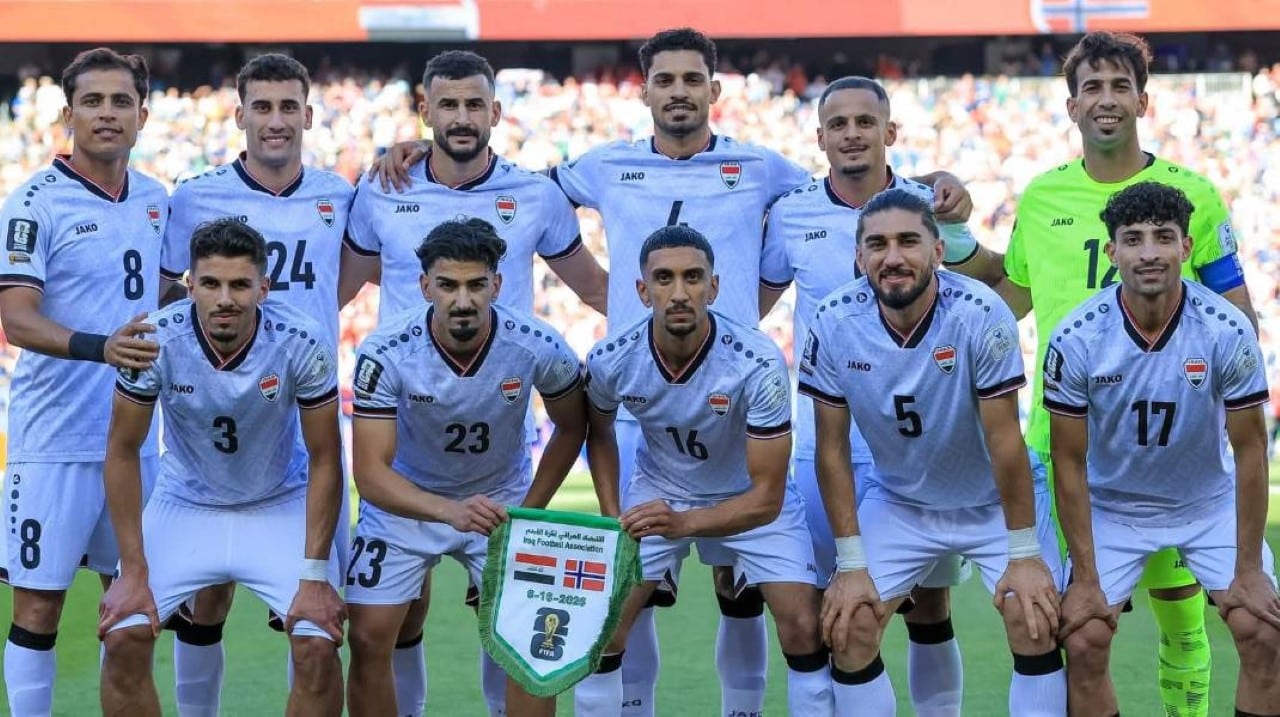
An unusual protocol was requested by the Iraqi Football Federation from FIFA for its national team’s games at the 2026 World Cup. The entity formally requested that the country’s flag not touch the pitch during pre-game ceremonies. The measure, which will be adopted during this Monday’s match against France, at 6pm (Brasília time), in Philadelphia, is a gesture of deep respect for a sacred inscription present in the national pavilion.
The reason behind the Iraqi demand for the ceremonial flag
The flag of Iraq, between its red and black stripes, displays on the white stripe the inscription in Arabic “God is the Greatest” (Allahu Akbar). This is one of the most revered phrases in Islam, the country’s official religion, which makes it a symbol of holiness for the nation. For this reason, the Iraqi authorities consider it disrespectful for the sacred phrase to come into direct contact with the ground, asking FIFA to adapt the traditional field rituals.
The captain of the Iraqi national team, Ayman Hussein, publicly confirmed the request, highlighting the importance of faith. “As the Iraqi flag includes the phrase ‘God is the Greatest’, the Iraqi Federation requested that the flag be removed from the field out of respect for the sanctity of the name,” the player explained in response to the press. This cultural sensitivity is now part of the operational guidelines for Iraq’s games at the tournament.
The meaning of the phrase “Allahu Akbar” and its sacredness in Islam
The expression “Allahu Akbar”, which means “God is the Greatest”, transcends a simple declaration; it represents a fundamental pillar of the Islamic faith. It is used daily by billions of Muslims in various situations, from the five daily prayers (salat), to the call to prayer (adhan), to moments of gratitude, joy or adversity. This phrase evokes divine sovereignty and greatness, being considered one of the most sublime manifestations of devotion to God.
The reverence for this expression is so profound that any act that could be interpreted as disrespect for the name of God or texts that contain it is avoided. In the context of the flag, its presence makes the fabric an object that carries a sacred character, demanding careful treatment and avoiding positions that could denigrate its sanctity, such as touching the ground, which in many cultures is associated with impurity or excessive humility. This cultural belief underlines the official request to FIFA.
Flag protocols: differences between Iraq and Saudi Arabia
Embora o Iraque tenha solicitado o protocolo especial para sua bandeira por uma questão de respeito religioso e cultural, é importante notar que não existe uma legislação específica sobre o tema no país, diferentemente de outras nações de maioria islâmica. Saudi Arabia, for example, has clear and formal rules that prohibit its flag from touching the ground, whether on national or international soil, precisely because of the inscription of the “Shahada” (the Islamic creed) and a sword, which are also considered sacred.
- Iraq:The request to FIFA is based on a strong cultural and religious value, without a specific formal law on the handling of the flag in relation to the ground. Represents a request for cultural adaptation.
- Saudi Arabia:There are explicit laws that regulate the use of the flag, prohibiting it from touching the ground or being flown at half-mast, due to the presence of the “Shahada” (Islamic creed), which makes it a legally protected and sacred object.
This distinction reflects the complexity for international bodies like FIFA, which must navigate distinct legal and cultural nuances in each participating country. FIFA’s response to the Iraqi request demonstrates the flexibility and sensitivity necessary to accommodate the traditions of member countries.
Logistical and cultural implications for FIFA in the 2026 World Cup
Adapting the flag protocol for Iraq will require adjustments to the teams’ presentation rituals, which traditionally include the display of national flags on the pitch before the anthem. FIFA, as the organizer of a global event, often faces challenges in balancing its operational standards with the diverse cultural and religious sensitivities of participating countries.
Cases like this, in which religious or cultural elements directly impact the ceremony, are recurrent in large events. In other editions of the World Cup, adaptations have already been made, such as restrictions on alcohol consumption in stadiums or modifications to game times to respect periods of fasting or prayer in certain cultures. Attention to these details is crucial to ensuring inclusion and mutual respect in a competition that brings together nations from across the planet.
Performance of the Iraqi national team at the 2026 World Cup
On the field, the Iraqi national team seeks to reverse an unfavorable start to the 2026 World Cup. In the opening round, the team was defeated by Norway with a 4-1 defeat, which puts them in a challenging position in Group I. Now, the challenge will be even greater in the confrontation against France, considered one of the favorites for the title and with a cast of stars.
Despite the opponent’s difficulty, the Iraqi team will try to surprise and score important points in the competition, seeking a reaction to maintain their hopes of qualifying. The team’s performance remains the main focus for fans, even with debates about cultural protocols outside the field.