⚲Foto: Anthropic, Claude - gguy / Shutterstock.com
Problems affect users of the Claude AI platform on a global scale
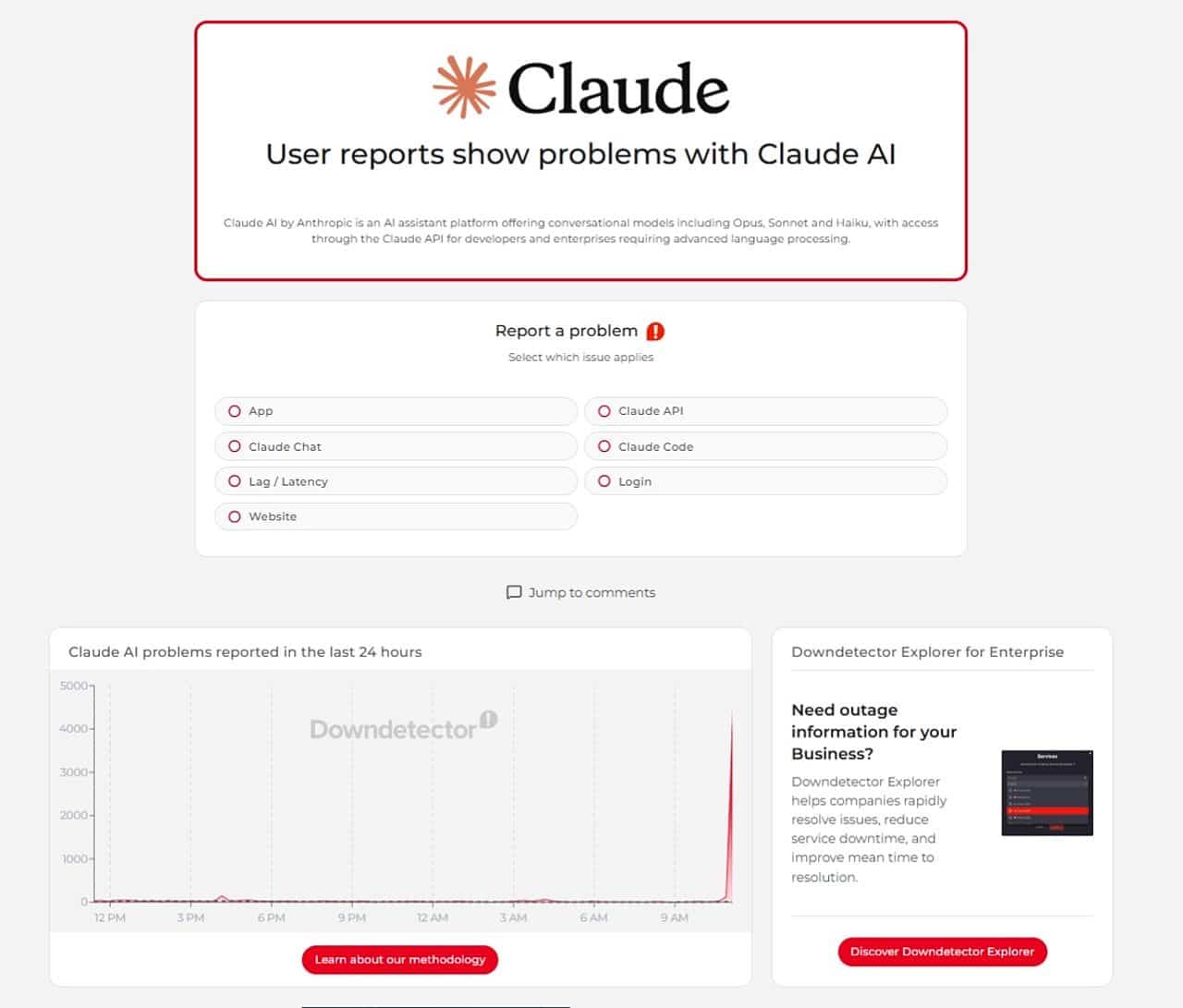
The artificial intelligence platform Claude, developed by Anthropic, recorded a series of instabilities on its servers this Tuesday, June 23, 2026, at around 11:25 am. Reports of failures have emerged in different parts of the world, as shown by data from Downdetector.com, a service that monitors the status of websites and other services. Thousands of users reported access and operation difficulties, generating concern in the community of technology developers and consumers.
The interruption impacted crucial functionalities of artificial intelligence, which has become an indispensable tool for many professionals and companies. Anthropic, one of the main developers of generative AI on the global stage, has not yet officially commented on the cause or forecast for the complete normalization of services. The absence of an official statement amplifies the anxiety of users who depend on the tool for their daily activities.
Critical components of Claude AI experienced significant failures
Analysis of user reports on Downdetector details that the issues were concentrated in specific areas of the Claude AI platform. Among the most cited, 45% of complaints were related to the “Claude Code”, the programming assistance tool. Another 27% of reports referred to “Claude Chat”, the conversational assistant, while 16% of users had difficulties with the general application. These flaws suggest a broad disruption that affects both developer usage and direct user interface access.
Error messages such as “API Error: 500 Internal server error” were recurring, indicating an internal problem with Anthropic’s servers. This failure, usually temporary, signals that the server encountered an unexpected condition that prevented it from fulfilling the request. Users of advanced models like Opus 4.8 have also mentioned “MODEL OVERLOADED, AGAIN”, which suggests possible demand overload or insufficient capacity to handle the volume of requests.
Widespread impact of the breakdown on routine and development work
The instability of Claude AI causes a ripple effect in several sectors that use artificial intelligence to optimize tasks and processes. Developers who rely on Claude Code to refactor code, debug, or generate new lines of programming face downtime in their projects. Content, marketing and customer service teams, who use Claude Chat for writing, ideas or support, are also directly affected, seeing their productivity compromised.
This growing reliance on artificial intelligence in corporate and personal environments makes any disruption a significant challenge. Companies may suffer financial losses due to delays in deliveries or interruption of services, while individuals may find their study or daily work routines disorganized. The incident underlines the criticality of the availability of AI platforms for the continuous operation of businesses and the execution of complex tasks that have been delegated to these systems.
Artificial intelligence competitive landscape and Anthropic’s position
Anthropic, creator of Claude AI, has established itself as a prominent force in the field of artificial intelligence, competing with giants such as OpenAI (with ChatGPT) and Google (with Gemini). The company is known for its cautious and ethical approach to AI development, with a strong focus on security and alignment with human values. Its templates, such as Opus, Sonnet, and Haiku, are widely used for a wide range of applications, from complex coding to writing assistance and data analysis.
The occurrence of failures in such a central service can have implications for the perception of brand reliability in a highly competitive market. While outages are common on large technology platforms, the frequency perceived by some users may raise concerns. Anthropic has invested heavily in infrastructure and research to ensure the performance and security of its systems, and an episode like this puts the resilience of these large-scale operations to the test.
User reports indicate frustration and frequency of failures
Downdetector’s comment sections are a barometer of user frustration. Expressions such as “dead”, “Break time” and “Again here we gather” illustrate a feeling of resignation and that these interruptions are not isolated incidents. Some users have expressed that the instability is “getting more frequent”, which suggests a worrying pattern of service interruptions.
There was also speculation about the cause, with some users, such as “Georges Mahl”, asking “Maybe they’re bringing Fable back?” (Maybe they’re bringing Fable back?), referring to a previous model or an expected update. Others discussed the feasibility of “run the models locally” or configuring “fallback to GLM” (alternative to GLM), highlighting the search for palliative solutions given the lack of access to Claude. These dialogues on the forums reflect the user community’s deep dependence and search for resilience.
Challenges in the search for alternatives amid the Claude AI shutdown
The Claude AI outage has led some users to explore or discuss commercially available alternatives. A review of “No Name” mentions “Sakana Fugu” as an option, albeit with caveats, describing it as “isn’t worth it” and that the $20 per month plan limited usage after just five messages, without impressing in its benchmarks. This search for replacements highlights the critical need for uninterrupted access to AI tools and the difficulty of finding solutions that match Claude’s quality and capabilities.
Migrating to another AI platform, even if temporary, involves a learning curve and adapting to new interfaces and functionalities. For developers and companies with work pipelines integrated with Claude API, this transition can be complex and consume valuable time. The absence of a robust fallback system or contingency plan for large-scale failures can expose users and organizations to significant risks, emphasizing the importance of diversifying the use of AI tools or having redundant systems.
Expectations for communication and resolution from Anthropic
Given the extent of the reports and the impact on use, the artificial intelligence community awaits an official position from Anthropic. Clear and transparent communication about the nature of the failure, the measures being taken to resolve it, and an estimated return to normality are essential to calm users and restore trust in the platform. Cutting-edge technology companies, especially those operating cloud or AI services on a global scale, are closely monitored for their ability to maintain the availability and performance of their infrastructures.
The speed and effectiveness with which Anthropic responds to this service crisis could influence its reputation and long-term user loyalty. In addition to reestablishing the service, it will be essential for the company to explain the root causes of the interruption and detail preventive actions to avoid similar occurrences in the future. Quality of support and promptness in problem resolution are as crucial as technological innovation in the competitive artificial intelligence market.
Luís Henrique Costa é jornalista formado pela FMU, editor-chefe e fundador do Mix Vale, portal de notícias em atividade desde 2013. Responde pela direção editorial do veículo, que cobre Brasil e mundo em economia, benefícios sociais, esportes, tecnologia, ciência e entretenimento. Atua na área há mais de 15 anos e lidera uma equipe de cerca de 15 colaboradores.