

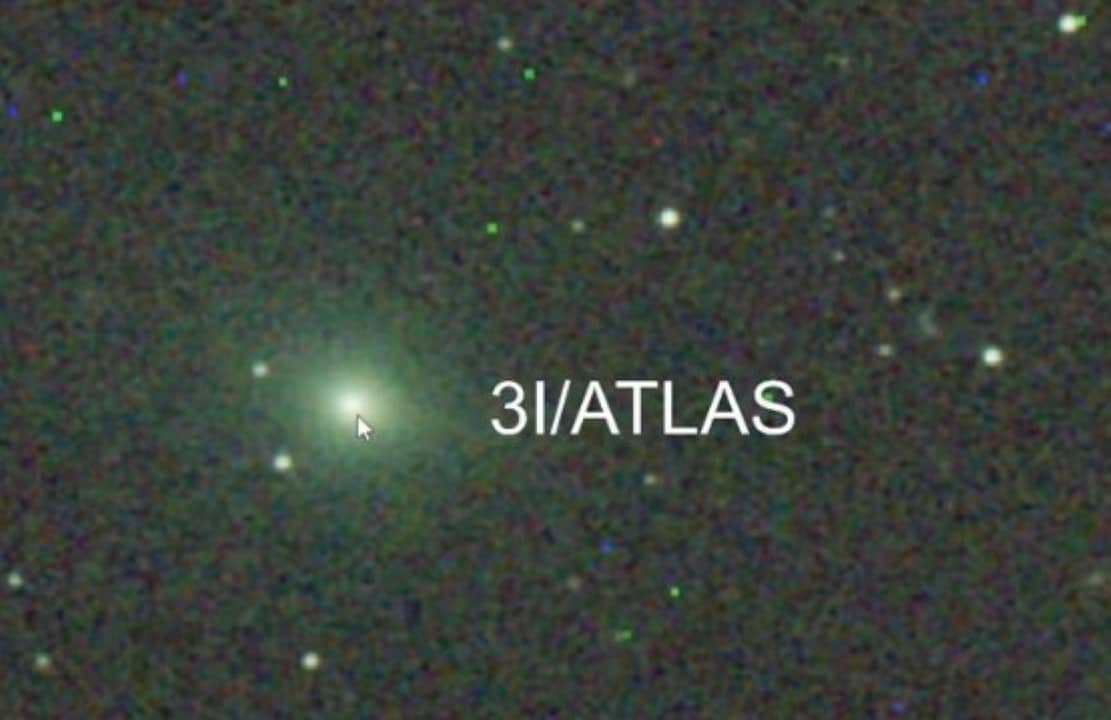
Researchers monitoring the trajectory of the 3I/ATLAS celestial body have discovered that this visitor from deep regions of the universe is impressively old. The data indicate that its genesis occurred between 10 and 12 billion years in the past, within a primitive planetary arrangement, exhibiting a completely unprecedented chemical signature when compared to the materials that orbit our Sun.
Mapping the molecular structure of this traveler, recognized as the third interstellar body to cross our space neighborhood, gave astronomers fundamental clues. Through this reading, it became possible to understand the physical dynamics and chemical reactions that dominated the star system where the ice rock formed.

With an estimated size of 2.6 kilometers in length, the star is consolidated as the most ancient structure ever detected transiting through our solar system. The finding was detailed by Martin Cordiner, an astrochemistry specialist at NASA’s Goddard Space Flight Center, who led the survey recently published in the pages of the prestigious scientific journal Nature.
Extreme temperatures mark the birthplace of the ancestral celestial body
The scientific team identified that the space visitor emerged in a scenario of extreme cold, registering marks of approximately -243 degrees Celsius. This thermometer is drastically lower than the environment that shaped Earth and other neighboring planets around 4.5 billion years ago, indicating that the rock has traveled incalculable distances since it was expelled from its original orbit by forces not yet understood.
“We have never had the opportunity to analyze a cosmic artifact with the characteristics of 3I/ATLAS”, highlighted the main researcher at the American space agency.
To unravel these mysteries, experts turned to the high sensitivity of the James Webb Space Telescope, equipment capable of reading chemical signatures through spectroscopy. The tool made it possible to calculate the proportion of isotopes, which function as exclusive identities of fundamental elements, such as carbon and hydrogen embedded in rock ice.
The behavior of the hydrogen variants acted as a historical thermometer, revealing the heat level and radioactive load of the star’s stellar cradle. In parallel, the reading of carbon fractions provided a detailed map of the mixture of gases in the interstellar cloud that served as raw material for the creation of the comet and its sister planets.
Frozen water samples demonstrated a deuterium level thirty times higher than the average recorded in comets that inhabit our local galaxy. Furthermore, the distribution of carbon completely deviated from the patterns found both in nearby asteroids and in the dust disks orbiting young stars recently discovered by modern astronomy.
Given these chemical discrepancies, the NASA scientist assesses that the celestial body functions as an intact fossil, remaining as a direct leftover from the process of building planets around an alien sun.
“The crossing of data captured by James Webb proves that the planetary maternity of this object operated under very different rules from ours. The place was substantially colder, with a shortage of heavy metals, and suffered a constant bombardment of ultraviolet rays and cosmic radiation”, detailed the astrochemist.
Presence of compounds essential for life surprises astronomers
Even being born in paralyzing cold, the traveler carries a vast catalog of organic molecules, housing chains of oxygen, sulfur, nitrogen, hydrogen and carbon. According to the team’s assessment, this chemical inventory demonstrates that the fundamental building blocks for the emergence of biology were already widely distributed in that distant dust disk, contradicting the idea that extreme cold would impede this complexity.
Carbon tracking placed the age of the rock at around 12 billion years, a time marked by an explosion in the rate of star birth. Taking into account that the Big Bang occurred 13.8 billion years ago, the frozen artifact was formed when the universe was in its infancy with just 13% of its current maturity, giving humans an unprecedented window to observe the infancy of the cosmos.
The astronomical community works with the main hypothesis that the object’s birthplace is within the Milky Way itself. However, due to his extreme age, scholars do not rule out the chance that he crossed the intergalactic void after being born in another galaxy.
“I always considered the chasms between galaxies to be insurmountable barriers, but calculations show that a high-speed space projectile would only need a billion years to travel from the Magellanic Clouds to our backyard”, pondered the study leader.
The expulsion of this icy fossil from its original home likely resulted from a violent game of cosmic billiards, driven by the gravity of migrating giant planets, although a direct collision with another massive body also figures among the accepted theories.
Before this historic detection, humanity had only cataloged other intruders from outside the solar system on two specific occasions:
- The enigmatic 1I/’Oumuamua, which caught the attention of the scientific community due to its elongated shape in 2017;
- Comet 2I/Borisov, which crossed the lenses of our ground-based observatories in 2019.
At this very moment, the ancient traveler is advancing towards the orbit of Saturn, with mathematical projections indicating that it will surpass the line of the dwarf planet Pluto in the year 2029. The definitive farewell to the borders of our solar system should occur around 2035.
Those responsible for the research categorically reinforce that it is a natural rock formation. The statement aims to put an end to conspiracy theories that gained strength on the internet last year, which attempted to classify the anomaly as a probe of alien origin.
“Science demands that we always be willing to revise concepts, but we maintain absolute rigor when weighing the evidence for any extraordinary theory,” concluded the NASA scientist. “In this particular situation, the initial data already screamed that we were looking at a traditional comet, and all the ongoing monitoring just solidified that physical reality.”