

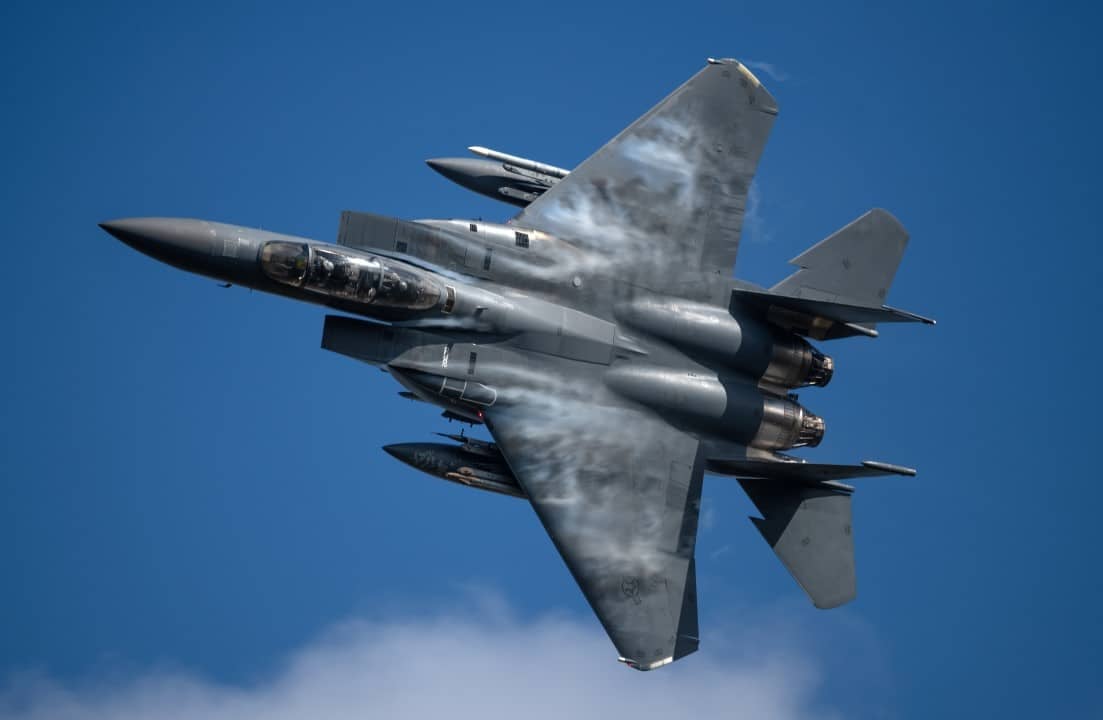
A United States Air Force fighter pilot, rescued after being shot down over Iran in April, has surfaced a report that has shocked the American intelligence community. Before ejecting from his F-15, the soldier described witnessing a formation of Iranian drones that moved in an unprecedented way, resembling a “jellyfish” in the air. This detailed description, kept confidential until now, has generated intense discussions among intelligence officials, who seek to understand the scope of Iran’s possible new military capacity.
The experience experienced by the pilot, whose name was not disclosed, occurred during a period of high tension in the region. The information, obtained from sources close to the investigation, suggests that, if what the aviator described is true, it would represent a significant and worrying advance in operations with unmanned aerial vehicles (UAVs) by Tehran.
Details of the surprising aerial formation observed

The aviator’s testimony captured the attention of American intelligence due to its singularity. He reported seeing multiple drones interconnected, acting as a single unit. Sources described that there were “smaller drones below the larger ones, as if they were legs”, in a scene considered “something from another world”. Another description given by the pilot was that of a “minefield of drones” suspended in the sky.
Although the exact cause of the F-15 crash remains under investigation, the formation of UAVs raised the initial hypothesis that Iranian devices could have contributed to shooting down the American aircraft. This capability, which suggests advanced coordination, indicates that Iran may have developed a one-to-many mesh network, allowing it to command multiple drones simultaneously with high precision and synchrony.
The rescue of the pilot and the crash of the F-15 on Iranian territory
The incident occurred in April, when the F-15 fighter jet, carrying a pilot and a weapons systems officer, was shot down over Iranian airspace. This was the first time that an American military aircraft was shot down in the region during the conflict. US forces promptly began a search and rescue operation to recover the two crew members.
The pilot was saved hours after ejecting, while the weapons systems officer managed to evade capture in the mountains for more than a day before also being rescued. It was not confirmed whether the weapons systems officer also witnessed the drone formation. During the complex rescue operation, a second aircraft, an A-10, was shot down, but its pilot managed to eject safely outside Iranian territory.
Debates in American intelligence about the veracity of the report
The pilot’s description triggered intense debate within the US intelligence community. There were disagreements about the interpretation of what was seen and the clarity of the airman’s report. Officials questioned whether he had actually witnessed an unknown advanced capability or whether it was a “desert mirage” given the circumstances of the accident.
One factor that added complexity to the analysis was the pilot’s own history. He had suffered a concussion in the F-15 crash and this was the second time he had been shot down during the war with Iran; previously, he was involved in a friendly fire incident by Kuwaiti forces. This prior experience and the injury raised doubts among investigators about the accuracy of his memory and perception. The US Air Force and the Office of the Director of National Intelligence did not comment on what happened.
Strategic implications of Iranian drone technology
If the capability described by the pilot — that of drones moving in a “one-to-many mesh network” — is confirmed, it represents a significant shift in the regional and global security landscape. Although American intelligence agencies have not previously assessed this specific ability for Iran, there are historical reports that Tehran has received assistance from China and Russia in developing its drone technology.
The ability to control multiple drones simultaneously allows an operator to command a “hive” of UAVs, making them an extremely effective asymmetric weapon. Emma Bates, expert in drone warfare and founder of the company Cachai, highlights the gravity: “We are going to spend a fortune, a lot of blood and resources, to protect ourselves from something that can coordinate itself in this way.” She adds that if this coordination includes explosives and the ability to hold resources in reserve for subsequent attacks, the approach is “very effective.”
Concern over Iran’s drone program comes at a delicate time, as the US and Tehran negotiate a deal to end the conflict. Current discussions, focused on Iran’s nuclear program, may have to incorporate the emergence of new unmanned weapons capabilities, which pose a complex challenge to the security of American forces and their allies in the Gulf region.