

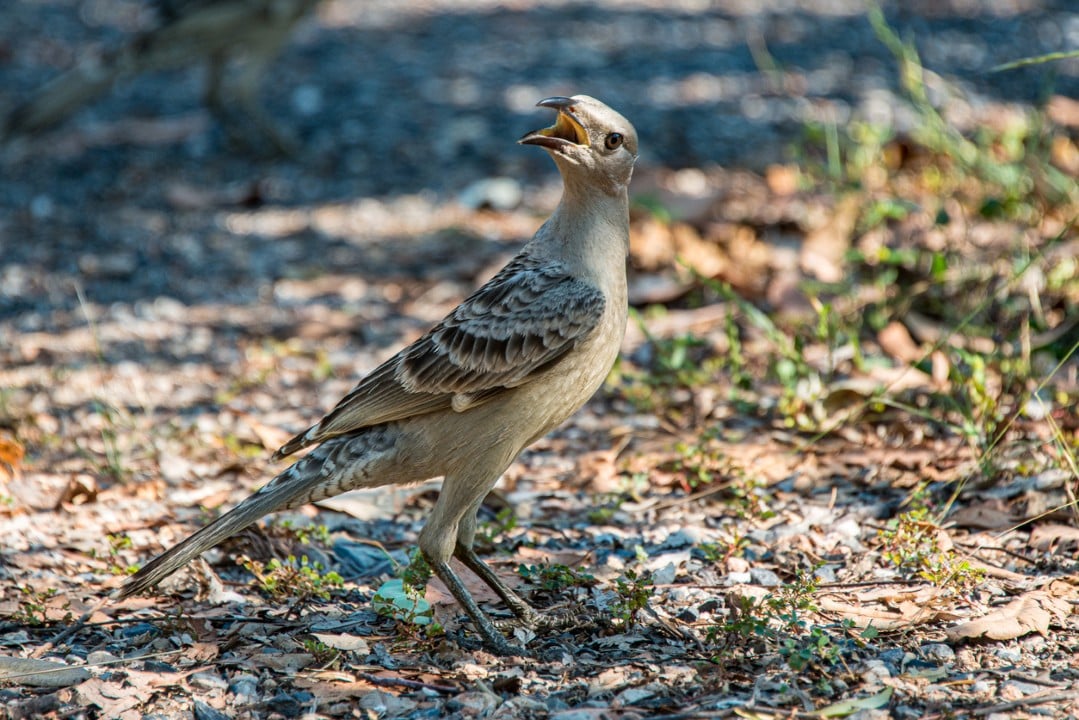
In search of partners, greater gardener birds, a species native to Australia known scientifically as Chlamydera nuchalis, employ a peculiar tactic: they build elaborate decorative structures. These “showcases” serve to impress females during the mating period.
The advancement of urbanization has revealed an unexpected source of ornaments for these birds: human disposal. Fragments of colored glass, various plastics, electrical wires, lids, medicine packaging, banknotes and even unusual items such as handcuffs were recorded as part of these constructions by the males.
This behavioral adaptation was detailed in research carried out by the University of Exeter, in the United Kingdom, and the findings were recently published in the prestigious journal Royal Society Open Science.
During the breeding season, males of the species create complex constructions on the ground, known as arbors. Assembled with branches intertwined in the shape of a tunnel, these buildings have a single purpose: to gain the attention of females for mating.
Historically, the selection of adornments for arbors included natural objects. Elements such as fresh leaves, colorful fruits, various seeds, small sticks and shells were preferred to beautify the nests.
The selection of these items does not occur at random. Males show a preference for objects that contrast sharply with their feathers and the structure of the bower, aiming to create a more visually attractive and impactful display for observing females.
The courtship ritual is dynamic, as described by Caitlin Evans, lead author of the study and researcher at the University of Exeter. “When a female approaches and positions herself in the arbor, the males throw an object towards her, then display the plumage on their heads and throw another item, and so on,” Evans detailed in a statement.
However, urban expansion over these birds’ natural ecosystems has significantly altered their decoration options, introducing a wide range of new materials into their repertoire.
To investigate the influence of urbanization on this complex attraction ritual, scientists monitored 61 bowers in the state of Queensland, Australia, throughout the 2023 reproductive period. Some of these structures were located in the city of Townsville, with around 200,000 residents, while the rest were in a rural area, on the Dreghorn Cattle Station property.
The research team carried out a photographic record and a thorough analysis of a total of 3,782 decorative objects. Of this amount, an impressive 3,270 items were identified in arbors located in urban environments, contrasting with the 512 found in rural areas.
The evaluation of the images took into account the birds’ visual capacity, a crucial factor in understanding their choices. Unlike humans, these birds have a vision spectrum that includes ultraviolet wavelengths, which allows them to perceive colors in a unique way.
The data revealed a clear distinction between the environments. Arbors located in urban areas had, on average, almost five times more decorative elements, with an average of 93 items per structure, compared to the 20 found in rural regions. One urban example accumulated more than 300 decorations.
Additionally, the probability of finding materials of human origin in city nests was ten times higher. Approximately 89% of objects in urban areas were artificial, such as glass fragments, plastic pieces and metals, while in rural regions this proportion was around 46%.
The types of objects preferred by birds also varied depending on the habitat. In rural areas, the preference was for green leaves and seeds. However, in urban centers, green glass and red threads emerged as the most coveted adornments.

Research suggests that these birds acquire materials in different ways. Some specimens simply collect items discarded by humans, while others demonstrate “stealing” behavior, subtracting decorations from the bowers of rival birds.
The predilection for human waste is not merely a matter of availability in urban environments. To test this hypothesis, the researchers carried out a controlled experiment: they removed decorations from arbors in both areas and presented a mixed selection of urban and rural objects to different males.
The experiment demonstrated that both birds living in urban areas and those in rural regions showed a marked preference for objects of human origin. The chance of choosing these items was approximately ten times greater than that of choosing natural materials found in the field.
The exact reason for the fascination with these materials is still the subject of study, but several hypotheses have been raised. One of them suggests that objects produced by humans have more vibrant colors and tones that are rarely found in nature. For species that depend on visual cues for courtship, an element that stands out in the environment would naturally attract more attention.
Another factor that may justify the popularity of trash is its inherent durability. Unlike fruits, leaves and other organic elements that degrade or lose their shine quickly, fragments of glass, plastic and metal retain their characteristics for much longer periods, reducing the need for constant maintenance of the arbor’s decoration.
Despite the ingenuity demonstrated, the research highlights that this adaptation to human waste does not necessarily imply a benefit for birds. Laura Kelley, co-author of the study and also a researcher at the University of Exeter, noted in a statement that “there is still no conclusive data on a negative or positive impact on these animals.”
Kelley emphasizes that the availability of these human-made objects is clearly altering the behavior of garden birds. She concludes that this study serves as a “powerful reminder of how human actions are reshaping the natural world in often unpredictable and profound ways.”