

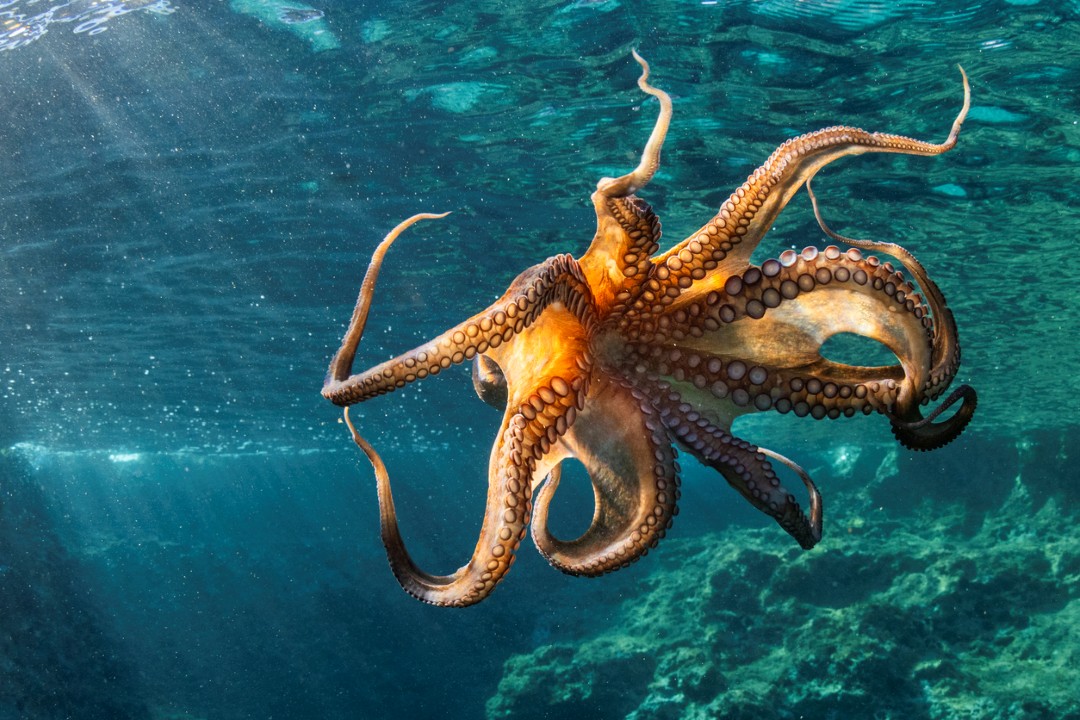
These marine creatures, with a unique aesthetic, a remarkable mind and capabilities that go beyond the ordinary, are considered among the most captivating in the oceans. Their uniqueness is such that the renowned philosopher of science, Peter Godfrey-Smith, even compared them to the closest alien beings that humanity could glimpse.
Recent studies have solidified the image of these animals, pointing to a high level of consciousness and a significant capacity to learn. The perception of sentience in them, that is, the ability to feel pain, fear and anguish, raises the debate about their protection and invites us to better understand the complexities of non-human life, something that few terrestrial species demonstrate so strongly.
Discover now five notable characteristics that make these marine beings truly impressive:
Three hearts drive the octopus’ life
Unlike mammals, the octopus has a circulatory system with three hearts. Two of these organs are responsible for pumping blood to the gills, facilitating the exchange of essential gases. The remaining heart has the function of sending already oxygenated blood to all other parts of the body.
A notable peculiarity is that the central heart of the octopus temporarily stops beating while the animal is swimming. This characteristic may explain the preference of these cephalopods for moving on the ocean floor, using their arms instead of constantly swimming.
Remarkable intelligence: octopuses solve challenges and even play
Octopuses demonstrate an impressive ability to decipher elaborate puzzles, unravel mechanisms for opening containers, discover paths in mazes and retain strategies for overcoming obstacles in their memory.
Furthermore, scientists have recorded behavior in them that resembles games and games, a type of behavior that is rare to be found in most of the animal kingdom.
Independence from tentacles: neurons distributed in the arms
Most of an octopus’s nerve cells are distributed along its arms. This neural architecture allows each tentacle to perform functions almost autonomously, without the need for continuous instructions from the animal’s main brain.
In some research, it has been observed that arms separated from the body are still capable of responding to external stimuli for a brief period of time.
Blue coloring in the blood is the result of a special protein
Unlike humans, who depend on iron-based hemoglobin to transport oxygen, octopuses use a protein called hemocyanin, which contains copper in its composition. When reacting with oxygen, this substance takes on a blue hue, giving octopuses the well-known “blue blood”.
Dramatic life cycle: death after reproduction
The reproductive process of octopuses culminates in an impactful outcome. After the act of mating, males typically succumb shortly thereafter.
Females, in turn, dedicate the remainder of their existence to the custody and safeguarding of their eggs. During this period, they stop feeding and maintain constant vigil over the nest until the chicks hatch. By the time the eggs hatch, the mother has often passed away or is in the final stages of her life.
Extraordinary creatures: camouflage and mysteries of the oceans
In addition to these particularities, octopuses demonstrate the ability to quickly change the color, texture and shape of their body. This ability allows for effective camouflage in the environment, essential for losing predators.
Endowed with highly evolved brains, complex behaviors and unique adaptations, these animals remain one of the greatest enigmas of the oceanic fauna and one of the most notable species ever investigated by the scientific universe.