

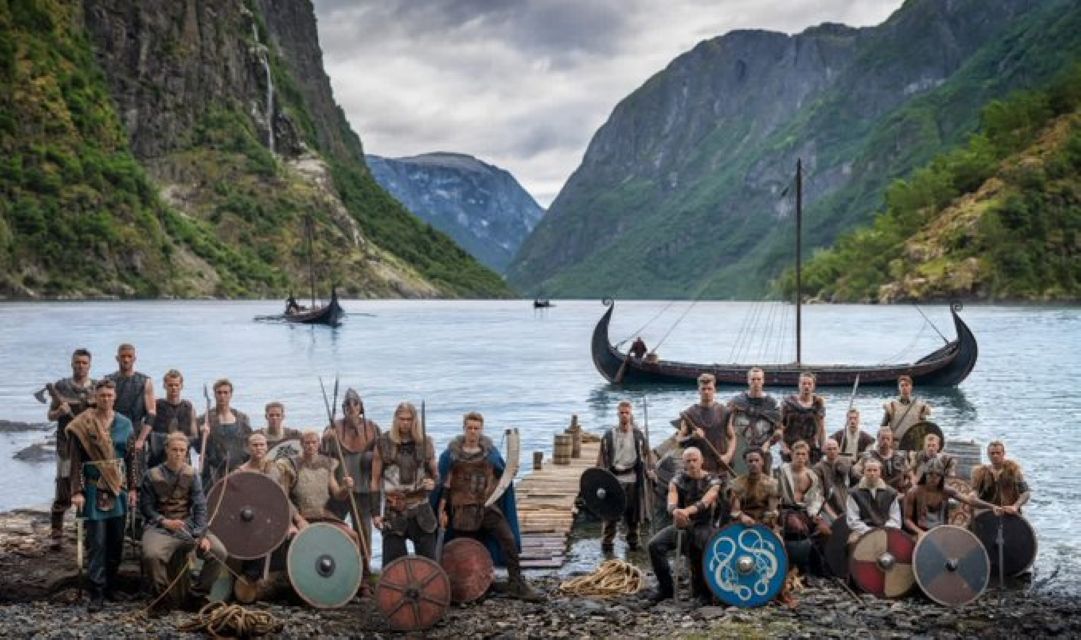
After securing a 3-2 victory against Senegal, Norway’s players positioned themselves on the pitch and performed synchronized rowing movements. Meanwhile, midfielder Martin Ødegaard set the rhythm with a drum and his sticks.
This specific celebration reproduces the famous “Viking row”, which became a trademark of the vibrant Norwegian fans during the 2026 World Cup.
Throughout several games of the tournament, fans of the team adopted the choreography that simulates the act of rowing. The demonstration makes a clear allusion to the rich naval heritage and historical traditions of the people who left a profound mark on the country’s trajectory, representing a link with the exploratory audacity of their ancestors.
Understanding the origin of the Viking people
The Vikings were people originally from the Scandinavia region, comprising present-day Denmark, Sweden and Norway. Their routine involved cultivating land in the spring and expeditions to plunder villages in other territories during the summer months.
The period of greatest influence and exploratory and military activity, known as the Viking Age, extended approximately from the 8th to the 11th century after Christ.
Those Norse who settled in the lands after the maritime incursions predominantly dedicated themselves to trade and the formation of permanent settlements.
This population had notable dominance over agriculture. Many were farmers in areas with favorable climatic conditions, and it was common to find items such as barley, cabbage and turnips in their food reserves.
Artistic expression also occupied a central place in Viking identity. According to Davy Cooper, a member of the Shetland Amenity Trust, the jewelery had a purpose beyond aesthetics.
He explained that jewelry served to demonstrate religious affiliation, and many individuals wore the symbol of Thor’s hammer.
In Norse mythology, Thor, whose ancient name is Þórr, is recognized as the god of thunder and is intrinsically linked to the protection of humanity.
Popular belief attributed to Thor the defense of divine order against his adversaries, using the power of his hammer.
The surprising expansion and technology of Vikings
Commercial activities became more diverse as the Vikings spread across the European continent, integrating both confrontations and mercantile exchanges.
A notable example is the Volga River, located in contemporary Russia. The Vikings who settled along its banks, known as Rus, were responsible for originating the country’s name, Russia.
The Volga trade route established a connection between northern Europe and exchange opportunities with the Arab world and the Byzantine Empire.
According to Cooper, artifacts looted from monasteries along the routes allowed the acquisition of goods that could not be produced on their own farmland.
Among the products traded were salt, pigments and spices, exchanged for honey, furs and even people enslaved during the Viking raids.
They ventured long distances, reaching North America in the late 10th century, where they reportedly established conflictual interactions with the native peoples of that region and Greenland.
These people were designated by the Vikings as “Skræling”, a term that can be interpreted as “thin people” or “miserable people”.
Viking technology was remarkably advanced for its time. Naval engineering, in particular, placed them at the forefront of navigation and made them feared on any body of water.
Cooper highlights that his vessels were meticulously designed to reach high speed, transport a large number of crew and enter rivers.
He also noted that the design of the boats formed bubbles on the sides, which, in practice, allowed a Viking ship to slide on a kind of “air cushion”, considerably reducing resistance in the water.
For navigation, they employed a “solar compass”, which Cooper described as a “simple circle with a pin in the center”, used to determine the position of the sun and the time of day.
However, not all journeys had previously defined destinations.
Cooper explained that they were often blown to unexpected places by the wind, but they had the knowledge to find their way back. This ability meant they could revisit these places and guide others to get there.
In addition to using nature for subsistence, the Vikings also used it for navigation, making use of special crystals.
According to Cooper, “they used a crystal that darkened or lightened depending on the direction in which it was rotated.” Pointed at a light source, it worked even in foggy conditions, as long as the location of the sun was known, helping to identify the travel route.
Revising the popular image of Vikings through science
The common cultural representation of Vikings often shows them as fierce warriors, with blond hair and blue eyes, sailing the seas to plunder coastal communities. However, recent scientific research has challenged this view.
An international consortium of evolutionary geneticists has conducted an analysis of the genetic ancestry of these notorious Germanic warriors, arriving at surprising results about ethnic diversity.
Eske Willerslev, a Danish evolutionary geneticist and professor at the universities of Cambridge (United Kingdom) and Copenhagen (Denmark), told the BBC that “it all started when we managed to sequence the first ancient human genome.”
He stated in a 2019 interview that “this has given us a huge amount of information from individuals that we can use to deduce the human’s past.”
Willerslev added: “Once we saw that this was possible, we decided to start exploring the human past around the world to see how we became who we are today.”
Over a six-year period, scientists examined human remains found at more than 80 archaeological sites, including Viking tombs. To decipher the past through ancient DNA, the team sequenced the genomes of 442 men, women, children and babies from the Viking era.
Martin Sikora, from the University of Copenhagen and one of the experts on the project, noted that the DNA was best preserved in dental remains and in a bone called the petrous or temporal bone, part of the ear bones and particularly resistant.
By extracting genetic material from these sources, experts were able to compare the DNA of these people with DNA sequences from more than a thousand ancient individuals and around four thousand modern humans. That study, the largest genetic analysis ever of Viking remains, revealed that their genes had origins in southern Europe and Asia.
Willerslev explained: “The typical Viking is described as a big, strong, blond Scandinavian. But in fact, being blond was much less common in Scandinavia in the Viking Age than it is now.”
He added that “the Viking period is characterized by a huge interest by Scandinavian Vikings in the rest of the world, but a very limited interest in what was actually happening in Scandinavia.”
Viking trade routes extended from Canada, at one end, to Afghanistan, at the other, indicating that these people were, in fact, much more diverse than previously imagined.
This mixing with southern and eastern populations enriched their genetic makeup, resulting in a wide range of physical characteristics.
Sikora stated: “It is not possible to say for sure whether there was a genetically homogeneous group that was very Scandinavian and the same everywhere. In reality, there was a lot of diversity.”
The study also made it possible to identify different Viking groups that traveled to different parts of the world. Willerslev detailed that “the Danes went mainly to England, the Norwegians to Ireland, Iceland and Greenland, and the Swedes to the Baltic Sea”.
Research further suggests that Viking identity was not linked to genetic or ethnic ancestry, but rather to a social construction.
The scientist who led the project stated: “The Viking phenomenon is not something Scandinavian, in the sense that it is not ethnicity that determines whether someone is a Viking or not. It is a lifestyle.” He confirmed that Vikings had been discovered who “did not possess Scandinavian genes”.
Willerslev pondered that “thanks to this work, we are changing history, and by changing history, we are also changing our identity.”
The scientist sees this as a positive aspect. “At least the debate now is about identity, which is a political debate, grounded in real science.”