

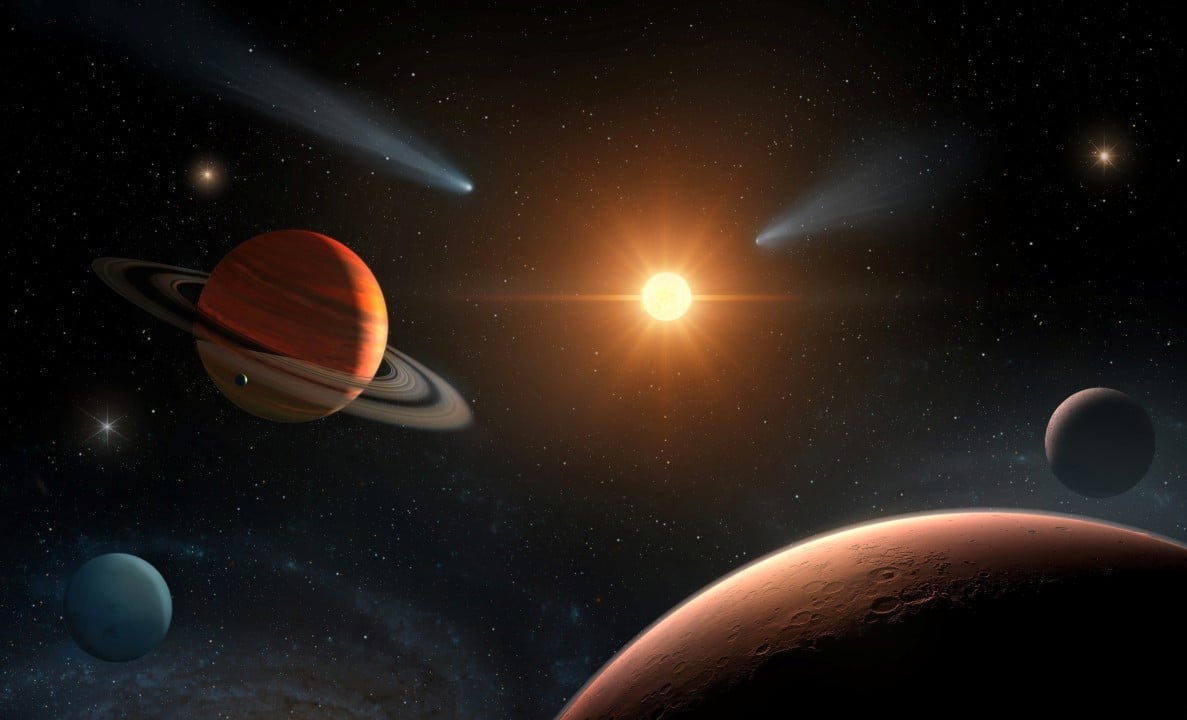
Space scientists have revealed the discovery of two giant exoplanets with a remarkable feature: their density is so low that they are lighter than cotton candy. Orbiting a star an impressive 1,110 light-years from Earth, these celestial bodies were classified as “super-puffs”, being the largest ever found with such a low density.
The research team, led by George Dransfield of the University of Oxford, recently published their findings in the Monthly Notices of the Royal Astronomical Society. The identification of these gas giants sheds new light on planetary formation processes and the diversity of worlds outside our solar system.
Understanding the unique density of new worlds
The most striking feature of the newly discovered exoplanets is their extremely low density. Although they are comparable in size to Jupiter, the largest planet in our solar system, they are considerably less dense, making them true “light giants”. This surprising lightness has caused astronomers to compare them to a “cloud of shaving foam fresh out of the can.”
Jupiter, for example, has a density up to 35 times greater than that of these new worlds. Researchers estimate that the composition of these planets is predominantly hydrogen and helium. The probable color of these stars varies between white and blue, depending on the presence of clouds in their atmospheres, demystifying the idea of a “cotton candy pink”.
The rarity of “super-puffs” in the universe
Planets with such low density, known as “super-puffs”, are considered true cosmic anomalies. In NASA’s vast census of nearly 6,300 exoplanets confirmed to date, fewer than 40 fall into this peculiar category. This scarcity raises fundamental questions about the specific conditions that allow their formation.
“Super-puffs” are believed to originate from disks of gas and dust around newborn stars. In these primordial environments, the proportion of gas is significantly greater than that of dust. Over time, these planets lose much of their material, which leads to such an unusual density. The study of these exotic systems is crucial to unraveling the complex puzzle of planetary formation, offering valuable data that challenge and refine existing theoretical models. Understanding how such light and large planets form could reveal yet unknown mechanisms of accretion and planetary evolution.
The essential role of space technology in discoveries
The initial detection of these two “super-puffs” was carried out by NASA’s TESS (Transiting Exoplanet Survey Satellite), a fundamental tool in the search for exoplanets. This space observatory has been responsible for identifying thousands of exoplanet candidates through the transit method, observing the small drops in brightness of a star when a planet passes in front of it.
After identification by TESS, researchers used ground-based telescopes to perform follow-up observations. This combination of space and terrestrial data was crucial to accurately determine the orbits of the planets and, consequently, calculate their densities. The measurements were complex, given the distance of 1,110 light years, which represents almost 9.7 trillion kilometers per light year of distance. Future analyses, especially with the help of NASA’s James Webb Space Telescope, will be essential to confirm the exact chemical composition of their atmospheres.
Implications for the science of planetary formation
The existence of exoplanets like these “super-puffs” significantly expands our understanding of planetary diversity. Because they are rare and have characteristics that deviate from the most common formation models, they provide a natural laboratory for testing and improving scientific theories. Each new discovery of a planet with extreme properties adds vital information.
The in-depth study of these systems allows scientists to better understand the mechanisms of accretion, migration and evolution of planets in different stellar environments. By investigating how these “cute” worlds fit into the grand scheme of planetary formation, humanity advances its quest to understand the origin and prevalence of life in the cosmos, as well as situating our own solar system within a broader universal context.