

Detailed research into the effectiveness of the COVID-19 vaccine was released last Tuesday, after being blocked from inclusion in a weekly government report.
Developed by scientists from the CDC and several regions of the United States, including California, Colorado, Georgia, Indiana, Maryland, Minnesota, New York, Oregon, Texas and Utah, the work investigated the action of the 2025-26 vaccine in adults aged 18 and over, without immunodeficiency, throughout the fall and winter period of 2025.
The results showed that the most recent doses reduced the risk of hospital admission due to COVID-19 by 55%. Furthermore, visits to emergency rooms or emergency centers linked to the disease fell by half among those vaccinated, compared to those who did not take the vaccine.
Those responsible for the research highlighted that factors such as previous COVID-19 infection or previous vaccinations were not considered. This means the data could indicate extra protection offered by the 2025-26 vaccine, adding to any immunity already existing in the population.
In a similar case, the FDA had previously removed the release of research results on COVID and shingles vaccines.
The findings corroborate previous research, which already indicated the ability of the COVID-19 vaccine to reduce the risk of developing severe forms of the disease.
The research, now available in the renowned scientific journal JAMA Network Open, should have initially been published in the Centers for Disease Control and Prevention’s (CDC) Morbidity and Mortality Weekly Report in March.
Questioning the decision, Dr. Peter Hotez, professor and dean of the National School of Tropical Medicine at Baylor College of Medicine, expressed his perplexity to ABC News. According to him, to encourage vaccination, the CDC should widely disseminate all data that attest to the effectiveness of immunizers, allowing the population to monitor the results; trying to hide or block such information contradicts the principles of public health.
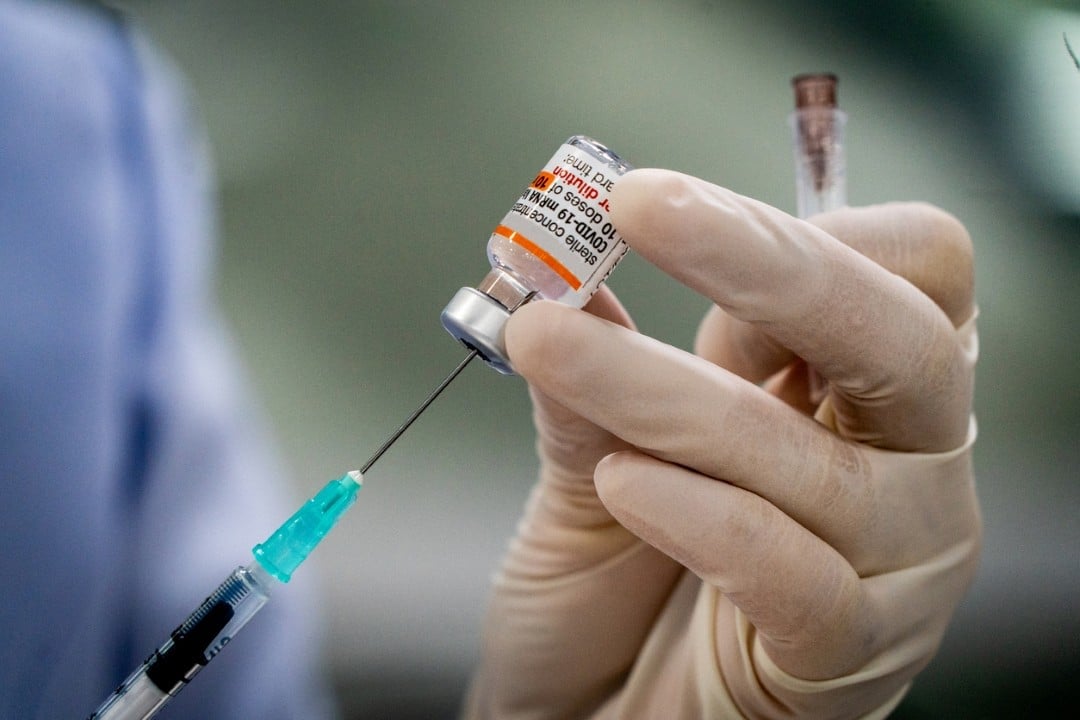
Containers and syringe containing doses of Pfizer’s COVID-19 vaccine were recorded in Culver City, California, on September 23, 2025, image by Allen J. Schaben/Los Angeles Times via Getty Images.
In April, Dr. Jay Bhattacharya, then acting director of the CDC and leader of the National Institutes of Health, published an op-ed in The Washington Post, where he expressed reservations about the research methodology, which was based on a negative test model.
This type of observational study, with a negative test design, evaluates the practical effectiveness of vaccines for infectious diseases such as COVID-19. To do this, it compares the vaccination status of patients who seek medical help for symptoms and whose test for the disease is positive, with those who test negative.
The researchers recognized some limitations inherent to the study, such as the possibility that patients sought hospitals for conditions unrelated to COVID-19, incomplete vaccination records, and the reduced amount of data on vaccination and hospitalization, which impacted certain analyses.
Emily Hillard, spokeswoman for the Department of Health and Human Services (HHS), told ABC News, in a statement, that the institution “directly addresses” any questions about the methodology used in studies.
The statement further highlighted that “responsible science requires careful review. Taking time to ensure methodologically robust analyzes and clarity in communication is always preferable to risking errors.”
The original article included a list of other popular news stories of the time, such as live updates on Iran, the Pentagon’s search for an additional $67.1 billion to cover war costs, and Congress’s passage of a war powers resolution rebuking Trump.
The HHS statement also emphasized that “CDC does not issue scientific opinions based on predetermined conclusions.” The statement said the agency “evaluates the weight of evidence with rigorous methods, communicates uncertainties and limitations, and subjects its work to scientific scrutiny before publication.”
In a related article, layoffs at the Department of Health and Human Services (HHS) and questions about vaccine safety were discussed, raising the question of how the Trump administration could be “attacking” science.
However, several public health experts have argued that, despite the limitations inherent to any methodology, the negative test model offers a solution to challenges such as the absence of a unified and comprehensive health database, essential for monitoring the effectiveness of vaccines.
It is important to highlight that the research maintained the same negative testing methodology when it was finally published in JAMA Network Open, after discussions.
Dr. Paul Offit, director of the Vaccine Education Center at Children’s Hospital of Philadelphia, told ABC News that “we’ve been using the negative test method for years to try to answer questions like this.” He added that “when individuals, such as those in management, classify the method as flawed or producing unreliable results, they need to specifically justify why.”
Offit went on to say that it would be more appropriate for these people to “come forward publicly and confront experts on the concept of a negative test, debating the validity of their claims, rather than making unilateral decisions that deprive us of information crucial to the health of our families.”
The CDC is under the authority of Robert F. Kennedy Jr., the current Secretary of Health and Human Services (HHS), known for his criticism of vaccines against COVID-19 and for disseminating information considered misinformation by the medical community during the pandemic, including erroneous claims that the vaccine would be dangerous.
In December 2021, during a meeting of the Louisiana House of Representatives debating a proposal to make the COVID-19 vaccine mandatory for students, Kennedy made the false statement that it was the “deadliest vaccine ever created.”
Another image shows a pharmacist preparing a dose of the Pfizer-BioNTech vaccine against Covid-19 at an immunization event in Los Angeles, on October 24, 2025, with credit to Patrick T. Fallon/AFP via Getty Images.
Later that year, Kennedy sent a formal request to the US Food and Drug Administration (FDA) for all COVID-19 vaccine authorizations to be revoked. The agency, however, refused the request three months later.
In contrast, health authorities continue to assert that vaccines against COVID-19 are safe and effective. This conclusion is based on clinical trials with tens of thousands of participants, and vaccines are credited with saving millions of lives since their development.
Offit also highlighted that research since 2020, when Pfizer and Moderna introduced their first vaccines against COVID-19, had already demonstrated the safety and effectiveness of the doses.
“The vaccine demonstrated high efficacy against severe cases of the disease and, over time, its protection against mild to moderate cases decreased somewhat,” he explained. Offit concluded that, “in its main purpose, this immunizer consistently prevents hospitalizations, the need for intensive care and deaths. This observation is in line with everything we have monitored since the beginning of the pandemic, in 2020.”