

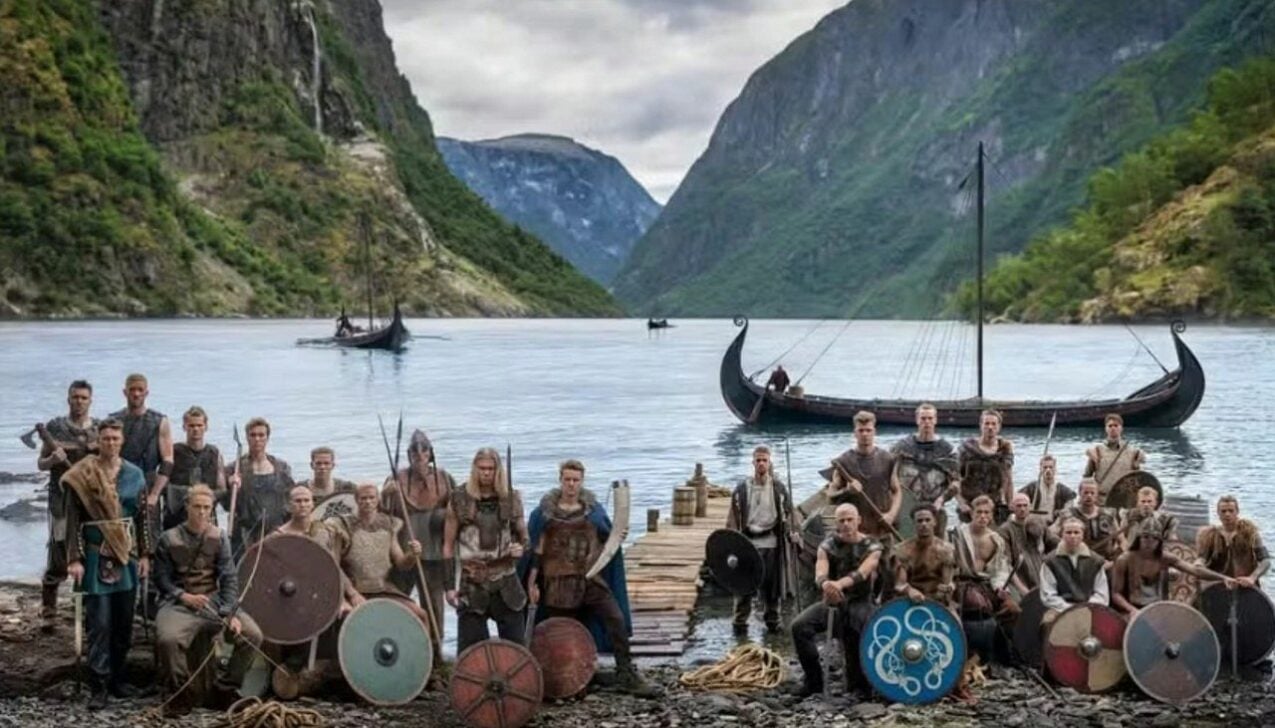
The Norwegian national football team brought to light an ancient and fascinating cultural heritage as they celebrated a recent victory in the 2026 World Cup. After the 3-2 victory over Senegal, the players came together on the field to simulate the famous “Viking row”, a gesture that quickly became a symbol of identification with the country’s Nordic past. Midfielder Martin Ødegaard led the rhythm with a drum, while the other athletes replicated the synchronized movements.
The celebration resonated with fans and reignited interest in the true history of the Vikings, a people who, beyond popular myths, had a profound impact on Europe and beyond. The “Viking row” on the lawns is not just a festive choreography, but a bridge to understanding the maritime traditions and complex identity of these explorers and traders.
The celebration of the “Viking row” on the lawns

The gesture of simulating rowing became a trademark of Norwegian fans during the 2026 World Cup. In several clashes, fans of the team adopted the choreography that mimics the movement of rowing, evoking the deep maritime traditions and the rich cultural heritage left by the Vikings. This festive event reinforces the Norwegian people’s connection with their historical ancestors.
Martin Ødegaard, a key member of the team, not only coordinated the drum and sticks, but also embodied leadership inspired by the ancient Norse. The players’ synchronicity when performing the “row” on the pitch highlighted the strength of the collective spirit and the cultural identity that permeates the team and its supporters. The image went viral, connecting the modernity of the sport with the antiquity of a legendary people.
Who were the Nordic people really?
The Vikings were people originally from Scandinavia, a region that today comprises Denmark, Sweden and Norway. Its main activity was divided between agriculture, practiced during the spring, and commercial and looting raids, carried out mainly in the summer. The Viking Age, a period of greatest exploratory and military activity among these people, lasted approximately from the 8th to the 11th century AD.
Despite the popular image of incessant warriors, many Vikings were skilled farmers, growing cereals such as barley, as well as vegetables such as cabbage and turnips, wherever the climate permitted. Art and jewelry also played a central role in their identity, with many people wearing the hammer of Thor, the god of thunder in Norse mythology, as a symbol of protection and religious affiliation.
The vast expansion and naval technology that shaped the Viking Age
Over time, Viking trade diversified, driving its expansion across Europe through a combination of conflict and exchange. A notable example of this expansion is the Volga River, in present-day Russia, where the Vikings, known as “Rus”, settled and gave rise to the country’s name. This river route was crucial, opening northern Europe to trade with the Arab world and the Byzantine Empire.
Items obtained on their travels, such as salt, dyes and spices, were exchanged for honey, furs and even enslaved people. The Vikings advanced further, arriving in North America in the late 10th century, where they maintained complex relationships with the native peoples of the region and Greenland, referring to them as “Skræling”. Viking naval engineering was revolutionary and placed them at the forefront of navigation at the time.
- Their ships were designed to:
- Speed:Aerodynamic structure that allowed fast movement.
- Capacity:Ability to transport large numbers of men and cargo.
- River versatility:Design that allowed navigation in deep rivers.
- Technical innovation:The shape of the boat created air bubbles on the edge of the planks, making them slide on an “air cushion” with less resistance in the water.
For navigation, they employed a “solar compass”, a simple circle with a central pin used to determine the position of the sun and the time of day. Furthermore, they used special crystals that changed tone depending on the direction of the light, allowing them to identify the position of the sun even in foggy conditions and thus maintain their course.
Uncovering the true identity of the Vikings through science
Popular culture often portrays Vikings as blond, blue-eyed warriors, relentless in their sea raids. However, recent scientific research has challenged this image. An international study led by Danish evolutionary geneticist Eske Willerslev of the University of Cambridge and the University of Copenhagen has revealed surprising ethnic diversity among these Nordic peoples.
Over six years, the team analyzed human remains from more than 80 archaeological sites, including 442 genomes from Viking Age men, women, children and babies. The genetic material, extracted mainly from teeth and the temporal (petrous) bone — which appears to be better preserved — was compared with the DNA of more than a thousand individuals from Antiquity and around four thousand modern humans. This analysis, the largest ever carried out, brought crucial revelations about its origins:
- Ethnic diversity:Viking genes had origins that extended to southern Europe and Asia, demystifying the idea of a genetically homogeneous population.
- Lower incidence of blondes:Being blonde was significantly less common in Scandinavia during the Viking Age than it is today.
- “Viking” as a lifestyle:Research indicates that Viking identity was not intrinsically linked to genetic or ethnic ancestry, but rather to a lifestyle and social identity. Individuals were found who, although they identified as Vikings, did not have Scandinavian genes.
- Specific migratory routes:The study detailed that different Viking groups tended to travel to different regions; the Danes predominantly to England, the Norwegians to Ireland, Iceland and Greenland, and the Swedes to the Baltic Sea.
These discoveries change the historical understanding of the Vikings, revealing a much more mixed and complex society than previously imagined. Genetic diversity, the result of extensive trade and exploration routes that reached from Canada to Afghanistan, generated a wide range of physical appearances. As Willerslev highlighted, the current debate over the identity of the Vikings is a political debate grounded in real science.