

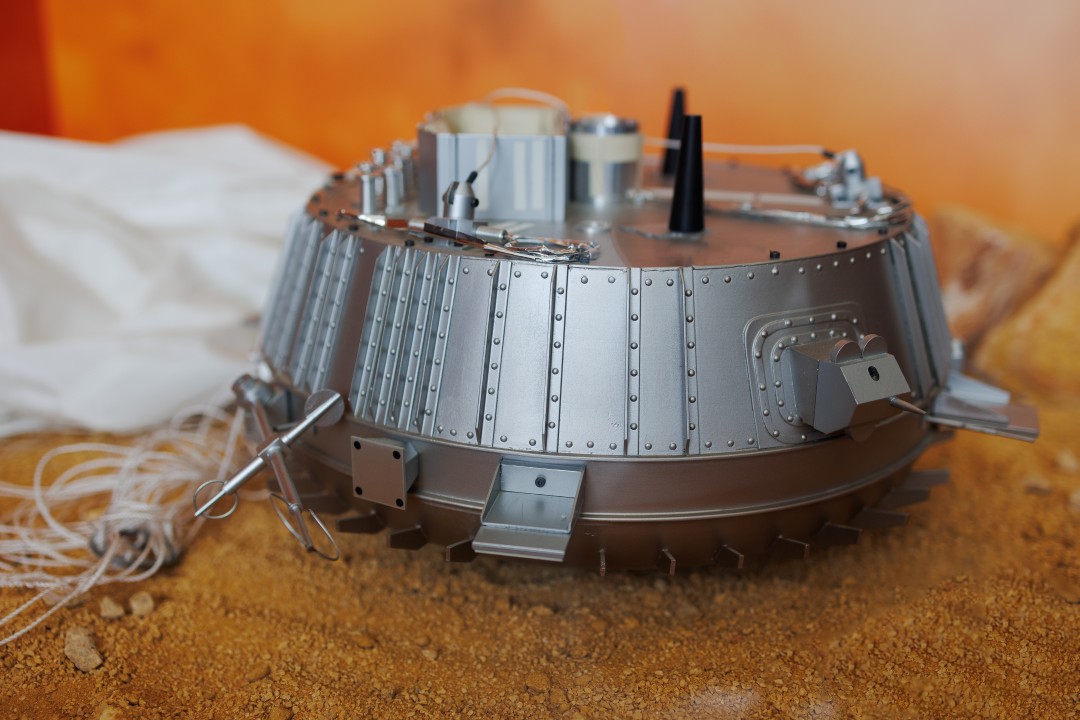
In a remarkable feat of space exploration, only one robotic probe has managed to successfully land on a celestial body beyond the orbit of Mars. This historic achievement was achieved by the Huygens probe, a project of the European Space Agency (ESA), which touched the ground of the mysterious moon Titan, on Saturn, in 2005. The event marked a crucial moment in the quest to understand distant worlds and their complex formations.
Preparing for an unprecedented exploration
Designed by the European Space Agency (ESA), the Huygens probe was a crucial tool in the Cassini-Huygens mission, launched in 1997. Its main objective was to closely investigate the surface and atmosphere of Titan, Saturn’s largest moon. The journey through the solar system lasted approximately seven years, with the Cassini spacecraft performing several gravitational assistance maneuvers to reach its destination.
Cassini-Huygens made strategic stops at Venus and Jupiter before finally being inserted into Saturn’s orbit in June 2004. The complex space choreography culminated on December 25, 2004, when the Huygens probe was released from its mothership. After about three weeks of autonomous navigation, Huygens began its descent on Titan on January 14, 2005.
Titan: a world of methane and mysteries
Among the countless moons in our solar system, Titan stands out as the only one to have a substantial atmosphere. This dense atmosphere, composed predominantly of nitrogen, with traces of methane and ethane, has always intrigued scientists. Before the Huygens mission, the orange haze that enveloped Titan prevented direct observation of its surface, leaving many mysteries about what was hiding beneath it.
Titan is particularly fascinating due to the presence of stable liquid methane, forming rivers, lakes and even oceans. This hydrological methane cycle, analogous to the water cycle on Earth, suggests a geologically active and complex world. It was believed that Titan’s environment could offer clues about conditions on early Earth, before the emergence of life, albeit with a very different chemistry based on hydrocarbons rather than water.
Controlled descent in extreme conditions
Huygens’ entry into Titan’s dense atmosphere marked the beginning of a complex sequence of events. The probe plunged into the outer layer of the atmosphere at thousands of kilometers per hour, a process that required precision engineering. Quickly, an 8.5 meter diameter main parachute was deployed to control the speed and begin a gradual and monitored descent.
For about two and a half hours, until landing, the probe transmitted crucial data and images. She sailed through extreme temperatures, reaching -170 degrees Celsius, and layers of orange fog that began to dissipate only at an altitude of about 70 kilometers from the surface. The landing took place with impressive precision, just seven kilometers from the planned point.
Images and data from an unprecedented landing
After landing on a plain on Titan, the Huygens probe continued to operate for more than an hour, sending valuable information back to Earth via Cassini. The images revealed a surprising landscape, with plateaus composed of ice and plains that resembled dry lake beds. The presence of a branching terrain clearly indicated the flow of liquid methane onto the surface at some point in the moon’s geological history.
The mission team had designed Huygens with the ability to float, anticipating the possibility of landing in a methane lake or ocean. However, later Cassini observations confirmed that Titan’s largest liquid bodies were restricted to the polar regions. At the landing site, the probe detected rounded ice rocks, which appeared to have been eroded from the surface, in addition to capturing the shadow of the parachute used in its descent.
The lasting legacy of the Huygens probe
Despite technical challenges that limited complete data transmission — only 376 images were sent, about half of what was planned due to a communications problem — the Huygens mission provided an unprecedented wealth of information. The data collected was fundamental for scientists on Earth to unravel the atmospheric composition and geological characteristics of Titan.
Huygens’ achievement redefined our understanding of the possibilities of life and planetary processes on distant worlds. It proved to be a milestone in space engineering, demonstrating the human ability to explore and land on celestial bodies billions of kilometers away, in completely inhospitable environments. His legacy continues to inspire new missions and research into the secrets of the outer solar system.
Remarkable facts about the Huygens probe
- Launched in 1997, as part of the Cassini-Huygens mission, a collaboration between NASA, ESA and ASI.
- After seven years of travel, it reached Saturn’s orbit in June 2004.
- It separated from the Cassini mother probe on December 25, 2004, traveling alone for three weeks.
- It landed on Titan on January 14, 2005, marking the first and only landing in the outer solar system.
- It transmitted data for approximately 3 hours and 40 minutes (during descent and after landing on the surface).
- It faced temperatures of -170 degrees Celsius during landing in a liquid methane environment.
The aircraft you see on the screen is Cassini.
The Huygens probe has been released from Cassini.
The Huygens probe entered Titan’s atmosphere on January 14, 2005. For approximately two and a half hours until landing, the Huygens probe transmitted data, including images captured on Titan.
Titan’s atmosphere is composed primarily of nitrogen, with the small remaining amount consisting of clouds and organic smoke formed by methane and ethane. Titan was shrouded in an orange haze, but it began to dissipate at an altitude of about 70 km above the surface.
Titan’s surface features plateaus made of ice and plains that resemble dry lake beds, as well as branching terrain that indicates the presence of liquid methane flowing on the surface.
Researchers designed the Huygens probe to float, considering the possibility of landing in methane lakes or oceans. However, later Cassini observations showed that Titan’s large lakes and oceans are restricted to the polar regions.
Fortunately, the Huygens probe landed on a plain and continued transmitting data for 1 hour and 10 minutes. Rounded ice rocks, eroded from the surface, have been observed on Titan.
It was also possible to see the shadow of the parachute used by the Huygens probe.
Due to problems with the communications program, the number of images that the Huygens probe sent to Cassini was limited to 376, about half of what had been planned. Still, the Huygens probe provided valuable data to scientists on Earth.