

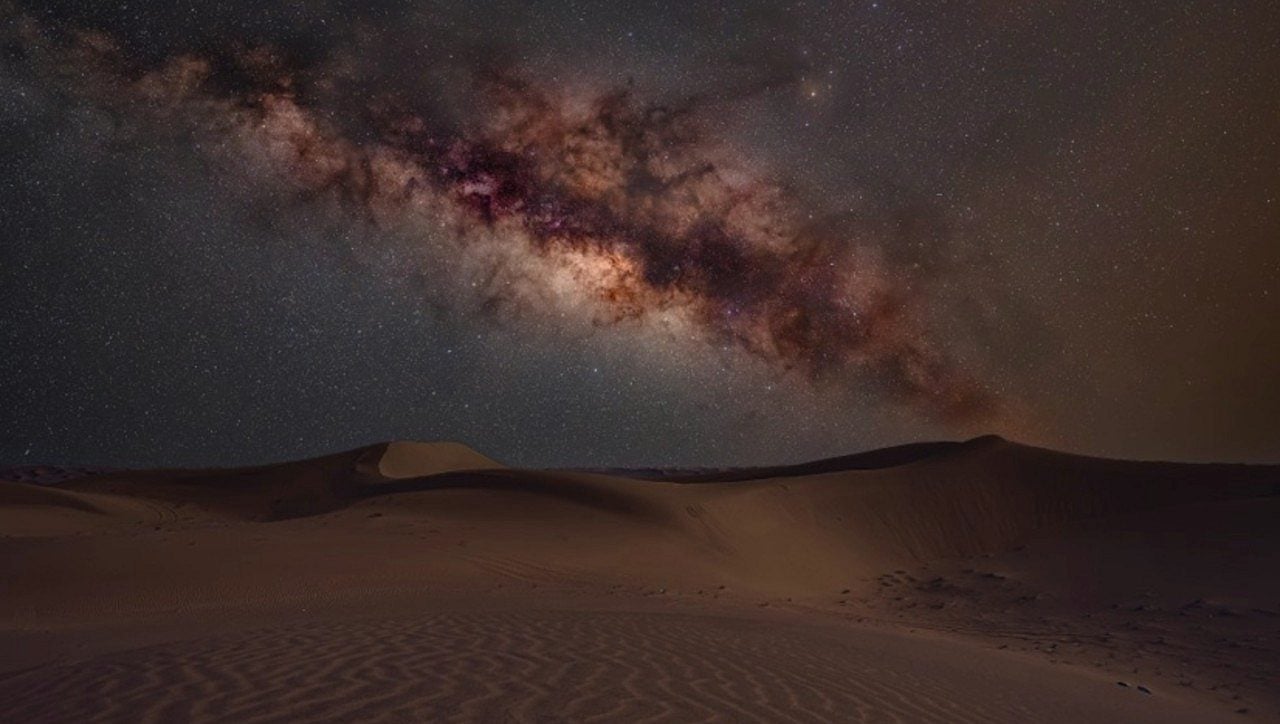
The vast and complex universe holds mysteries that defy human understanding, and one of the most intriguing directly involves our own cosmic neighborhood.
Specifically, the Milky Way and its nearby galaxies are incessant motion toward an enigmatic region in deep space. This displacement occurs at an impressive speed of 600 kilometers per second, heading towards a colossal concentration of mass known as the Great Attractor, located at an estimated distance of between 150 and 250 million light years from Earth.
This gigantic attraction phenomenon was first identified about four decades ago by a group of renowned astronomers known as the Seven Samurai. They based their findings on a thorough analysis of the direction and speed of 400 elliptical galaxies. Despite the advancement of time, directly observing this specific area remains an extremely challenging task for the global scientific community, as the very structure of our galaxy, with its dense electromagnetic emissions, impedes visibility.
The exact location of this powerful gravitational engine is in the area designated as the Avoidance Zone. This swath of sky remains hidden behind the dense galactic plane, where intense starlight and cosmic dust act as an insurmountable obstacle for conventional optical telescopes. This is why astronomers cannot directly visualize the structures that form this massive nucleus, although the use of other bands of the electromagnetic spectrum, such as X-rays and radio waves, has provided some clues about its composition. However, the gravitational effects on matter are so evident that it is possible to clearly trace the trajectory of approximately 100,000 galaxies, all being dragged in a coordinated way to this same point in outer space.
Understand the gravitational hierarchy of the cosmic supercluster
Progress in the cartography of the universe reached a much higher level of precision in 2014, when a group of researchers managed to decipher the complex network of influences that direct our cosmic region. Until that moment, astronomy had established that the Milky Way and the so-called Local Group moved under the pull of the Virgo cluster. In turn, this set of stellar systems was massively attracted by a structure of considerably larger dimensions, known to experts as the Virgo supercluster, revealing a clear hierarchy of forces in the fabric of the observable universe.
These new measurements revealed that the entire Virgo complex is in a continuous shift towards an even more vast and imposing cluster of galaxies, officially named Laniakea. By investigating the internal dynamics of this supercluster of titanic proportions, astrophysicists identified that the true nerve center of this movement is the gigantic accumulation of matter concentrated in its deep core. It is precisely in the heart of this immense network of galaxies that the “gravity battery” operates that attracts the entire cosmic environment, unanimously identified as the Great Attractor.
Although the internal components of this mysterious anomaly are unknown and there are no visual records of its true form, the influence of its gravitational field is unquestionable to modern science. The dynamic behavior of adjacent star clusters indicates that we are facing one of the greatest intergalactic cohesion forces detected to date. However, the chronicle of this fascinating cosmic journey has an unexpected twist that goes against the laws of everyday physics and presents a future scenario that surprised experts in the field.

Cosmic expansion and the uncertain fate of the Milky Way
Conventional logic would suggest that, at the end of this million-year journey, our galaxy would eventually collide or join its cosmic neighbors at the magnetic epicenter of Laniakea. However, the outcome of this story of mutual attraction is shaped by an opposite factor of universal scale that prevents physical encounter: the continuous expansion of the universe, which stretches the very fabric of space and constantly moves the target of the approach away.
This accelerated departure from the cosmic fabric, which theorists often associate with the invisible action of dark energy, causes an uninterrupted increase in the actual separation between the Milky Way and the Great Attractor every second. Currently, our galactic neighborhood is close enough to remain under the influence of its powerful gravitational pull. However, evolutionary models estimate that, within billions of years, the expansion will have moved the objective so far away that the gravitational connection will definitively break, making it impossible for the meeting to occur.